
Mind map
Genetic Engineering
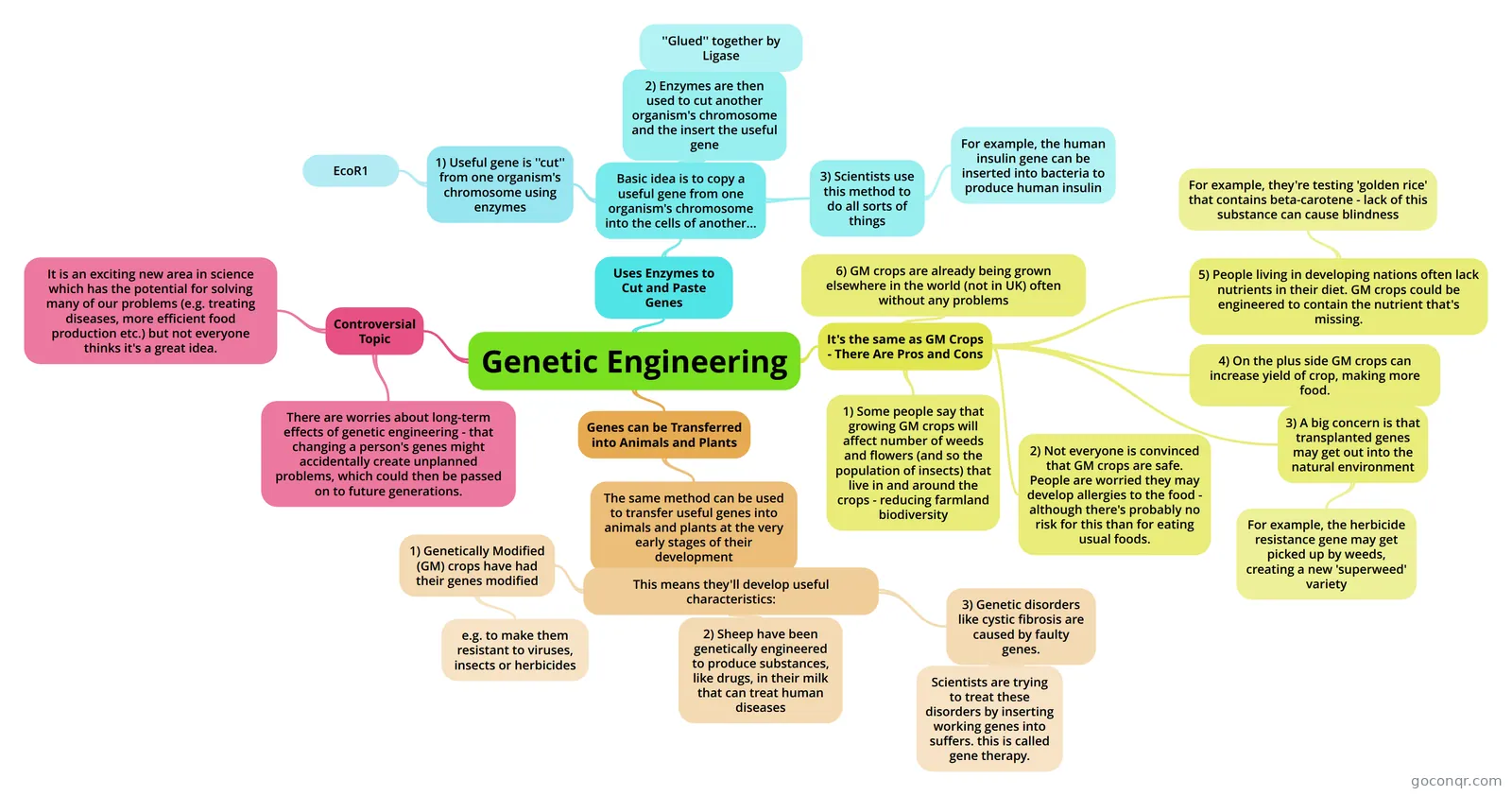
Mind map: genetic engineering
Map content
Genetic Engineering
Uses Enzymes to Cut and Paste Genes
- Basic idea is to copy a useful gene from one organism's chromosome into the cells of another...
- 1) Useful gene is ''cut'' from one organism's chromosome using enzymes
- EcoR1
- 2) Enzymes are then used to cut another organism's chromosome and the insert the useful gene
- ''Glued'' together by Ligase
- 3) Scientists use this method to do all sorts of things
- For example, the human insulin gene can be inserted into bacteria to produce human insulin
- 1) Useful gene is ''cut'' from one organism's chromosome using enzymes
- Basic idea is to copy a useful gene from one organism's chromosome into the cells of another...
Genes can be Transferred into Animals and Plants
- The same method can be used to transfer useful genes into animals and plants at the very early stages of their development
- This means they'll develop useful characteristics:
- 1) Genetically Modified (GM) crops have had their genes modified
- e.g. to make them resistant to viruses, insects or herbicides
- 2) Sheep have been genetically engineered to produce substances, like drugs, in their milk that can treat human diseases
- 3) Genetic disorders like cystic fibrosis are caused by faulty genes.
- Scientists are trying to treat these disorders by inserting working genes into suffers. this is called gene therapy.
- 1) Genetically Modified (GM) crops have had their genes modified
- This means they'll develop useful characteristics:
- The same method can be used to transfer useful genes into animals and plants at the very early stages of their development
Controversial Topic
- It is an exciting new area in science which has the potential for solving many of our problems (e.g. treating diseases, more efficient food production etc.) but not everyone thinks it's a great idea.
- There are worries about long-term effects of genetic engineering - that changing a person's genes might accidentally create unplanned problems, which could then be passed on to future generations.
It's the same as GM Crops - There Are Pros and Cons
- 1) Some people say that growing GM crops will affect number of weeds and flowers (and so the population of insects) that live in and around the crops - reducing farmland biodiversity
- 2) Not everyone is convinced that GM crops are safe. People are worried they may develop allergies to the food - although there's probably no risk for this than for eating usual foods.
- 3) A big concern is that transplanted genes may get out into the natural environment
- For example, the herbicide resistance gene may get picked up by weeds, creating a new 'superweed' variety
- 4) On the plus side GM crops can increase yield of crop, making more food.
- 5) People living in developing nations often lack nutrients in their diet. GM crops could be engineered to contain the nutrient that's missing.
- For example, they're testing 'golden rice' that contains beta-carotene - lack of this substance can cause blindness
- 6) GM crops are already being grown elsewhere in the world (not in UK) often without any problems
Information
- Description
- GCSE Biology Mind Map on Genetic Engineering, created by Caoimhín on 21/05/2013.
- Created by
- Caoimhín
- Views
- 173
- Tags
- Rating