
Mind map
Cold War (1945-1975)
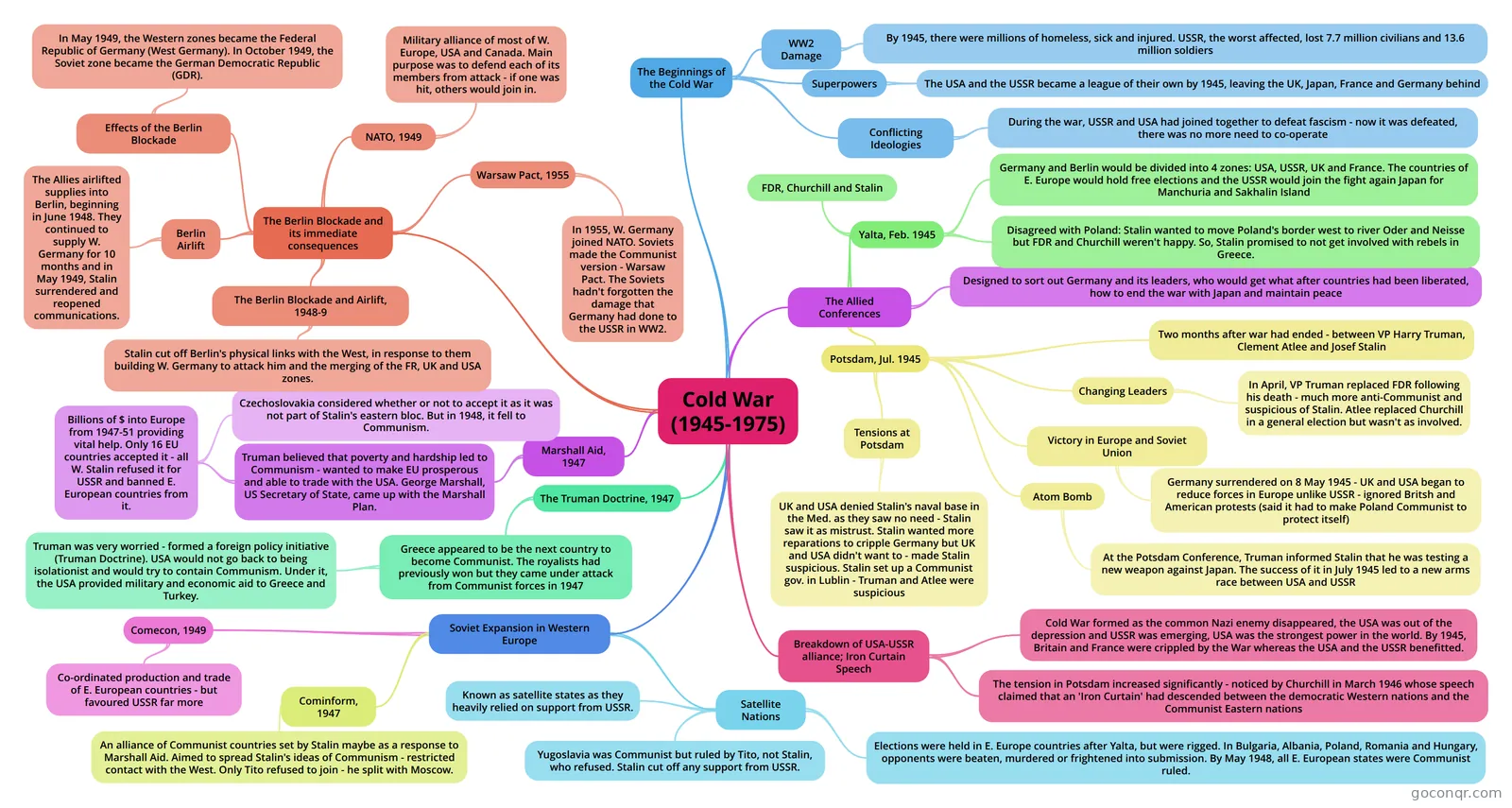
Mind map: Cold War 1945-1975
Map content
Cold War (1945-1975)
The Beginnings of the Cold War
- WW2 Damage
- By 1945, there were millions of homeless, sick and injured. USSR, the worst affected, lost 7.7 million civilians and 13.6 million soldiers
- Superpowers
- The USA and the USSR became a league of their own by 1945, leaving the UK, Japan, France and Germany behind
- Conflicting Ideologies
- During the war, USSR and USA had joined together to defeat fascism - now it was defeated, there was no more need to co-operate
- WW2 Damage
The Allied Conferences
- Yalta, Feb. 1945
- FDR, Churchill and Stalin
- Germany and Berlin would be divided into 4 zones: USA, USSR, UK and France. The countries of E. Europe would hold free elections and the USSR would join the fight again Japan for Manchuria and Sakhalin Island
- Disagreed with Poland: Stalin wanted to move Poland's border west to river Oder and Neisse but FDR and Churchill weren't happy. So, Stalin promised to not get involved with rebels in Greece.
- Potsdam, Jul. 1945
- Two months after war had ended - between VP Harry Truman, Clement Atlee and Josef Stalin
- Changing Leaders
- In April, VP Truman replaced FDR following his death - much more anti-Communist and suspicious of Stalin. Atlee replaced Churchill in a general election but wasn't as involved.
- Victory in Europe and Soviet Union
- Germany surrendered on 8 May 1945 - UK and USA began to reduce forces in Europe unlike USSR - ignored Britsh and American protests (said it had to make Poland Communist to protect itself)
- Atom Bomb
- At the Potsdam Conference, Truman informed Stalin that he was testing a new weapon against Japan. The success of it in July 1945 led to a new arms race between USA and USSR
- Tensions at Potsdam
- UK and USA denied Stalin's naval base in the Med. as they saw no need - Stalin saw it as mistrust. Stalin wanted more reparations to cripple Germany but UK and USA didn't want to - made Stalin suspicious. Stalin set up a Communist gov. in Lublin - Truman and Atlee were suspicious
- Designed to sort out Germany and its leaders, who would get what after countries had been liberated, how to end the war with Japan and maintain peace
- Yalta, Feb. 1945
Breakdown of USA-USSR alliance; Iron Curtain Speech
- The tension in Potsdam increased significantly - noticed by Churchill in March 1946 whose speech claimed that an 'Iron Curtain' had descended between the democratic Western nations and the Communist Eastern nations
- Cold War formed as the common Nazi enemy disappeared, the USA was out of the depression and USSR was emerging, USA was the strongest power in the world. By 1945, Britain and France were crippled by the War whereas the USA and the USSR benefitted.
Soviet Expansion in Western Europe
- Satellite Nations
- Elections were held in E. Europe countries after Yalta, but were rigged. In Bulgaria, Albania, Poland, Romania and Hungary, opponents were beaten, murdered or frightened into submission. By May 1948, all E. European states were Communist ruled.
- Yugoslavia was Communist but ruled by Tito, not Stalin, who refused. Stalin cut off any support from USSR.
- Known as satellite states as they heavily relied on support from USSR.
- Cominform, 1947
- An alliance of Communist countries set by Stalin maybe as a response to Marshall Aid. Aimed to spread Stalin's ideas of Communism - restricted contact with the West. Only Tito refused to join - he split with Moscow.
- Comecon, 1949
- Co-ordinated production and trade of E. European countries - but favoured USSR far more
- Satellite Nations
The Truman Doctrine, 1947
- Greece appeared to be the next country to become Communist. The royalists had previously won but they came under attack from Communist forces in 1947
- Truman was very worried - formed a foreign policy initiative (Truman Doctrine). USA would not go back to being isolationist and would try to contain Communism. Under it, the USA provided military and economic aid to Greece and Turkey.
- Greece appeared to be the next country to become Communist. The royalists had previously won but they came under attack from Communist forces in 1947
The Berlin Blockade and its immediate consequences
- The Berlin Blockade and Airlift, 1948-9
- Stalin cut off Berlin's physical links with the West, in response to them building W. Germany to attack him and the merging of the FR, UK and USA zones.
- Berlin Airlift
- The Allies airlifted supplies into Berlin, beginning in June 1948. They continued to supply W. Germany for 10 months and in May 1949, Stalin surrendered and reopened communications.
- Effects of the Berlin Blockade
- In May 1949, the Western zones became the Federal Republic of Germany (West Germany). In October 1949, the Soviet zone became the German Democratic Republic (GDR).
- NATO, 1949
- Military alliance of most of W. Europe, USA and Canada. Main purpose was to defend each of its members from attack - if one was hit, others would join in.
- Warsaw Pact, 1955
- In 1955, W. Germany joined NATO. Soviets made the Communist version - Warsaw Pact. The Soviets hadn't forgotten the damage that Germany had done to the USSR in WW2.
- The Berlin Blockade and Airlift, 1948-9
Marshall Aid, 1947
- Truman believed that poverty and hardship led to Communism - wanted to make EU prosperous and able to trade with the USA. George Marshall, US Secretary of State, came up with the Marshall Plan.
- Billions of $ into Europe from 1947-51 providing vital help. Only 16 EU countries accepted it - all W. Stalin refused it for USSR and banned E. European countries from it.
- Czechoslovakia considered whether or not to accept it as it was not part of Stalin's eastern bloc. But in 1948, it fell to Communism.
- Billions of $ into Europe from 1947-51 providing vital help. Only 16 EU countries accepted it - all W. Stalin refused it for USSR and banned E. European countries from it.
- Truman believed that poverty and hardship led to Communism - wanted to make EU prosperous and able to trade with the USA. George Marshall, US Secretary of State, came up with the Marshall Plan.
Information
- Description
- GCSE Cold War Mind Map on Cold War (1945-1975), created by sagar.joban on 23/05/2013.
- Created by
- sagar.joban
- Views
- 24,090
- Tags
- Rating
More on Origins of the Cold War