
The Cold War
625 resources created by 361 users
This History page on GoConqr gathers community-made mind maps, quizzes, flashcards, notes and slides on The Cold War, from the origins of the rivalry and the Cuban Missile Crisis to détente and the collapse of Communism. It's built for school students revising for GCSE, A-level, IB or AP exams, and for teachers after ready-made material. There are over 4,200 resources here, including more than 200 quizzes, over 2,700 mind maps and more than 1,000 flashcards. Pick a topic, try a quiz to find your gaps, then make your own revision sets.
Top The Cold War resources
-
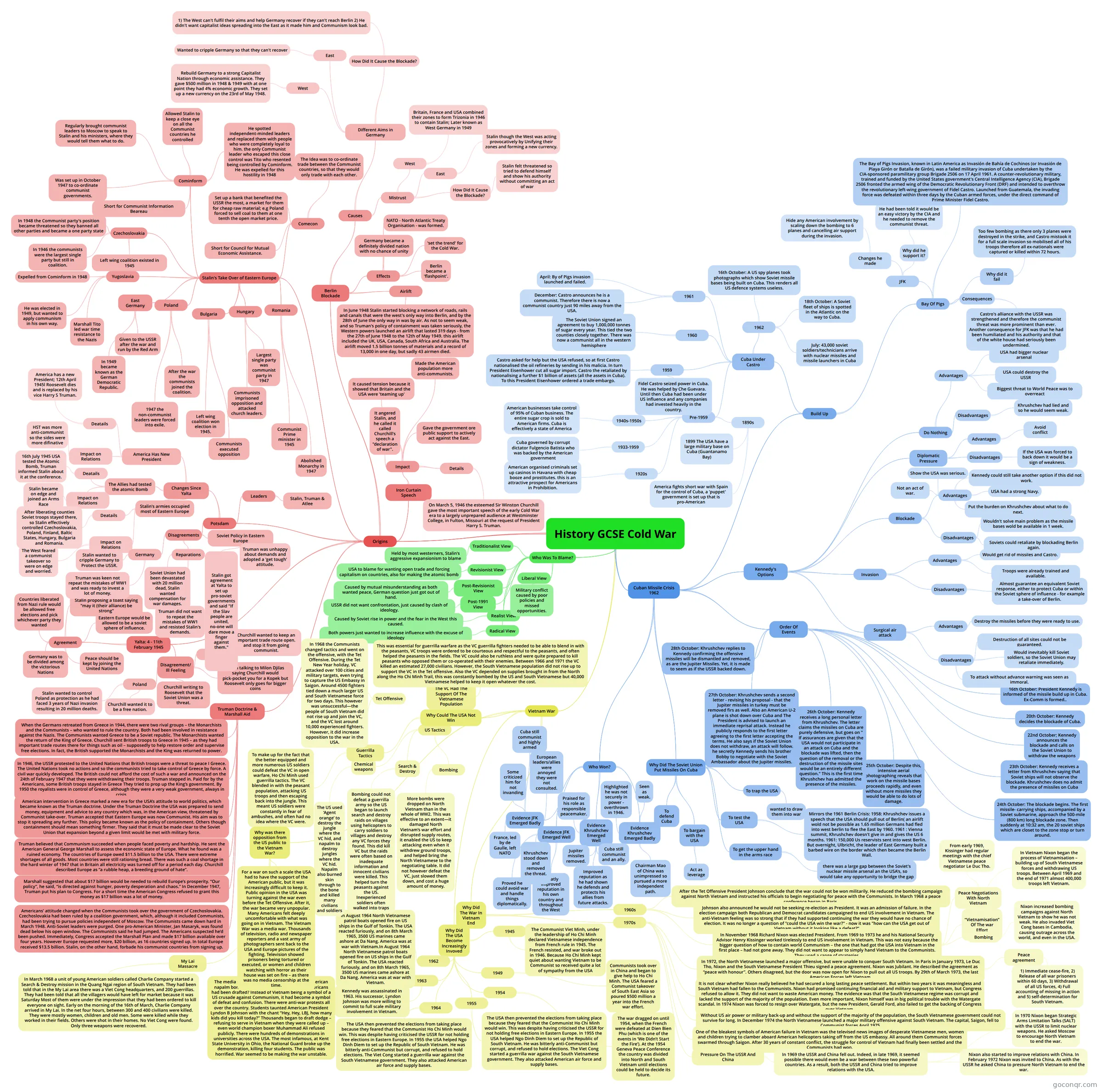 Mind map History GCSE Cold War
-
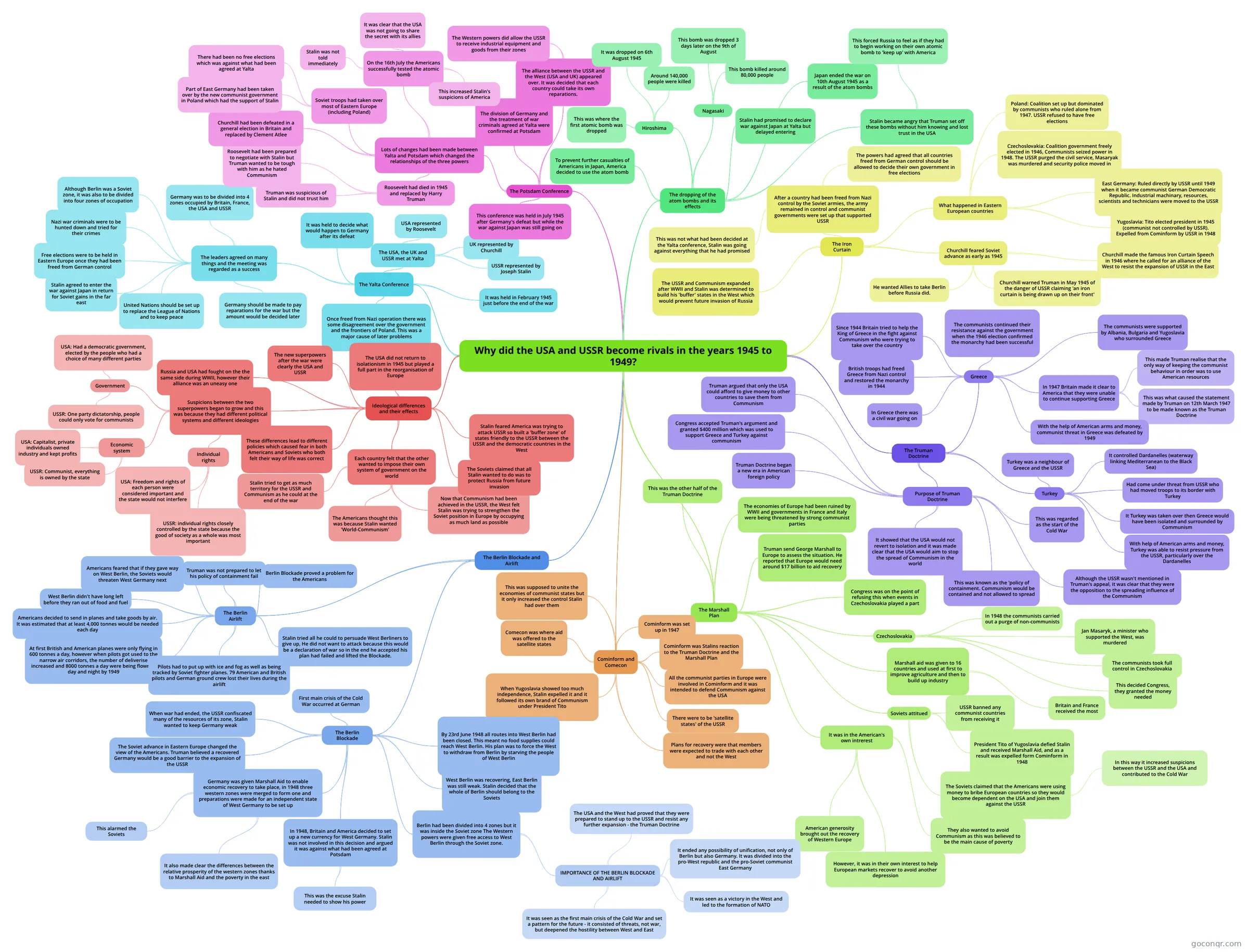 Mind map Why did the USA and USSR become rivals in the years 1945 to 1949?
-
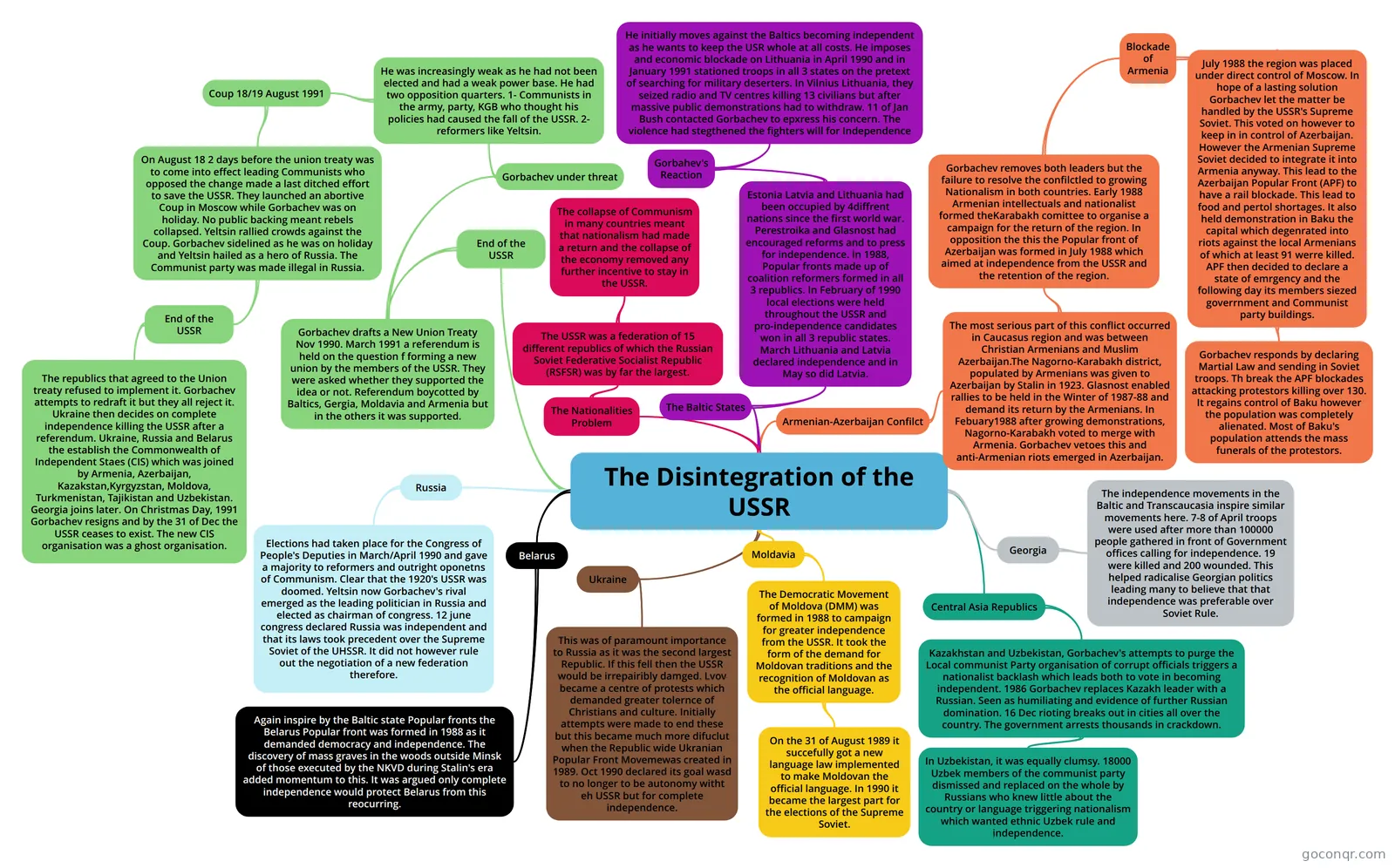 Mind map The Disintegration of the USSR A mindmap on the overview of the fall Of the USSR-How, Why and the impact that it had on the Cold War.
-
Mind map Sino-Soviet Relations and the Sino-US Rapprochement (1949-76)
-
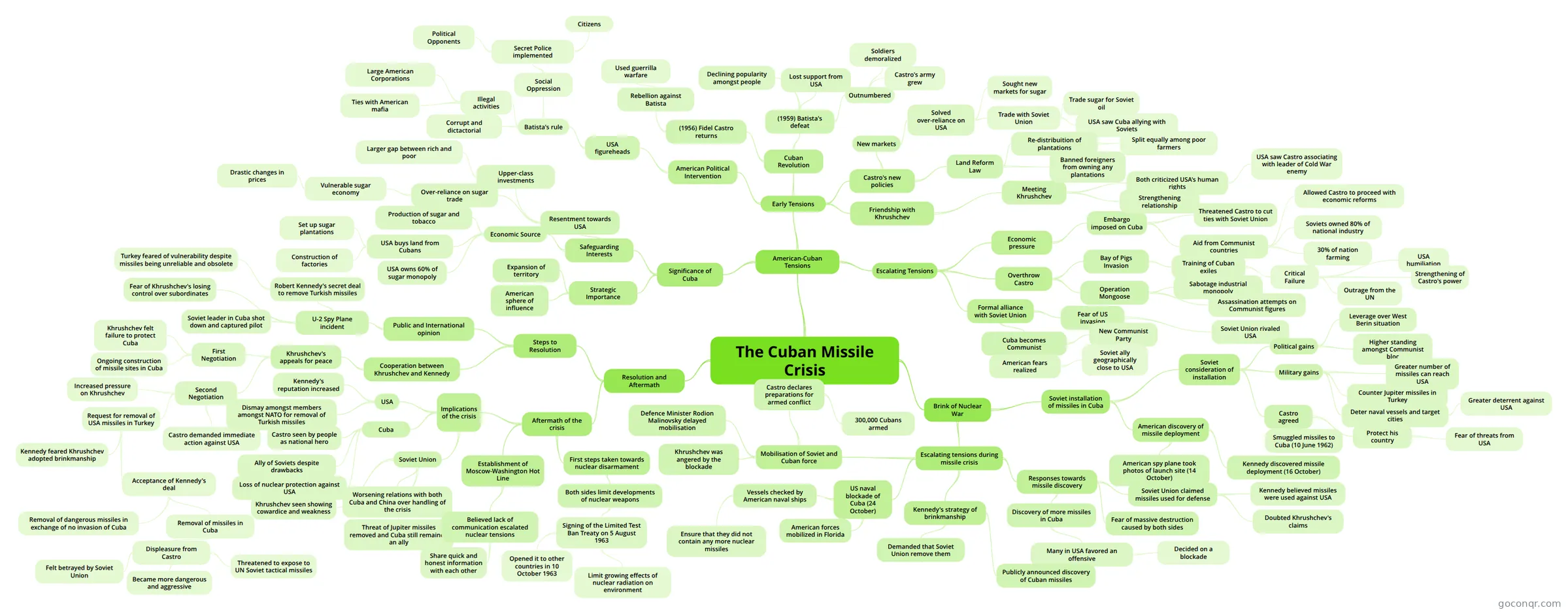 Mind map The Cuban Missile Crisis
-
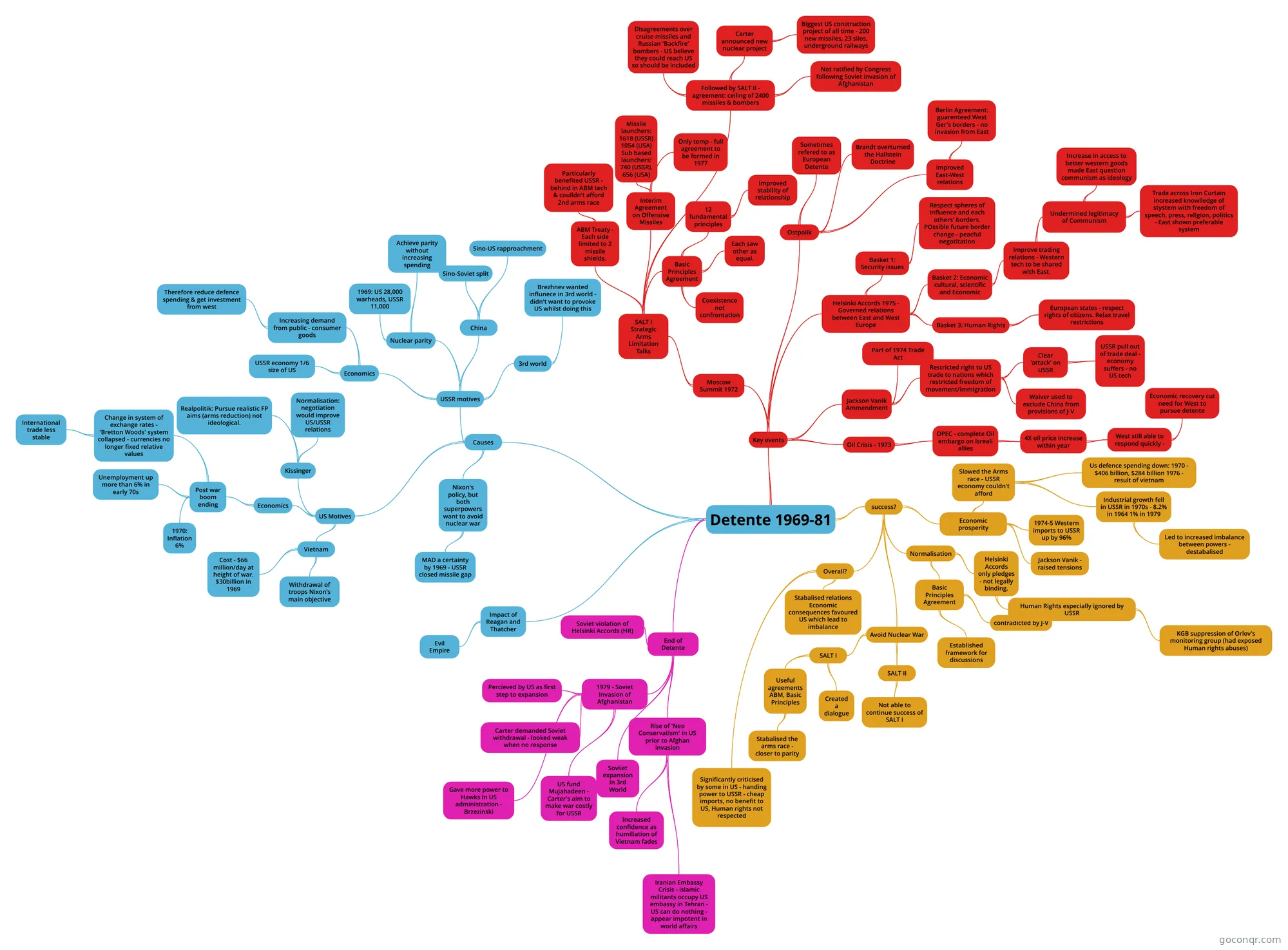 Mind map Detente 1969-81
-
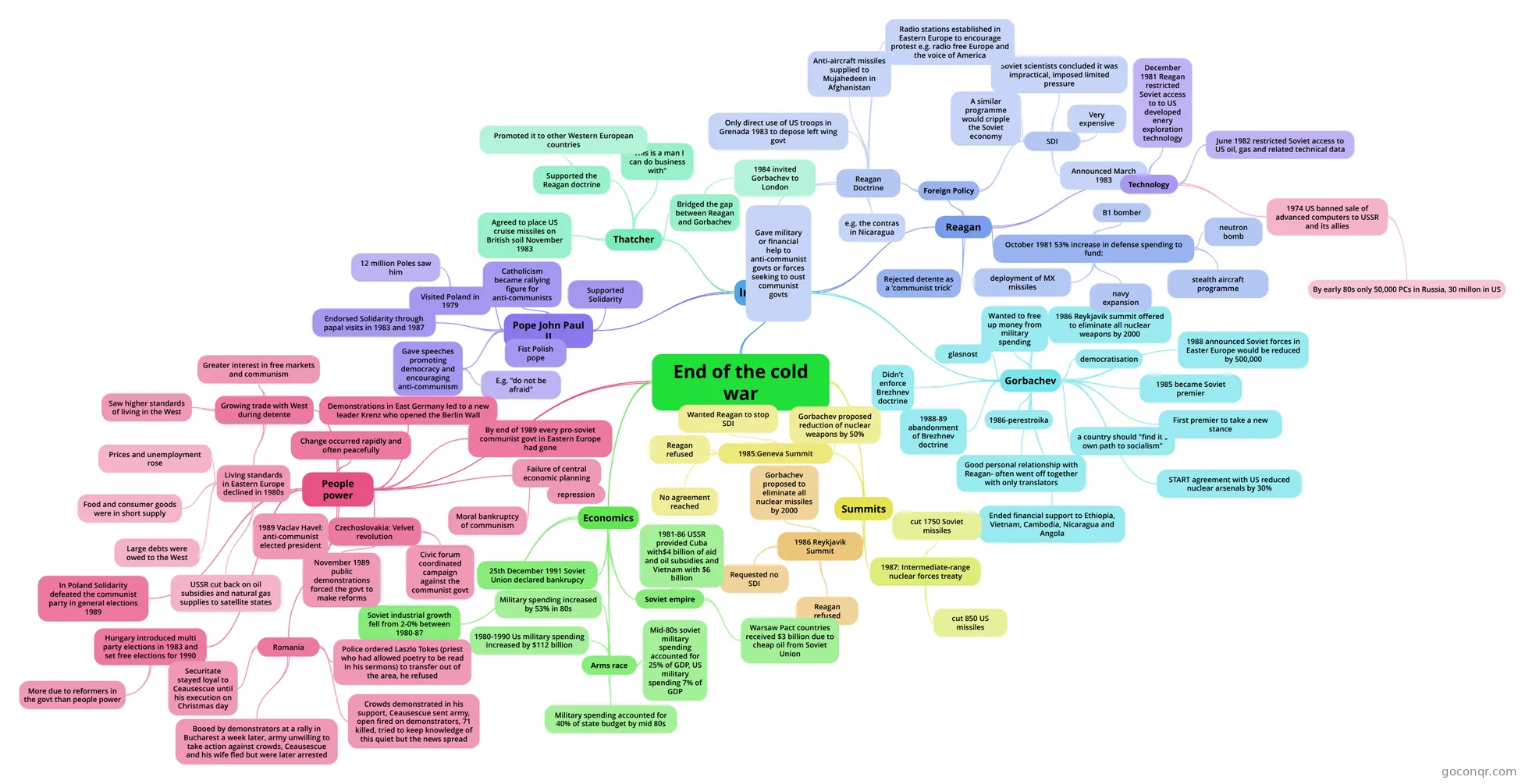 Mind map End of the cold war
-
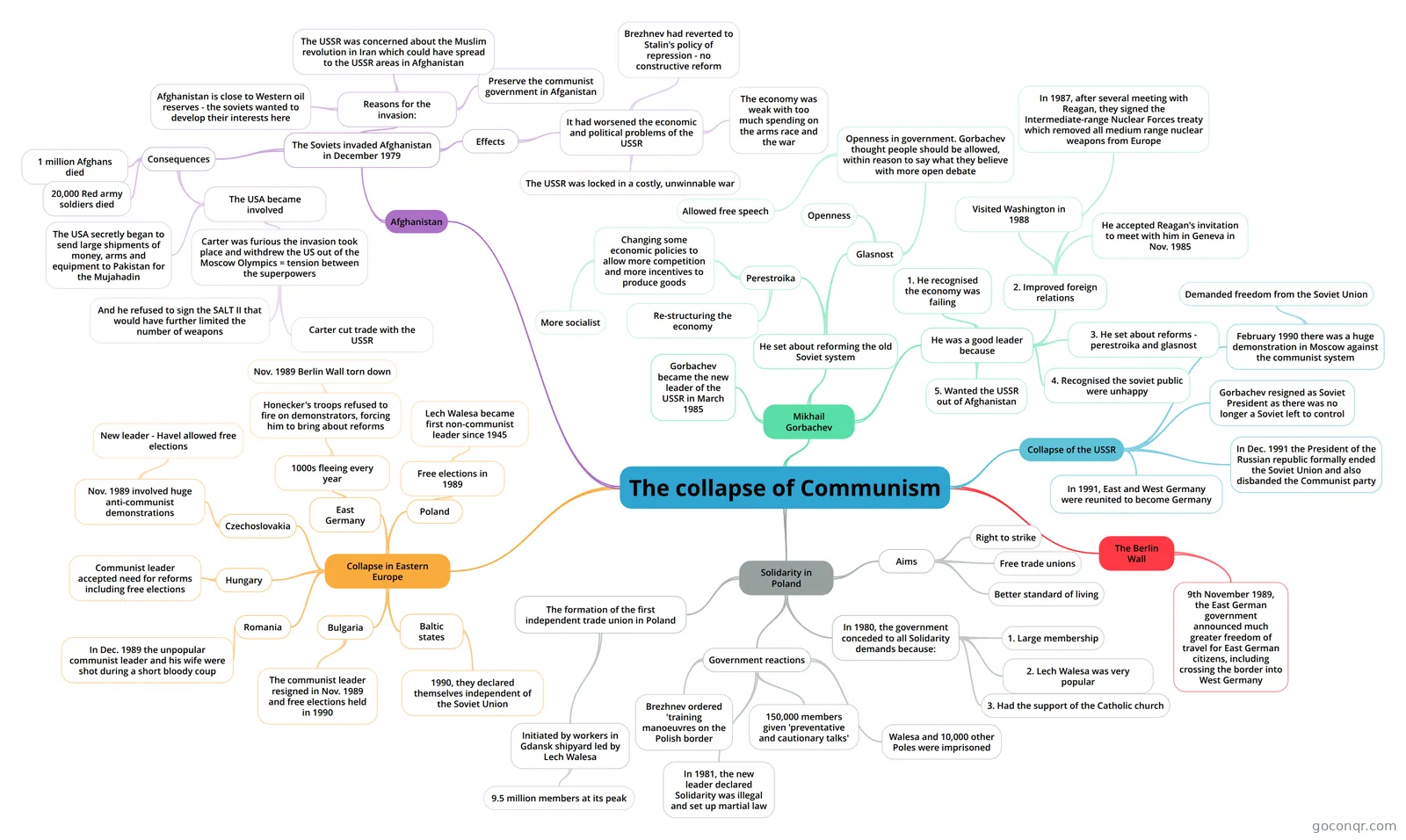 Mind map The collapse of Communism GCSE The collapse of Communism mind map
Quizzes
See all 65 quizzes-
38 questionsPart 6 US History EOC In 1957, the Eisenhower Doctrine expanded the principles of the Truman Doctrine by extending Middle East mi...
-
18 questionsThe Formation Of Two Germanys 1945 - 1949 After the unconditional surrender of Germany on the 8th May 1945, WWII was over. How much of Berlin had bee...
-
33 questionsThe Cold War Quiz The Cold War was referred to as "cold" because
-
20 questionsCold War: Europe Which of the following is presented in correct chronological order?
-
74 questionsCold War Dates Quiz When was the Tehran Conference?
-
20 questionsIron Curtain What form of protection did Stalin want at the beginning of the Cold War?
-
18 questionsConferences in Cold War Quiz Who was at the Yalta Conference?
-
15 questionsThe Yalta Conference When was the Yalta Conference?
Mind maps
See all 313 mind maps-
History GCSE Cold War
-
Why did the USA and USSR become rivals in the years 1945 to 1949?
-
The Disintegration of the USSR A mindmap on the overview of the fall Of the USSR-How, Why and the impact that it had on the Cold War.
-
Sino-Soviet Relations and the Sino-US Rapprochement (1949-76)
-
The Cuban Missile Crisis
-
Detente 1969-81
-
End of the cold war
-
The collapse of Communism GCSE The collapse of Communism mind map
Flashcards
See all 195 flashcards-
36 cardsChapter 4 - The Suez Crisis of 1956 Tension between Israel and Syria In 1949, what did the UN persuade Israel and Syria to agree on?
-
36 cardsEdexcel History A The Cold War - Detente and the End of the Cold War The final section of Edexcel History A's Cold War unit. From detente to Afghanistan to the dissolution of t...
-
9 cardsCuban missile crisis
-
25 cardsThe Cold War IB History of the Americas HL
-
28 cardsThe Geneva Spirit and Conference Diplomacy 1954-1961 Flashcards When was the Geneva Conference?
-
21 cardsKorean War (5Ws)
-
17 cardsMcCarthyism and Red Scare revision cards!! What was the domino theory?
-
4 cardsWHO WAS TO BLAME FOR THE COLD WAR? Reasons why the USA could be blamed
Flowcharts
-
 The Collapse of Communism in Eastern Europe 1989-1990 Part of our series on the Cold War, this chart details the main events across Eastern Europe that led to th...
-
 6) The 'Long Telegram' - Feb 1946
-
Cold war - mind map Why is it called cold war? What were the two sides of this war? Who was the instigator? What was the Iron c...
Notes
See all 37 notes-
Beginning of the Cold War How did the Cold War begin (1945-1990)? The balance of power shifted globally following the Second World War and the two dominating superpowers were the United States and USSR. Although they fought as allies during th...
-
END OF COLD WAR PRACTICE ESSAY “It was the USSR’s economic problems rather than Gorbachev’s New Thinking that hastened the end of the Cold War.” Assess the validity of this view (25 marks) The Cold war was inevitably going to end due to a combinati...
-
Conferences in 1945 Attended by the 'Big Three' [Roosevelt, Churchill & Stalin], this is what was decided... Nazi criminals would be hunted down and tried for their crimes Free Elections in Eastern Europe
-
Comecon and Cominform COMINFOM The Communist Information Bureau was set up in 1947 to enable the So...
-
Video Resources Part One: Comrades 1917-1945http://www.youtube.com/watch?v=8tCs-VZtwJY Part Two: Iron Curtain 1945-1947http://www.youtube.com/watch?v=J9UkOyBiRf4 Part Three: Marshall Plan 1947-1952http://www.youtube.com/watch?v=dooIg...
-
The Cold War - as I see how the IB sees it Long Term Causes (1917-28) distrust existed from 1917 w/ Bolshevik Revolution B. Rev. was seen as a threat to capitalism, and leaders of US (Wilson) were worried about international spread of communism with Lenin & Tr...
-
Cold War 1950's and 60's Crises and Confrontations: Korean War 1950 Korean War Communist North Korea invaded the democratic South Korea in 1950 South Korea was a US ally and the US, concerned about the 'domino effect', became involved in the ...
-
Chronology of The Cold War Chronology of The Cold War. 1. February 4th – 11th 1945 Yalta Conference. Chronology of The Cold WarThe Cold War occurred due to the clashing ideologies between Russia, Britain and USA. The violence was indirect, capi...
Slides
See all 12 slidesMore History topics
About The Cold War
GoConqr OriginalWhat this unit covers
The Cold War unit follows the story from the first disagreements between the USA and USSR to the fall of Soviet power. Early resources look at opposing ideologies, the post-war conferences and the rivalry of the late 1940s. Later ones deal with crises, détente and the end of the conflict.
Where to start
Begin with the Mind Map called The Cold War. It sets out the causes: capitalism versus communism, fear and mistrust, broken promises and the buffer zone of Eastern bloc countries. Then move to Why did the USA and USSR become rivals in the years 1945 to 1949?, which covers the Yalta Conference and the atom bombs on Hiroshima and Nagasaki.
After that, follow the story in order:
- Conferences and early policy, such as the Truman Doctrine and the Marshall Plan.
- The crises: the Berlin Blockade, Hungary in 1956, the Cuban Missile Crisis and the Prague Spring.
- Détente, using Detente 1969-81 and The origins of Détente 1969-1972.
- The ending, with End of the cold war and Why did the Cold War end?
Using quizzes and maps together
Read a mind map first, then test yourself. The Yalta Conference quiz and the Potsdam Conference quiz suit the early years. The Cold War Dates Quiz helps with timelines, and the Cuban Missile Crisis quiz checks the order of events. Where a question trips you up, go back to the matching map branch and read it again.
Flashcard decks such as Detente and The Berlin Wall are handy for short bursts of revision. Notes and slide sets, including the slides on the Soviet War in Afghanistan 1979-1989, add detail for essay planning.
Where it fits
This unit sits in the strand The Cold War and the Contemporary World, within History. The listed resources mention GCSE History, IGCSE History, A-level History, IB History and AP US History, so check which one matches your course. Teachers can use the maps and quizzes as ready-made starting points.
Choose one topic today, take a quiz, and then build your own maps and flashcards to fill any gaps.
Frequently asked questions
Which resource should I open first?
Start with the Mind Map called The Cold War. It lays out the causes, including opposing ideologies, fear and mistrust, and the Eastern bloc buffer zone. Once that makes sense, move on to the map on the rivalry between the USA and USSR from 1945 to 1949.
What do the mind maps cover?
They cover the whole span: the origins, the Cuban Missile Crisis, the Berlin crises, Hungary, the Prague Spring, détente, Afghanistan and the collapse of Communism. Many have branches for causes, key events and outcomes, so they work well as a first read.
Which exams are these resources for?
The listed resources mention GCSE History, IGCSE History, A-level History, IB History and AP US History. Most are for school students, so look at a resource's title and content to see whether it matches your course before you rely on it.
Are the resources free to use?
Yes. Every resource listed here is free to open, study and take, with no account needed. They were made by GoConqr users rather than by GoConqr itself. A free account also saves your quiz scores and lets you create your own quizzes, maps, flashcards and notes.
Which quizzes help with dates and conferences?
Try the Cold War Dates Quiz for timelines, and the quizzes on The Yalta Conference and The Potsdam Conference for the 1945 meetings. There is also a quiz on NATO and the Warsaw Pact, and one on the Marshall Plan.
What if I can't find the topic I need?
Browse the mind maps, notes and flashcard decks, as a topic may sit under a different title, such as Comecon and Cominform or the Suez Crisis. If it still isn't there, make your own map or flashcards on it.