
Mind map
identity
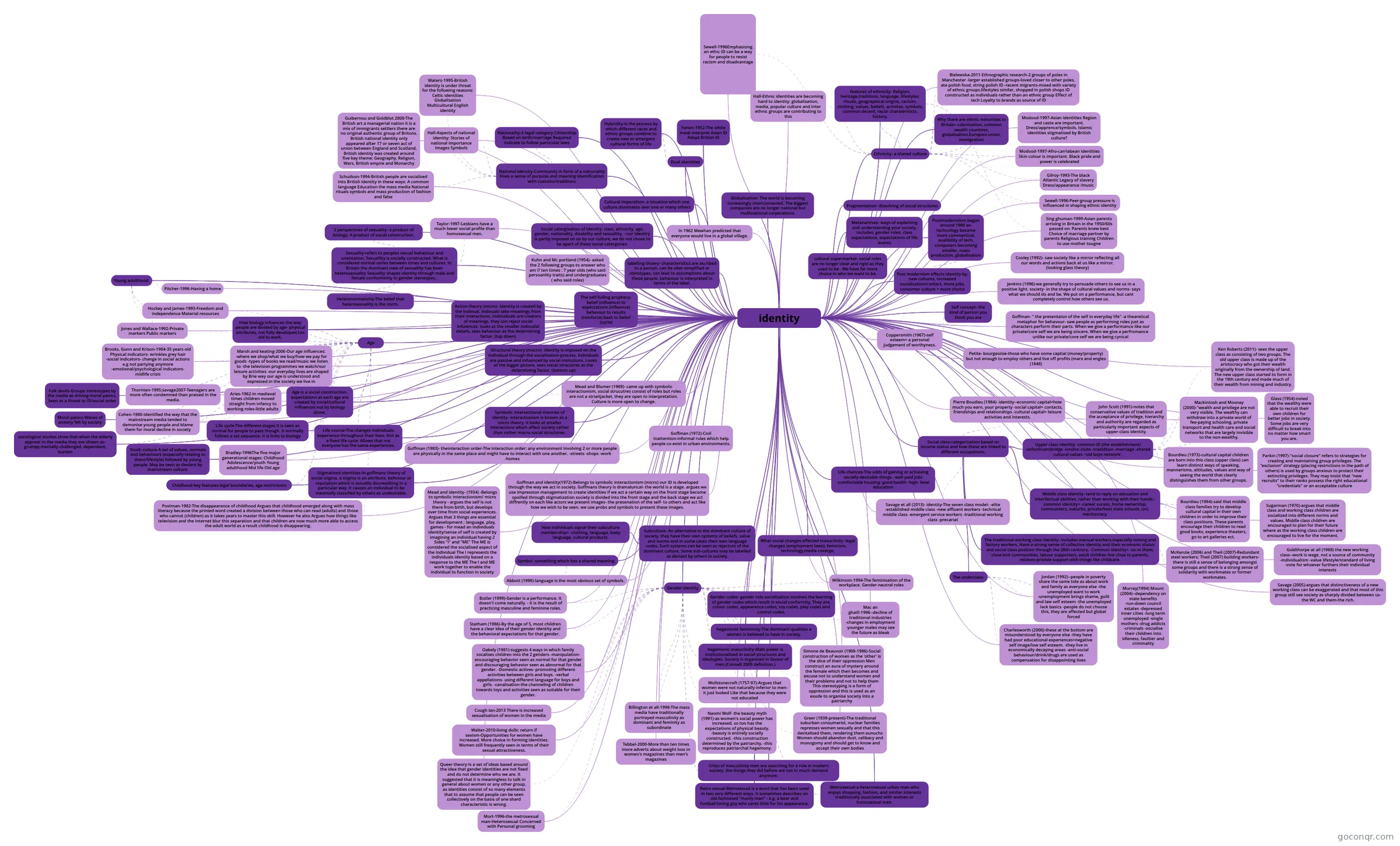
Mind map: Identity, Postmodernism, Globalisation, and Self Concept
Map content
identity
Postmodernsism began around 1980 as- technology became more commertical, avalibility of tech, computers becoming smaller, mass production, globalisation
Post modernism effects identity by: new cultures, increased socialisation/contact, more jobs, consumer culture = more choice
Fragmentation- dissolving of social structures
Metanartives- ways of explaining and understanding your society, includes. gender roles, class expectations, expectations of life events
cultural supermarket- social roles are no longer clear and rigid as they used to be . We have far more choice in who we want to be.
Globalisation- The world is becoming increasingly interconnected. The biggest companies are no longer national but mulitnational corperations.
In 1962 Mewhan predicted that everyone would live in a global village.
Cultural imperalism- a situation which one culture dominates over one or many others
Jenkins (1996)-we generally try to persuade others to see us in a positive light. society- in the shape of cultural values and norms- says what we should do and be. We put on a performance, but cant completely control how others see us.
Self concept- the kind of person you think you are
Cooley (1992)- saw society like a mirror reflecting all our words and actions back at us like a mirror. (looking glass theory)
Kuhn and Mc portland (1954)- asked the 2 following groups to answer who am i? ten times : 7 year olds (who said persoanlity traits) and undergraduates ( who said roles)
Social catergisation of identity; class, ethnicity, age, gender, nationality, disability and sexuallity. - our identiry is partly imposed on us by our culture, we do not chose to be apart of these social catergories.
Goffman- " the presentaion of the self in everyday life" -a thearetical metaphor for behavour- saw people as performing roles just as characters perform their parts. When we give a performance like our private/core self we are being sincere. When we give a perfromance unlike our private/core self we are being cynical
Coppersmith (1967)-self esteem= a personal judgement of worthyness.
labelling thoery- characteristics are ascribed to a person, can be ober-simplified or sterotypes, can lead to assumptions about these people, behavour is interpreted in terms of the label.
The self-fulling prophecy- belief (influence) to expectations (influence) behavour to results (reinforce) back to belief (cycle)
Structural theory (macro)- identity is imposed on the individual through the socialisation process. Indviduals are passive and infuenced by social insitutions. Looks at the bigger picture, sees social strucutres as the determining factor. (bottom up)
Action theory (micro)- identity is created by the indivual. Indivuals take meanings from their interactions. Indviuduals are creators of meanings, they can reject social infulences. looks at the smaller indivudal details, sees behavour as the determining factor. (top down)
Symbolic intersactional theories of identity- interactionism is known as a micro theory, it looks at smaller interactions which affect society rather than rather macro social structures.
Mead and Blumer (1969)- came up with symbolic interactionism, social strucutres consist of roles but roles are not a striaitjacket, they are open to interpretation. Culture is more open to change.
Mead and identity- (1934) -Belongs to symbolic interactionism/ micro theory - argues the self is not there from birth, but develops over time from social experiences. Argues that 3 things are essential for development : language, play, games - for mead an individuals identity/sense of self is created by imagining an individual having 2 Sides "I" and "ME" The ME is considered the socialised aspect of the individual The I represents the individuals identity based on a response to the ME The I and ME work together to enable the individual to function in society
Goffman and identity(1972)-Belongs to symbolic interactionism (micro) our ID is developed through the way we act in society. Goffmans theory is dramalurical- the world is a stage. argues we use impression management to create identities if we act a certain way on the front stage become spoilled through stigmatization society is divided into the front stage and the back stage we act diffrently on each like actors we present images- the presenation of the self- to others and act like how we wish to be seen. we use probs and symbols to present these images.
Goffman (1972)-Civil inattention-informal rules which help people co-exist in urban environments.
Goffman (1983)- theinteraction order-The interaction order: any environment involving 2 or more people are physically in the same place and might have to interact with one another. -streets -shops -work -homes
Petite- bourgeoisie-those who have some captial (money/property) but not enough to employ others and live off profits (marx and engles (1848)
Social class-categorization based on income status and how these are linked to different occupations.
- Upper class identity- common ID (the establishment) -oxford/cambridge -london clubs -tradidtion -marriage -shared cultural values -'old boys network'.
- Middle class identity- tend to reply on education and interllectual abilities, rather than working with their hands.- common identity= -career sucess, home ownership, communters, suburbs, private/best state schools, uni, meritocracy.
- The traditional working class identity- includes manual workers,especially mining and factory workers. Have a strong sense of collective identity and their ecomonic status and social class position through the 20th centrury. -Common identity= -us vs them, close knit communities, labour supporters, adult children live close to parents, relaives provide support with things like childcare.
- The underclass-
Life chances-The odds of gaining or achieving socially desirable things. -well paid jobs -comfortable housing -good health -high- level education
Pierre Boudieu (1984)- identity--economic capital=how much you earn, your property -social capital= contacts, friendships and relationships -cultural capital= leisure activities and interests.
Savage et all (2013)- identity-The seven class model- -elite -established middle class -new affluent workers -technical middle class -emergent service workers -traditional working class -precariat
Ken Roberts (2011)- sees the upper class as consisting of two groups. The old upper class is made up of the aristocracy who got their wealth originally from the ownership of land. The new upper class started to form in the 19th century and made much of their wealth from mining and industry.
John Scott (1991)-notes that conservative values of tradition and the acceptance of privilege, hierarchy and authority are regarded as particularly important aspects of upper-class identity.
Mackintosh and Mooney (2000)-"wealth and privilege are not very visible. The wealthy can withdraw into a private world of fee-paying schooling, private transport and health care and social networks that are largely invisible to the non-wealthy.
Bourdieu (1973)-cultural capital children are born into this class (upper class) can learn distinct ways of speaking, mannerisms, attitudes, values and way of seeing the world that clearly distinguishes them from other groups.
Parkin (1997)-"social closure" refers to strategies for creating and maintaining group privileges. The "exclusion" strategy (placing restrictions in the path of others) is used by groups anxious to protect their extincting privileges. They may insist that "new recruits" to their ranks possess the right educational "credentials" or an acceptable culture
Glass (1954)-noted that the wealthy were able to recruit their own children for better jobs in society. Some jobs are very difficult to break into no matter how smart you are.
Bourdieu (1984)-said that middle class families try to develop cultural capital in their own children in order to improve their class positions. These parents encourage their children to read good books, experience theaters, go to art galleries ect.
Sugarman (1970)-argues that middle class and working class children are socialized into different norms and values. Middle class children are encouraged to plan for their future where as the working class children are encouraged to live for the moment.
McKenzie (2006) and Theil (2007)-Redundant steel workers; Theil (2007) building workers- there is still a sense of belonging amongst some groups and there is a strong sense of solidarity with workmates or former workmates.
Goldthorpe at all (1968) the new working class--work is wage, not a source of community -individualism -value lifestyle/standard of living -vote for whoever furthers their individual interests
Savage (2005)-argues that distinctiveness of a new working class can be exaggerated and that most of this group still see society as sharply divided between us- the WC and them-the rich.
Murray(1994) Mount (2004)--dependency on state benefits -run-down council estates -depressed inner cities -long term unemployed -single mothers -drug addicts -criminals -socialise their children into idleness, faultier and criminality
Jordan (1992)--people in poverty share the same tide as about work and family as everyone else -the unemployed want to work -unemployment brings shame, guilt and law self esteem -the unemployed lack basics -people do not choose this, they are affected but global forced
Charlesworth (2000)-these at the bottom are misunderstood by everyone else -they have had poor educational experiences=negative self image/low self esteem. -they live in economically decaying areas -anti-social behaviour/drink/drugs are used as compensation for disappointing lives
Subculture- An alternative to the dominant culture of society, they have their own systems of beliefs, value and norms and in some cases their own language codes. Such systems can be seen as rejectors of the dominant culture. Some sub-cultures may be labelled as deviant by others in society.
- How individuals signal their subculture membership= -clothing, language, body language, cultural products.
Symbol- something which has a shared meaning.
Abbott (1998)-language is the most obvious set of symbols.
Gender identity
Butler (1999)-Gender is a performance. It doesn't come naturally. - it is the result of practicing masculine and feminine roles.
Oakely (1981)-suggests 4 ways in which family socalises children into the 2 genders -manipulation- encouraging behavior seen as normal for that gender and discouraging behavior seen as abnormal for that gender. -Domestic actives- promoting different activities between girls and boys. -verbal appellations- using different language for boys and girls. -canalisation-the channeling of children towards toys and activities seen as suitable for their gender.
Gender codes- gender role socialisation involves the learning of gender codes which result in social conformity. They are; colour codes, appearence codes, toy codes, play codes and control codes.
Statham (1986)-By the age of 5, most children have a clear idea of their gender identity and the behavioral expectations for that gender.
hegemonic masuclinity-Male power is institutionalised in social structures and ideologies. Society is organised in favour of men (Connell 2009 definition.)
Wollstonecraft (1757-97)-Argues that women were not naturally inferior to men- it just looked Like that because they were not educated
Simone de Beauvoir (1908-1986)-Social construction of women as the 'other' is the slice of their oppression Men construct an aura of mystery around the female which then becomes and excuse not to understand women and their problems and not to help them This stereotyping is a form of oppression and this is used as an exude to organise society into a patriarchy
Greer (1939-present)-The traditional suburban consumerist, nuclear families represses women sexually and that this devitalised them, rendering them eunuchs Women should abandon dust, celibacy and monogomy and should get to know and accept their own bodies
Naomi Wolf- the beauty myth (1991)-as women's social power has increased, so too has the expectations of physical beauty. -beauty is entirely socially constructed. -this construction determined by the patriarchy. -this reproduces patriarchal hegemony.
Billington et all-1998-The mass media have traditionally portrayed masculinity as dominant and feminity as subordinate
Tebbel-2000-More than ten times more adverts about weight loss in women's magazines than men's magazines
Cough Ian-2013 There is increased sexualisation of women in the media
Queer theory-Is a set of ideas based around the idea that gender identities are not fixed and do not determine who we are. It suggested that it is meaningless to talk in general about women or any other group, as identities consist of so many elements that to assume that people can be seen collectively on the basis of one shard characteristic is wrong.
Walter-2010-living dolls: return if sexism-Opportunities for women have increased. More choice in forming identities. Women still frequently seen in terms of their sexual attractiveness.
hegemonic femininity-The dominant qualities a women is believed to have in society.
Crisis of masculinity-men are searching for a role in modern society. the things they did before are not in much demand anymore.
Mac an ghaill-1996--decline of traditional industries -changes in employment -younger males may see the future as bleak
Wilkinson-1994-The feminisation of the workplace. Gender-neutral roles
Mort-1996-the metrosexual man-Heterosexual Concerned with Personal grooming
Retro sexual-Retrosexual is a word that has been used in two very different ways. It sometimes describes an old-fashioned "manly man" - e.g. a beer and football-loving guy who cares little for his appearance.
Metrosexual-a heterosexual urban man who enjoys shopping, fashion, and similar interests traditionally associated with women or homosexual men.
What social changes effected masuclinity- legal changes (employment laws), feminism, technology,media covarge,
Stigmatised identities-In goffmans theory of social stigma, a stigma is an attribute, behviour or reputation which is soicallly discreaditing in a particular way. It causes an individual to be meantally classified by others as undesirable.
Sexuality-refers to peoples sexual behaviour and orientation. Sexuallity is socially constructed. What is considered normal varies between times and cultures. In Britain the dominant view of sexualilty has been heterosexuality Sexuality shapes identity through male and female conforminity to gender sterotypes..
2 perspectives of sexuality- a product of biology. A product of social construction.
Taylor-1997-Lesbians have a much lower social profile than homosexual men.
Heteronormativity-The belief that heterosexuality is the norm.
Ethnicity- a shared culture
features of ethnicity- Religion, heritage,traditions, language, lifestyles, rituals, geographical origins, racisim, clothing, values, beliefs, activites, symbols, common decent, racial charaterisicts, history.
Why there are ethnic minorities in Britain- colonisation, common wealth countires, globalisation,Europien union, immigration
Modood-1997-Asian identities Region and caste are important. Dress/apprence/symbols. Islamic identities stigmatised by British culture?
Modood-1997-Afro-carriabean identities Skin colour is important. Black pride and power is celebrated
Gilroy-1993-The black Atlantic Legacy of slavery Dress/appearance /music
Sewell-1996-Peer-group pressure is influenced in shaping ethnic identity
Sing ghuman-1999-Asian parents arriving in Britain in the 1950/60s passed on: Parents knew best Choice of marriage partner by parents Religious training Children to use mother tougne
Dual identities
Fanon-1952-The white mask Interpret Asian ID Adopt British ID
Hybridity-Is the process by which different races and ethnic groups combine to create new or emergent cultural forms of life
Hall-Ethnic identities are becoming hard to identity: globalisation, media, popular culture and inter ethnic groups are contributing to this
Bielewska-2011-Ethnographic research-2 groups of poles in Manchester -larger established groups-loved closer to other poles, ate polish food, string polish ID -recent migrants-mixed with variety of ethnic groups,lifestyles similar, shopped in polish shops ID constructed as individuals rather than an ethnic group Effect of tech Loyalty to brands as source of ID
Sewell-1996Emphasising an ethic ID can be a way for people to resist racism and disadvantage
National identity-Community in form of a nationality Fives a sense of purpose and meaning Identification with customs/traditions
Nationality-A legal category Citizenship Based on birth/marriage Required indicate to follow particular laws
Hall-Aspects of national identity: Stories of national importance Images Symbols
Guibernou and Goldblot 2000-The British art a managerial nation it is a mix of immigrants settlers there are no original authentic group of Britons. British national identity only appeared after 17 or seven act of union between England and Scotland. British identity was created around five key theme: Geography, Religion, Wars, British empire and Monarchy
Schudson-1994-British people are socialised into British identity in these ways: A common language Education the mass media National rituals symbols and mass production of fashion and false
Waters-1995-British identity is under threat for the following reasons: Celtic identities Globalisation Multicultural English identity
Age
Marsh and keating-2006-Our age influences: -where we shop/what we buy/how we pay for goods -types of books we read/music we listen to -the television programmes we watch/our leisure activities -our everyday lives are shaped by Brie way our age is understood and expressed in the society we live in
How biology infuences the way people are divided by age- physical attributes, not fully developed,too old to work.
Aries-1962-In medieval times children moved straight from infancy to working roles-little adults
Age is a social construction. expectations at each age are created by social/cultural influences not by biology alone.
Life cycle-The different stages It is seen as normal for people to pass though. It normally follows a set sequence. It is links to biology
Life course-The changes Individuals experience throughout their lives. Not as a fixed life cycle. Allows that not everyone has the same experiences.
Bradley-1996The five major generational stages: Childhood Adolescence/youth Young adulthood Mid life Old age
Childhood-key features-legal boundaries, age restrictions
Postman-1982-The disappearance of childhood Argues that childhood emerged along with mass literacy because the printed word created a division between those who can read (adults) and those who cannot (children) as it takes years to master this skill. However he also Argues how things like television and the internet blur this separation and that children are now much more able to access the adult world as a result childhood is disappearing.
Youth culture-A set of values, normals and behaviours (especially relating to dress/lifestyle) followed by young people. May be seen as deviant by mainstream culture.
Cohen-1980-Identified the way that the mainstream media tended to demonise young people and blame them for moral decline in society
Thornten-1995;savage2007-Teenagers are more often condemned than praised in the media.
Moral panics-Waves of anxiety felt by society
Folk devils-Groups stereotypes by the media as driving moral panics. Seen as a threat to ID/social order
Brooks, Gunn and Krison-1984-35 years old Physical indicators- wrinkles grey hair -social indicators- change in social actions e.g not partying anymore -emotional/psychological indicators- midlife crisis
Jones and Wallace-1992-Private markers Public markers
Hockey and James-1993-Freedom and independence Material resources
Pitcher-1996-Having a home
Young adulthood.
sociological studies show that when the elderly apprear in the media they are shown as- grumpy,mentally challenged, dependent, burden
Information
- Description
- A level Sociology Mind Map on identity, created by sophie may on 12/11/2017.
- Created by
- sophie may
- Views
- 2
- Rating