
Mind map
Chapter 1 - Atomic structure and Periodic table
Map content
Chapter 1 - Atomic structure and Periodic table
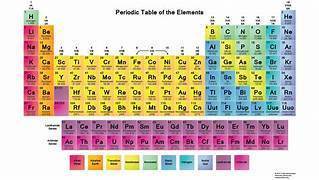
All elements can be found inside the periodic table.
- An element is a substance that cannot be brokn down.
Compounds are a substance that contains 2 or more different types of atoms.
- Magnesium + Chlorine ---> Magnesium Chloride
...ate means oxygen is involved in the reaction
Electricity can break compounds apart
MgO(2) is a formulae
- Mg is in group 2
- Oxygen is diatomic - O(2)
- It is in group 6
- Oxygen is diatomic - O(2)
- This adds up to 8 and it has a full outer shell. It is Happy :)
- Mg is in group 2
If 2 or more elements join be sharing electrons , it is a molecule
Mixtures are more than one type of atom not chemically joined. This means they can easily be separated from eachother
Filtration - This technique separates a insoluble liquid from a solid. One beaker contains solid and liquid , the other is filter paper.The mixtueres are both poure din and the solid will be left behind, the solid will not.
Crystallisation can be used to separate a solid dissolved in liquid.
Distillation is separating out liquids with different boiling points
Chromatograpghy is separating out the different coloured inks.
Theories of the atom
- 1. 400 BC, Democritus suggested the atom was a group of small particles that could not be divided.
- 2. John Dalton, 200years after suggested the atom was a "billiard ball" that could not be divided
- 3.1897 ,JJ. Thompson discovered the electron and said the electrons were embedded in a ball of positive charge, like a Plum Pudding.
- 4. 1909 Geiger and Marsden found interesting results and with Ernest Rutherford, they discovered that the atom had a nucleus and Rutherford said that it has a positive charge in the centre where the mass is concentrated and much was empty space . This is the nuclear model
- 5. 1913, Niels bohr used
- 4. 1909 Geiger and Marsden found interesting results and with Ernest Rutherford, they discovered that the atom had a nucleus and Rutherford said that it has a positive charge in the centre where the mass is concentrated and much was empty space . This is the nuclear model
- 3.1897 ,JJ. Thompson discovered the electron and said the electrons were embedded in a ball of positive charge, like a Plum Pudding.
- 2. John Dalton, 200years after suggested the atom was a "billiard ball" that could not be divided
- 1. 400 BC, Democritus suggested the atom was a group of small particles that could not be divided.
Elecron has a negative charge, Proton has a positive charge and Neutron hasn't got a charge.
Relative Atomic mass mass can be found by : (Mass of first Isotope x %of first Isotope) x (mass of 2nd Isotope x % of second Isotope)
Images and files in the map
Information
- Description
- Chemistry Mind Map on Chapter 1 - Atomic structure and Periodic table, created by Ali-a's Adopted Brother on 09/05/2018.
- Created by
- Ali-a's Adopted Brother
- Views
- 131
- Rating