
Mind map
Terms
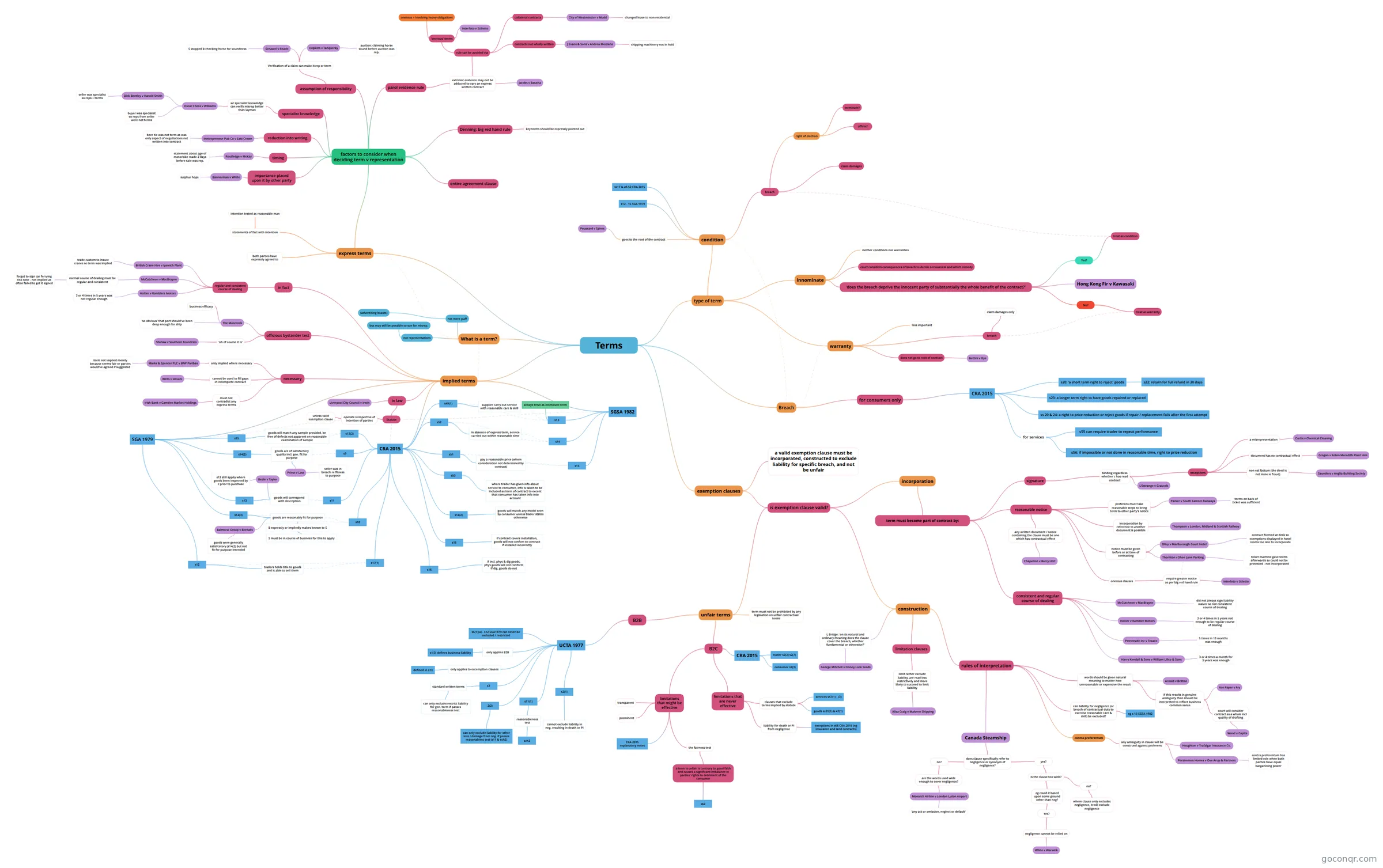
Mind map: Contractual Terms, Breach, and Exemption Clauses
Map content
Terms
What is a term?
- not mere puff
- (advertising boasts)
- not representations
- but may still be possible to sue for misrep.
- not mere puff
express terms
- statements of fact with intention
- intention tested as reasonable man
- factors to consider when deciding term v representation
- importance placed upon it by other party
- Bannerman v White
- sulphur hops
- Bannerman v White
- timing
- Routledge v McKay
- statement about age of motorbike made 2 days before sale was rep.
- Routledge v McKay
- reduction into writing
- Inntrepreneur Pub Co v East Crown
- beer tie was not term as was only aspect of negotiations not written into contract
- Inntrepreneur Pub Co v East Crown
- specialist knowledge
- w/ specialist knowledge can verify misrep better than layman
- Oscar Chess v Williams
- buyer was specialist so reps from seller were not terms
- Dick Bentley v Harold Smith
- seller was specialist so reps = terms
- Oscar Chess v Williams
- w/ specialist knowledge can verify misrep better than layman
- assumption of responsibility
- Verification of a claim can make it rep or term
- Schawel v Reade
- S stopped B checking horse for soundness
- Hopkins v Tanqueray
- auction: claiming horse sound before auction was rep.
- Schawel v Reade
- Verification of a claim can make it rep or term
- parol evidence rule
- extrinsic evidence may not be adduced to vary an express written contract
- Jacobs v Batavia
- rule can be avoided via
- contracts not wholly written
- J Evans & Sons v Andrea Merzario
- shipping machinery not in hold
- J Evans & Sons v Andrea Merzario
- collateral contracts
- City of Westminster v Mudd
- changed lease to non-residential
- City of Westminster v Mudd
- 'onerous' terms
- Interfoto v Stilletto
- onerous = involving heavy obligations
- contracts not wholly written
- extrinsic evidence may not be adduced to vary an express written contract
- Denning: big red hand rule
- key terms should be expressly pointed out
- entire agreement clause
- importance placed upon it by other party
- both parties have expressly agreed to
- statements of fact with intention
implied terms
- in fact
- regular and consistent course of dealing
- British Crane Hire v Ipswich Plant
- trade custom to insure cranes so term was implied
- McCutcheon v MacBrayne
- normal course of dealing must be regular and consistent
- forgot to sign car ferrying risk note - not implied as often failed to get it signed
- normal course of dealing must be regular and consistent
- Hollier v Ramblers Motors
- 3 or 4 times in 5 years was not regular enough
- British Crane Hire v Ipswich Plant
- regular and consistent course of dealing
- officious bystander test
- The Moorcock
- business efficacy
- 'so obvious' that port should've been deep enough for ship
- 'oh of course it is'
- Shirlaw v Southern Foundries
- The Moorcock
- in law
- Liverpool City Council v Irwin
- Statute
- operate irrespective of intention of parties
- unless valid exemption clause
- operate irrespective of intention of parties
- necessary
- only implied where necessary
- Marks & Spencer PLC v BNP Paribas
- term not implied merely because seems fair or parties would've agreed if suggested
- Marks & Spencer PLC v BNP Paribas
- cannot be used to fill gaps in incomplete contract
- Wells v Devani
- must not contradict any express terms
- Irish Bank v Camden Market Holdings
- only implied where necessary
- SGA 1979
- s12
- traders holds title to goods and is able to sell them
- s13
- goods will correspond with description
- Beale v Taylor
- s13 still appliy where goods been inspected by c prior to purchase
- Beale v Taylor
- goods will correspond with description
- s14(2)
- goods are of satisfactory quality incl. gen. fit for purpose
- Priest v Last
- seller was in breach re fitness to purpose
- Priest v Last
- goods are of satisfactory quality incl. gen. fit for purpose
- s14(3)
- goods are reasonably fit for purpose
- B expressly or impliedly makes known to S
- S must be in course of business for this to apply
- Balmoral Group v Borealis
- goods were generally satisfcatory (s14(2) but not fit for purpose intended
- B expressly or impliedly makes known to S
- goods are reasonably fit for purpose
- s15
- goods will match any sample provided, be free of defects not apparent on reasonable examination of sample
- s12
- CRA 2015
- s17(1)
- s11
- s13(2)
- s14(2)
- goods will match any model seen by consumer unless trader states otherwise
- s9
- s10
- s15
- if contract covers installation, goods will not confom to contract if installed incorrectly
- s16
- if incl. phys & dig goods, phys goods will not conform if dig. goods do not
- s49(1)
- supplier carry out service with reasonable care & skill
- s52
- in absence of express term, service carried out within reasonable time
- s51
- pay a reasonable price (where consideration not determined by contract)
- s50
- where trader has given info about service to consumer, info is taken to be included as term of contract to excent that consumer has taken info into account
- SGSA 1982
- s13
- always treat as inominate term
- s14
- s15
- s13
- in fact
type of term
- condition
- goes to the root of the contract
- Poussard v Spiers
- breach
- right of election
- affirm?
- terminate?
- claim damages
- right of election
- s12 - 15 SGA 1979
- ss17 & 49-52 CRA 2015
- goes to the root of the contract
- warranty
- less important
- breach
- claim damages only
- does not go to root of contract
- Bettini v Gye
- innominate
- neither conditions nor warranties
- court considers consequences of breach to decide seriousness and which remedy
- 'does the breach deprive the innocent party of substantially the whole benefit of the contract?'
- Hong Kong Fir v Kawasaki
- Yes?
- treat as condition
- No?
- treat as warranty
- condition
Breach
- for consumers only
- CRA 2015
- s20: 'a short term right to reject' goods
- s22: return for full refund in 30 days
- s23: a longer term right to have goods repaired or replaced
- ss 20 & 24: a right to price reduction or reject goods if repair / replacement fails after the first attempt
- for services
- s55 can require trader to repeat performance
- s56: if impossible or not done in reasonable time, right to price reduction
- s20: 'a short term right to reject' goods
- CRA 2015
- for consumers only
exemption clauses
- is exemption clause valid?
- incorporation
- term must become part of contract by:
- signature
- binding regardless whether c has read contract
- exceptions
- a misrepresentation
- Curtis v Chemical Cleaning
- document has no contractual effect
- Grogan v Robin Meredith Plant Hire
- non est factum (the deed is not mine ie fraud)
- Saunders v Anglia Building Society
- a misrepresentation
- L'Estrange v Graucob
- exceptions
- binding regardless whether c has read contract
- reasonable notice
- onerous clauses
- require greater notice as per big red hand rule
- Interfoto v Stiletto
- require greater notice as per big red hand rule
- proferens must take reasonable steps to bring term to other party's notice
- Parker v South Eastern Railways
- terms on back of ticket was sufficient
- Parker v South Eastern Railways
- incorporation by reference to another document is possible
- Thompson v London, Midland & Scottish Railway
- notice must be given before or at time of contracting
- Olley v Marlborough Court Hotel
- contract formed at desk so exemptions displayed in hotel rooms too late to incorporate
- Thornton v Shoe Lane Parking
- ticket machine gave terms afterwards so could not be protested - not incorporated
- Olley v Marlborough Court Hotel
- any written document / notice containing the clause must be one which has contractual effect
- Chapelton v Barry UDC
- onerous clauses
- consistent and regular course of dealing
- McCutcheon v MacBrayne
- did not always sign liability waiver so not consistent course of dealing
- Hollier v Rambler Motors
- 3 or 4 times in 5 years not enough to be regular course of dealing
- Petrotrade Inc v Texaco
- 5 times in 13 months was enough
- Harry Kendall & Sons v William Lilico & Sons
- 3 or 4 times a month for 3 years was enough
- McCutcheon v MacBrayne
- signature
- term must become part of contract by:
- construction
- rules of interpretation
- words should be given natural meaning to matter how unreasonable or expensive the result
- Arnold v Britton
- if this results in genuine ambiguity then should be interpreted to reflect business common sense
- Ace Paper v Fry
- court will consider contract as a whole incl quality of drafting
- Wood v Capita
- can liability for negligence (or breach of contractual duty to exercise reasonable care & skill) be excluded?
- eg s 13 SGSA 1982
- contra proferentum
- any ambiguity in clause will be construed against proferens
- Houghton v Trafalgar Insurance Co.
- Persimmon Homes v Ove Arup & Partners
- contra proferentum has limited role when both parties have equal barganining power
- any ambiguity in clause will be construed against proferens
- Canada Steamship
- does clause specifically refer to negligence or synonym of negligence?
- no?
- are the words used wide enough to cover negligence?
- Monarch Airline v London Luton Airport
- 'any act or omission, neglect or default'
- Monarch Airline v London Luton Airport
- are the words used wide enough to cover negligence?
- yes?
- is the clause too wide?
- eg could it based upon some ground other than neg?
- Yes?
- negligence cannot be relied on
- White v Warwick
- negligence cannot be relied on
- Yes?
- no?
- where clause only excludes negligence, it will exclude negligence
- eg could it based upon some ground other than neg?
- is the clause too wide?
- no?
- does clause specifically refer to negligence or synonym of negligence?
- words should be given natural meaning to matter how unreasonable or expensive the result
- limitation clauses
- limit rather exclude liability, are read less restrictively and more likely to succeed to limit liability
- Alisa Craig v Malvern Shipping
- limit rather exclude liability, are read less restrictively and more likely to succeed to limit liability
- L Bridge: 'on its natural and ordinary meaning does the clause cover the breach, whether fundamental or otherwise?'
- George Mitchell v Finney Lock Seeds
- rules of interpretation
- unfair terms
- B2B
- UCTA 1977
- s2(1)
- cannot exclude liability in neg. resulting in death or PI
- 2(2)
- can only exclude liability for other loss / damage from neg. if passes reasonabless test (s11 & sch2)
- s3
- standard written terms
- can only exclude/restrict liability for gen. term if passes reasonableness test
- standard written terms
- s11(1)
- reasonableness test
- sch2
- reasonableness test
- only applies B2B
- s1(3) defines business liability
- only applies to excemption clauses
- defined in s13
- s6(1)(a) - s12 SGA1979 can never be excluded / restricted
- s2(1)
- UCTA 1977
- B2C
- limitations that are never effective
- liability for death or PI from negligence
- exceptions in s66 CRA 2015 (eg insurance and land contracts)
- clauses that exclude terms implied by statute
- services s57(1) - (3)
- goods ss31(1) & 47(1)
- liability for death or PI from negligence
- limitations that might be effective
- the fairness test
- a term is unfair is contrary to good faith and causes a significant imbalance in parties' rights to detriment of the consumer
- s62
- a term is unfair is contrary to good faith and causes a significant imbalance in parties' rights to detriment of the consumer
- CRA 2015 explanatory notes
- transparent
- prominent
- the fairness test
- CRA 2015
- trader s2(2) s2(7)
- consumer s2(3)
- limitations that are never effective
- term must not be prohibited by any legislation on unfair contractual terms
- B2B
- incorporation
- a valid exemption clause must be incorporated, constructed to exclude liability for specific breach, and not be unfair
- is exemption clause valid?
Information
- Description
- Contract Law Mind Map on Terms, created by Tan Nah on 04/06/2018.
- Created by
- Tan Nah
- Views
- 1
- Rating