
Mind map
Macbeth - Act 1
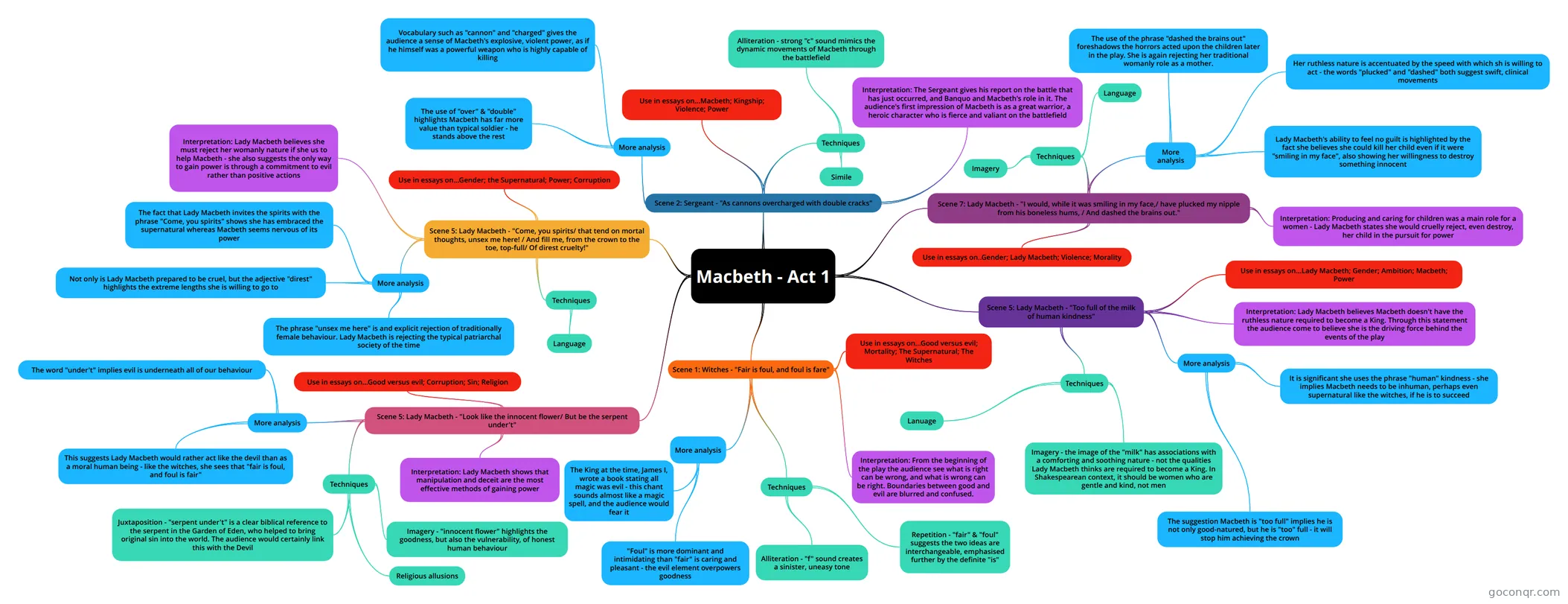
Mind map: Macbeth Act 1 quotes
Map content
Macbeth - Act 1
Scene 1: Witches - "Fair is foul, and foul is fare"
- Interpretation: From the beginning of the play the audience see what is right can be wrong, and what is wrong can be right. Boundaries between good and evil are blurred and confused.
- Techniques
- Alliteration - "f" sound creates a sinister, uneasy tone
- Repetition - "fair" & "foul" suggests the two ideas are interchangeable, emphasised further by the definite "is"
- More analysis
- "Foul" is more dominant and intimidating than "fair" is caring and pleasant - the evil element overpowers goodness
- The King at the time, James I, wrote a book stating all magic was evil - this chant sounds almost like a magic spell, and the audience would fear it
- Use in essays on...Good versus evil; Mortality; The Supernatural; The Witches
Scene 2: Sergeant - "As cannons overcharged with double cracks"
- Interpretation: The Sergeant gives his report on the battle that has just occurred, and Banquo and Macbeth's role in it. The audience's first impression of Macbeth is as a great warrior, a heroic character who is fierce and valiant on the battlefield
- Techniques
- Simile
- Alliteration - strong "c" sound mimics the dynamic movements of Macbeth through the battlefield
- More analysis
- Vocabulary such as "cannon" and "charged" gives the audience a sense of Macbeth's explosive, violent power, as if he himself was a powerful weapon who is highly capable of killing
- The use of "over" & "double" highlights Macbeth has far more value than typical soldier - he stands above the rest
- Use in essays on...Macbeth; Kingship; Violence; Power
Scene 5: Lady Macbeth - "Too full of the milk of human kindness"
- Interpretation: Lady Macbeth believes Macbeth doesn't have the ruthless nature required to become a King. Through this statement the audience come to believe she is the driving force behind the events of the play
- Techniques
- Imagery - the image of the "milk" has associations with a comforting and soothing nature - not the qualities Lady Macbeth thinks are required to become a King. In Shakespearean context, it should be women who are gentle and kind, not men
- Lanuage
- More analysis
- The suggestion Macbeth is "too full" implies he is not only good-natured, but he is "too" full - it will stop him achieving the crown
- It is significant she uses the phrase "human" kindness - she implies Macbeth needs to be inhuman, perhaps even supernatural like the witches, if he is to succeed
- Use in essays on...Lady Macbeth; Gender; Ambition; Macbeth; Power
Scene 5: Lady Macbeth - "Come, you spirits/ that tend on mortal thoughts, unsex me here! / And fill me, from the crown to the toe, top-full/ Of direst cruelty!"
- Interpretation: Lady Macbeth believes she must reject her womanly nature if she us to help Macbeth - she also suggests the only way to gain power is through a commitment to evil rather than positive actions
- Techniques
- Language
- More analysis
- The fact that Lady Macbeth invites the spirits with the phrase "Come, you spirits" shows she has embraced the supernatural whereas Macbeth seems nervous of its power
- The phrase "unsex me here" is and explicit rejection of traditionally female behaviour. Lady Macbeth is rejecting the typical patriarchal society of the time
- Not only is Lady Macbeth prepared to be cruel, but the adjective "direst" highlights the extreme lengths she is willing to go to
- Use in essays on...Gender; the Supernatural; Power; Corruption
Scene 5: Lady Macbeth - "Look like the innocent flower/ But be the serpent under't"
- Interpretation: Lady Macbeth shows that manipulation and deceit are the most effective methods of gaining power
- Techniques
- Imagery - "innocent flower" highlights the goodness, but also the vulnerability, of honest human behaviour
- Juxtaposition - "serpent under't" is a clear biblical reference to the serpent in the Garden of Eden, who helped to bring original sin into the world. The audience would certainly link this with the Devil
- Religious allusions
- More analysis
- This suggests Lady Macbeth would rather act like the devil than as a moral human being - like the witches, she sees that "fair is foul, and foul is fair"
- The word "under't" implies evil is underneath all of our behaviour
- Use in essays on...Good versus evil; Corruption; Sin; Religion
Scene 7: Lady Macbeth - "I would, while it was smiling in my face,/ have plucked my nipple from his boneless hums, / And dashed the brains out."
- Interpretation: Producing and caring for children was a main role for a women - Lady Macbeth states she would cruelly reject, even destroy, her child in the pursuit for power
- Techniques
- Imagery
- Language
- More analysis
- Lady Macbeth's ability to feel no guilt is highlighted by the fact she believes she could kill her child even if it were "smiling in my face", also showing her willingness to destroy something innocent
- Her ruthless nature is accentuated by the speed with which sh is willing to act - the words "plucked" and "dashed" both suggest swift, clinical movements
- The use of the phrase "dashed the brains out" foreshadows the horrors acted upon the children later in the play. She is again rejecting her traditional womanly role as a mother.
- Use in essays on..Gender; Lady Macbeth; Violence; Morality
Information
- Description
- GCSE English (Macbeth) Mind Map on Macbeth - Act 1, created by Liv Dale on 03/01/2019.
- Created by
- Liv Dale
- Views
- 1
- Rating