
Mind map
Cell Adaptation and Injury Mindmap
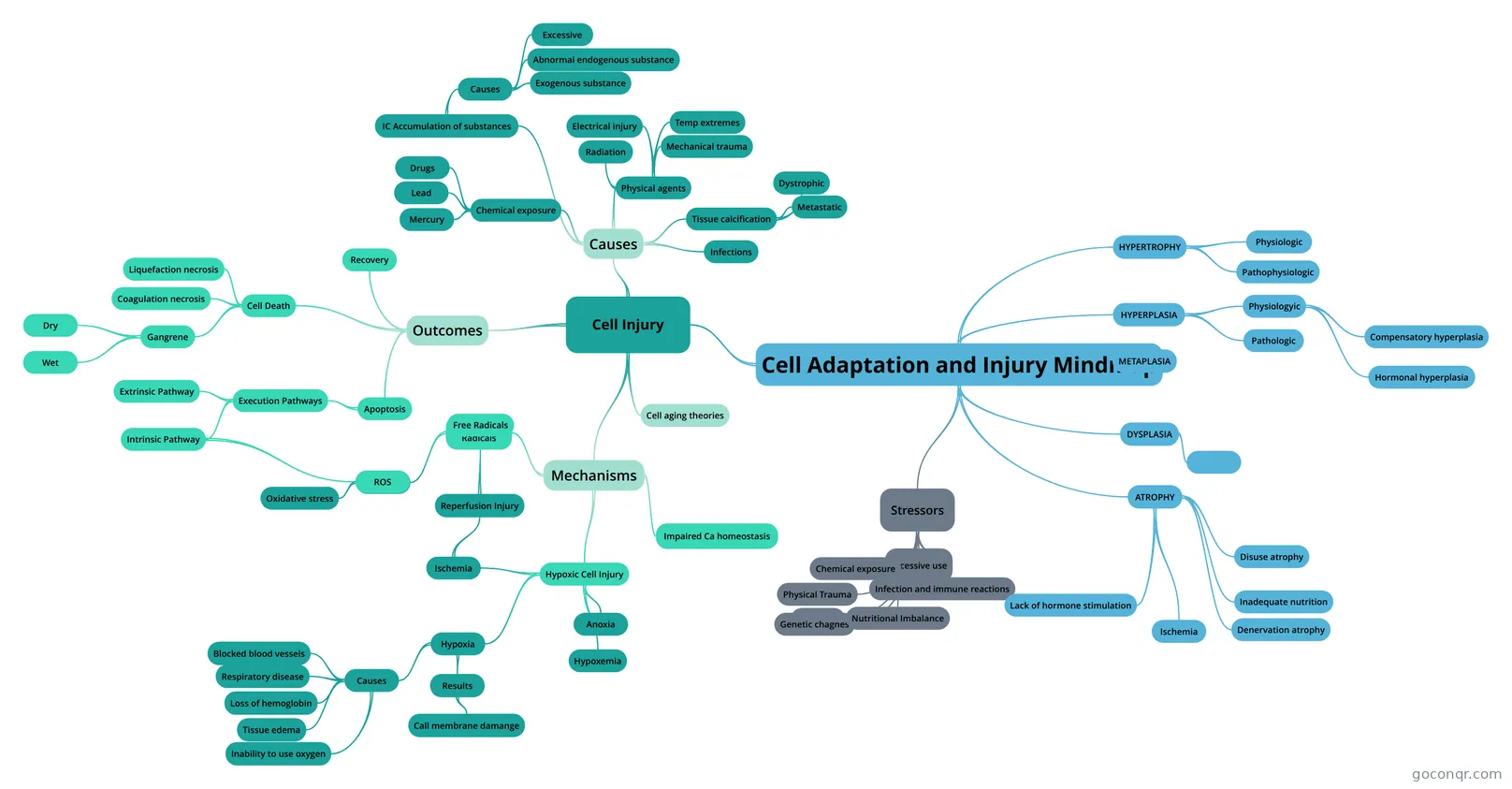
Mind map: cell adaptation and injury
Map content
Cell Adaptation and Injury Mindmap
ATROPHY
- -Decrease in cell size -Number of cells doesn't change
- Disuse atrophy
- -Decreased energy requirement -Cell structure changes: Muscles have less ER, mitochondria, filament
- Denervation atrophy
- -Nerve stimulation to muscle lost -Ex: Stroke patient
- Lack of hormone stimulation
- Inadequate nutrition
- Ischemia
- -Decreased blood flow to organ -Leads to atrophy of cells and organ itself
HYPERTROPHY
- -Increase in cell size --> tissue --> organ -Occurs in cells that can't increase in numbers (Ex: cardiac and striated -Increased protein, myofilaments, mito
- Physiologic
- -Ex: athletes -proportional increase in width and length of muscle cell -Changes stimulated by stretch of muscle fibers -Promoted by biochemical signals (growth hormone and other ligands --> protein production)
- Pathophysiologic
- -Ex: Heart failure -Cells not proportional, malformed, not functioning properly -Change due to different signal molecules
HYPERPLASIA
- -Increase in number of cells in tissue/organ -Occurs in cells that can undergo mitosis -Mechanism: activation of genes controlling cell proliferation -Increased rate of cell division
- Physiologyic
- -Compensatory response, leads to regeneration and healing -
- Compensatory hyperplasia
- Hormonal hyperplasia
- Pathologic
METAPLASIA
- -One cell type is replaced by another that is better able to survive -Mechanism: undifferentiated cells reprogrammed -Ex: In smokers, bronchial epithelial cells replaced by squamous cell
DYSPLASIA
- -Abnormal change in size, shape and organization of cells -Not a true adaptive change -Associated with irritation and inflammation
Stressors
- Excessive use
- Chemical exposure
- Hypoxia
- Physical Trauma
- Infection and immune reactions
- Genetic chagnes
- Nutritional Imbalance
Cell Injury
- -Cell membrane, unable to maintain homeostasis
- Causes
- IC Accumulation of substances
- -Cell tries to dispose if they could -Accumulates in cytoplasm or organelles
- Causes
- Excessive
- Too much normal body substance Ex: fat in liver (alcoholic cirrosis)
- Abnormal endogenous substance
- Abnormal lipids in brain (Tay Sachs disease)
- Exogenous substance
- From environment Ex: Coal dust in miner lungs
- Excessive
- Tissue calcification
- Dystrophic
- Ca salts deposited in injured tissues Ex: Atherosclerosis plaques (contains ca) Ex: Tuberculosis lesions, includes calcified granulomas
- Metastatic
- Hypercalcemia- deposits to normal tissues -Also leads to renal calculi (kidney stones)
- Dystrophic
- Physical agents
- Damage cell structure
- Mechanical trauma
- Direct damage to cells
- Temp extremes
- Damage to cells, organelle and enzymes -Hypothermia and frostbite
- Electrical injury
- damages tissues, disrupts cardiac and nerve impulses
- Radiation
- -Interrupt cell replication, cause mutation, kill cells -Cause cancers like leukemia
- Chemical exposure
- Mechanisms: injure cell membranes, chemicals block enzyme pathways, coagulate proteins, toxic to cells (ex: liver cells)
- Drugs
- Ex: Acetominophen toxic to liver
- Lead
- Interferes with nerve and brain development -May be toxic to children
- Mercury
- Toxic to nerves and kidneys
- Infections
- Biologic agents invade and destroy cells -Viruses change cell DNA -Bacteria produce toxins -Microorganisms cause inflammatory/immune response
- IC Accumulation of substances
- Mechanisms
- -Lead to anaerobic metabolism, cell swelling and direct injury to cells
- Free Radicals
- Molecules with unpaired electrons -Unstable/reactive -Damage cell membranes, DNA, tissues
- ROS
- Reactive oxygen species -Oxygen-containing molecules that include free radicals -Produced by normal process (Ex: metabolic burst accompanying phagocytosis)
- Oxidative stress
- -Occurs when body unable to eliminate ROS -Plays role in aging and development of disease (Ex: cancer)
- Hypoxic Cell Injury
- Lack of oxygen, interrupts oxidative metabolism, generation of ATP -Heart, brain and kidneys cells damaged quickly
- Hypoxia
- Lack of sufficient O2 to body cells, tissues and organs
- Causes
- -Blocked blood vessels -Respiratory disease, blocks inhalation and diffusion of oxygen across alveolar membrane
- Blocked blood vessels
- Respiratory disease
- Loss of hemoglobin
- Carries oxygen to cells Leads to anemia
- Tissue edema
- Can block oxygen from getting to cells
- Inability to use oxygen
- Ex: lactic acidosis -Cells unable to use oxygen even though it's being delivered to them
- Results
- Decreased ATP production, cells swell -Na/K pump fails -Na and water move into clls -Vacuoles form -Cytoplasm swells -Cells degenerate and rupture
- Call membrane damange
- -Cell destruction releases markers >Troponin from damaged heart cells >AST/ALT from damaged liver cells
- Hypoxemia
- Lack of O2 in the blood specifically
- Ischemia
- Lack of enough oxygen to cells or organ -Leads to anaerobic metabolism -Ex: Myocardial eschemia- coronary arteries blocked
- Reperfusion Injury
- -Occurs when O2 restored to ischemic tissue -Ischemia causes increase in ATP consumption, production of xanthine dehydrogenase -O2 --> metabolizes xanthine to produce massive amounts of superoxide hperoxide -Radicals cause membrane damage, ca overload of mitochondria -Mito pores open, ATP escapes, cells die
- Free Radicals
- -Product of xanthine dehydrogenase metabolism from influx of O2 during reperfusion injury
- Anoxia
- Lack of oxygen to cells Ex: brain - cerebral anoxia
- Impaired Ca homeostasis
- -Ca/Mg pump uses ATP to move Ca out of cell (only precise small amount needed in cell) -Cell membrane damage allows Ca to enter cell -Activates enzymes (proteases, lipases, protein kinases) that damage cell membranes, cytoskeleton, proteins, chromatin *-ases are enzymes that breakdown
- Outcomes
- Recovery
- Apoptosis
- -Programmed cell death -Purpose: removed injured cells -Cell fragments engulfed by phagocytes
- Execution Pathways
- carried out by proteolytic enzymes called caspases
- Extrinsic Pathway
- Activated by FAS ligand
- Intrinsic Pathway
- Activated by signals like ROS
- ROS
- Activates intrinsic pathway, which signals apoptosis
- Cell Death
- -Cell death to organ or tissue -Loss of cell membrane activity and enzyme breakdown of cell parts
- Liquefaction necrosis
- Coagulation necrosis
- Gangrene
- Large area of necrosis
- Dry
- Area shrinks, wrinkles -Turns black
- Wet
- Swollen, bacteria
- Cell aging theories
- -Molecular: Mutation or changes in gene expression -Cellular: senescence involving free radical injury, telomere shortening (happens with every cell division), apoptosis -Decline in integrative functions of organ systems *Senescence- decline of functioning with age
Information
- Description
- Mind map of Patho lecture 1- Adaptation and cell injury
- Created by
- Sasha Guimary
- Views
- 734
- Tags
- Rating