
Mind map
EVOLUTION
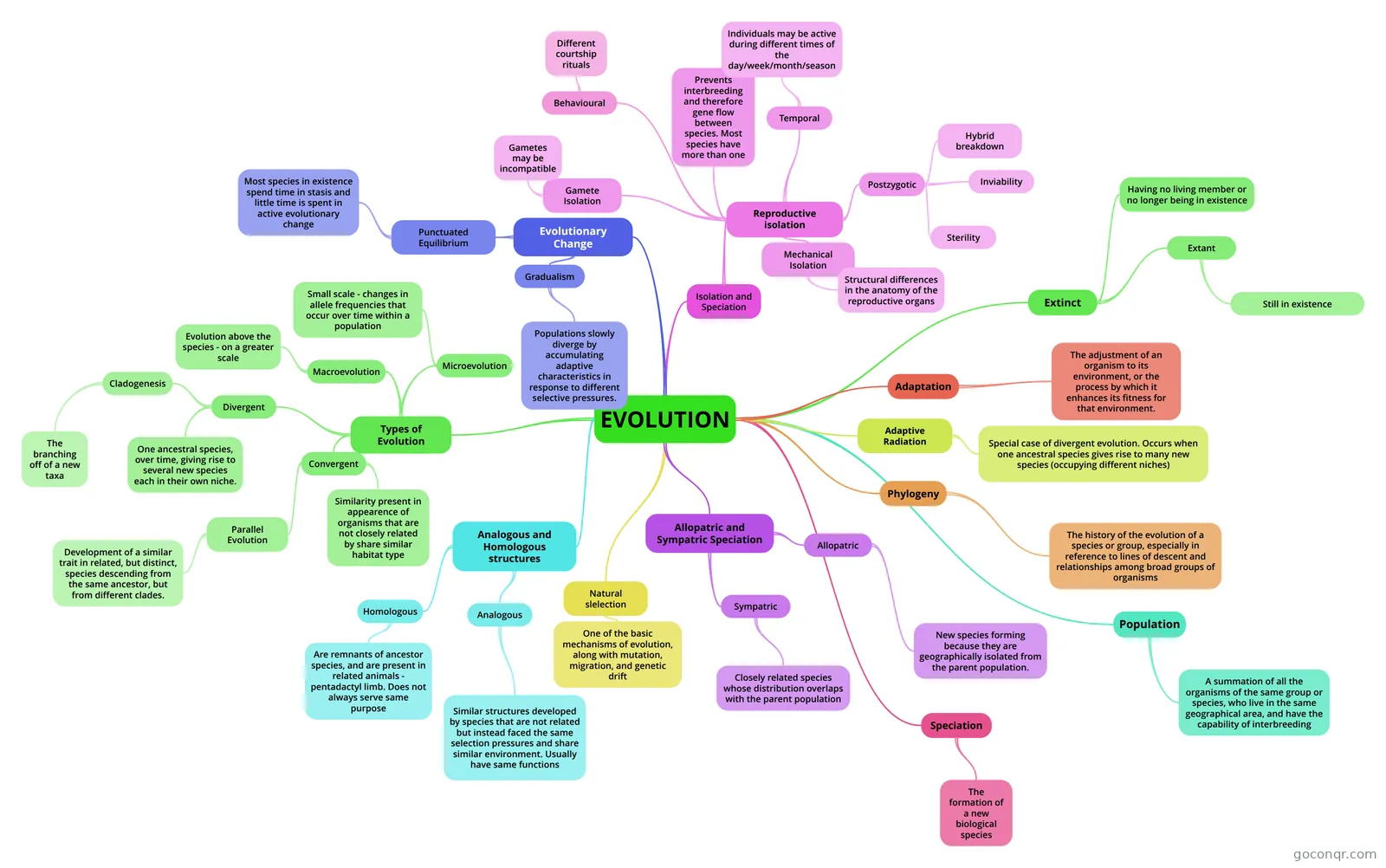
Mind map: evolution
Map content
EVOLUTION
Adaptation
- The adjustment of an organism to its environment, or the process by which it enhances its fitness for that environment.
Adaptive Radiation
- Special case of divergent evolution. Occurs when one ancestral species gives rise to many new species (occupying different niches)
Allopatric and Sympatric Speciation
- Allopatric
- New species forming because they are geographically isolated from the parent population.
- Sympatric
- Closely related species whose distribution overlaps with the parent population
- Allopatric
Analogous and Homologous structures
- Analogous
- Similar structures developed by species that are not related but instead faced the same selection pressures and share similar environment. Usually have same functions
- Homologous
- Are remnants of ancestor species, and are present in related animals - pentadactyl limb. Does not always serve same purpose
- Analogous
Types of Evolution
- Convergent
- Similarity present in appearence of organisms that are not closely related by share similar habitat type
- Parallel Evolution
- Development of a similar trait in related, but distinct, species descending from the same ancestor, but from different clades.
- Divergent
- One ancestral species, over time, giving rise to several new species each in their own niche.
- Cladogenesis
- The branching off of a new taxa
- Macroevolution
- Evolution above the species - on a greater scale
- Microevolution
- Small scale - changes in allele frequencies that occur over time within a population
- Convergent
Natural slelection
- One of the basic mechanisms of evolution, along with mutation, migration, and genetic drift
Evolutionary Change
- Gradualism
- Populations slowly diverge by accumulating adaptive characteristics in response to different selective pressures.
- Punctuated Equilibrium
- Most species in existence spend time in stasis and little time is spent in active evolutionary change
- Gradualism
Isolation and Speciation
- Reproductive isolation
- Prevents interbreeding and therefore gene flow between species. Most species have more than one
- Temporal
- Individuals may be active during different times of the day/week/month/season
- Gamete Isolation
- Gametes may be incompatible
- Behavioural
- Different courtship rituals
- Mechanical Isolation
- Structural differences in the anatomy of the reproductive organs
- Postzygotic
- Sterility
- Inviability
- Hybrid breakdown
- Reproductive isolation
Phylogeny
- The history of the evolution of a species or group, especially in reference to lines of descent and relationships among broad groups of organisms
Population
- A summation of all the organisms of the same group or species, who live in the same geographical area, and have the capability of interbreeding
Speciation
- The formation of a new biological species
Extinct
- Extant
- Still in existence
- Having no living member or no longer being in existence
- Extant
Information
- Description
- Key terms in the Evolution topic
- Created by
- Crystal D'Souza
- Views
- 166
- Tags
- Rating