
Mind map
B6 d-h
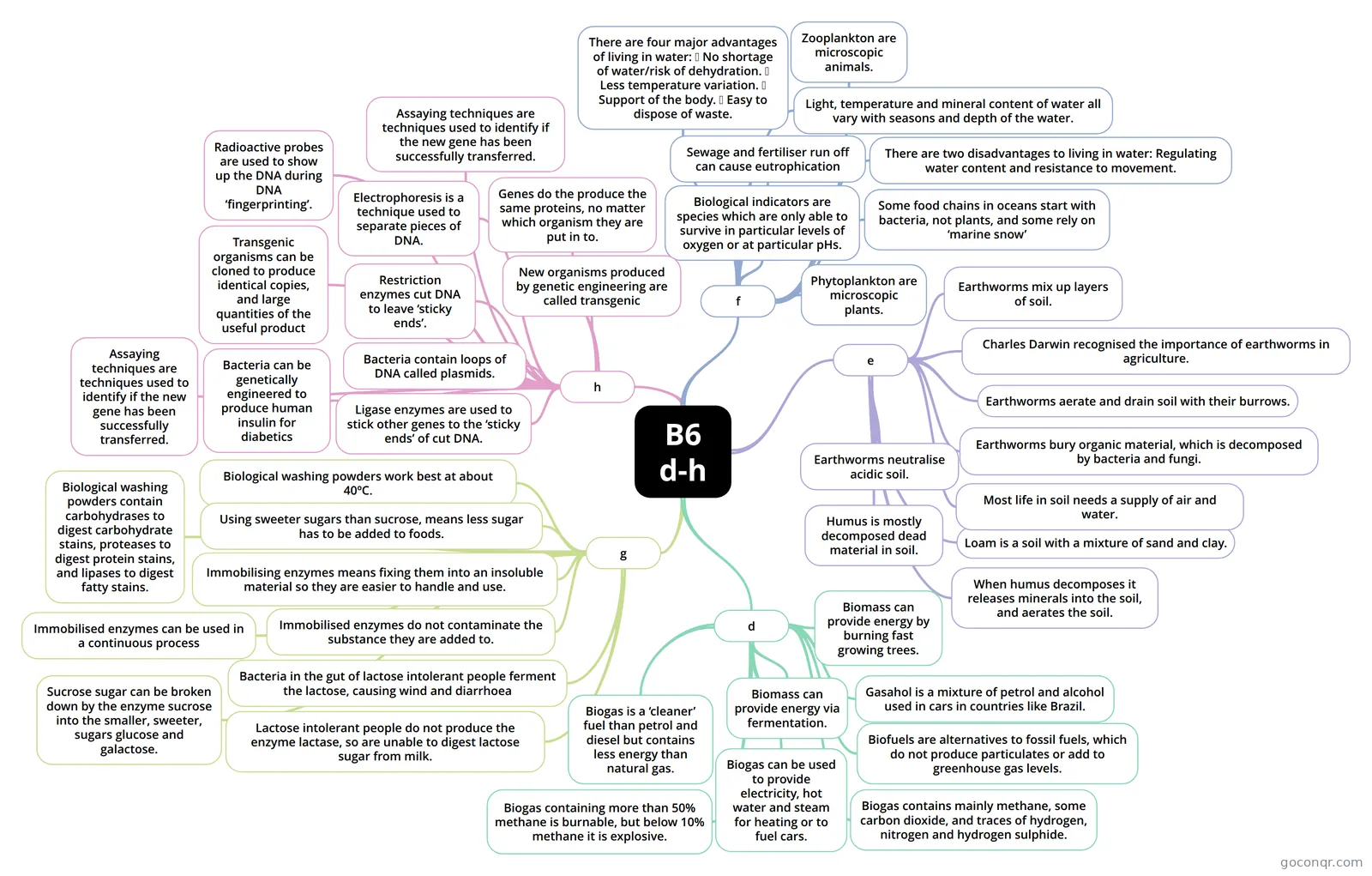
Mind map: Biology d-h: biomass, soil and water
Map content
B6 d-h
d
- Biomass can provide energy by burning fast growing trees.
- Biomass can provide energy via fermentation.
- Biofuels are alternatives to fossil fuels, which do not produce particulates or add to greenhouse gas levels.
- Biogas contains mainly methane, some carbon dioxide, and traces of hydrogen, nitrogen and hydrogen sulphide.
- Biogas containing more than 50% methane is burnable, but below 10% methane it is explosive.
- Biogas is a ‘cleaner’ fuel than petrol and diesel but contains less energy than natural gas.
- Biogas can be used to provide electricity, hot water and steam for heating or to fuel cars.
- Gasahol is a mixture of petrol and alcohol used in cars in countries like Brazil.
e
- Loam is a soil with a mixture of sand and clay.
- Humus is mostly decomposed dead material in soil.
- When humus decomposes it releases minerals into the soil, and aerates the soil.
- Most life in soil needs a supply of air and water.
- Earthworms bury organic material, which is decomposed by bacteria and fungi.
- Earthworms aerate and drain soil with their burrows.
- Earthworms mix up layers of soil.
- Earthworms neutralise acidic soil.
- Charles Darwin recognised the importance of earthworms in agriculture.
f
- There are four major advantages of living in water: No shortage of water/risk of dehydration. Less temperature variation. Support of the body. Easy to dispose of waste.
- There are two disadvantages to living in water: Regulating water content and resistance to movement.
- Light, temperature and mineral content of water all vary with seasons and depth of the water.
- Some food chains in oceans start with bacteria, not plants, and some rely on ‘marine snow’
- Phytoplankton are microscopic plants.
- Zooplankton are microscopic animals.
- Sewage and fertiliser run off can cause eutrophication
- Biological indicators are species which are only able to survive in particular levels of oxygen or at particular pHs.
g
- Biological washing powders contain carbohydrases to digest carbohydrate stains, proteases to digest protein stains, and lipases to digest fatty stains.
- Biological washing powders work best at about 40ºC.
- Sucrose sugar can be broken down by the enzyme sucrose into the smaller, sweeter, sugars glucose and galactose.
- Using sweeter sugars than sucrose, means less sugar has to be added to foods.
- Immobilising enzymes means fixing them into an insoluble material so they are easier to handle and use.
- Immobilised enzymes do not contaminate the substance they are added to.
- Immobilised enzymes can be used in a continuous process
- Lactose intolerant people do not produce the enzyme lactase, so are unable to digest lactose sugar from milk.
- Bacteria in the gut of lactose intolerant people ferment the lactose, causing wind and diarrhoea
h
- New organisms produced by genetic engineering are called transgenic
- Genes do the produce the same proteins, no matter which organism they are put in to.
- Restriction enzymes cut DNA to leave ‘sticky ends’.
- Ligase enzymes are used to stick other genes to the ‘sticky ends’ of cut DNA.
- Bacteria can be genetically engineered to produce human insulin for diabetics
- Transgenic organisms can be cloned to produce identical copies, and large quantities of the useful product
- Bacteria contain loops of DNA called plasmids.
- Assaying techniques are techniques used to identify if the new gene has been successfully transferred.
- Assaying techniques are techniques used to identify if the new gene has been successfully transferred.
- Electrophoresis is a technique used to separate pieces of DNA.
- Radioactive probes are used to show up the DNA during DNA ‘fingerprinting’.
Information
- Description
- Mind Map on B6 d-h, created by singu006 on 09/03/2015.
- Created by
- singu006
- Views
- 26
- Tags
- Rating