
Mind map
Globalisation
Map content
Globalisation
A variety of ways in which countries are becoming more and more closely integrated. "the ability to produce any good or service anywhere in the world, using raw materials, components, capital and technology from anywhere, and place the profits anywhere". (Peter Jay)
- Not a new phenomenon - the Roman empire was a time of considerable integration - yet the pace of global integration has increased in the past 30 years...
- Fall in transport costs. The invention of steam and air transport means goods can be physically moved easily.
- Fall in communication costs. 2.4 billion people now have internet access, and mobile phones are common even in the remotest villages.
- The lowering of trade barriers. The WTO negotiates the reduction of trade barriers like tariffs, in talks, the most recent being Doha.
- The collapse of Communism means that China, Russia and the eastern bloc countries can now experience foreign direct investment and trade with the EU and NAFTA.
- Transnational/multinational companies have offices in more countries, and organise trade on a global scale.
- Characterised by...
- An increase in trade as a % of world GDP.
- Increased movement of capital between countries.
- International division and specialisation of labour. The design of iPhones takes place in Silicon Valley, and the manufacturing of the parts occurs in China.
- The importance of TNCs and foreign direct investment.
- Not a new phenomenon - the Roman empire was a time of considerable integration - yet the pace of global integration has increased in the past 30 years...
Benefits
- Free trade enables the 'law of comparative advantage' (living standards and world output will improve when countries specialise in the goods they can produce for a lower opportunity cost). Consumers now have a wider choice of goods at lower cost and producers benefit from offshoring and economies of scale.
Disadvantages
- Promotes exploitation of workers and, children, farmers and the environment. Health and safety laws are often laxer in developing countries.
- The external costs of trade in relation to environmental degradation result in global warming, due to increased CO2 emissions from factories and airplanes.
- Increased inequality. As wealth creation is dependent on the availability of information, countries with less internet access are at a disadvantage to rich ones.
- An increasing number of internet cafes and cheap mobile phones means the availability of information is expanding. There are also charity efforts to install internet and iPads into the developing world.
- The neo-liberal deregulation of financial markets has increase global instability. The 1990s Asian banking crisis and the 2008 Great Recession/credit crunch are an example of this.
- Deglobalisation can be a knee jerk response to Globalisation proper. This includes protectionist policies and tariffs on external goods. This leads to diversion of trade and a decline in specialisation. The subsidies given to the US car industry, the Russian government's tariffs on non-Russian cars and the EU duties on Vietnamese shoes are examples of this.
International Trade
- Globalisation has led to an increase in world trade as a percentage of world GDP. Since 1970 it has risen by at least 6% per annum. The entry of China and the eastern bloc has accelerated this.
- The law of comparative advantage states that even if a country has an absolute advantage making a good, they will still benefit from specialisation in goods where they have a comparative advantage (goods where the opportunity cost is lowest).
- Ghana can produce 20,000 palm oils and 10,000 televisions and England can produce 8,000 palm oils and 8,000 televisions. Ghana clearly has an absolute advantage in both industries. The opportunity costs for Ghana would be 1/2 a television and 2 palm oils. Ghana clearly has a comparative advantage in palm oils as the opportunity cost is lower.
- Free trade may not be fair trade. Rich countries use their monopsony power to lower prices
- Based on the assumption of constant costs of production, zero transport costs and no barriers to trade.
Types of protection/trade barriers.
- Tariffs, when taxes are placed on foreign goods.
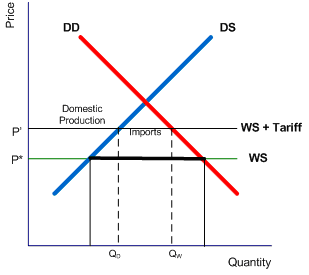
- Tariffs result in higher prices on foreign goods, reduced consumer surplus, increased domestic producer surplus, lower imports, tax revenue for the government and new welfare loss.
- Quotas, when an upper limit of how much of a good can be imported. The government does not receieve any revenue.
- Subsidies, when the government contribute grants to lower domestic producers' costs.
- Administrative regulations, labelling, health and safety and environmental standards. These increase the costs of foreign producers.
- For...
- Protecting infant industries. In developing countries some industries may be unable to compete as they haven't had time to become competitive or establish an economy of scale.
- Protecting geriatric industries, industries which need time to restructure production. This often occurs in industries losing their competitive advantage.
- Protect employment in the domestic economy.
- Prevent dumping, goods exported below the average cost of production. It is predatory pricing and illegal under WTO rules. It also distorts comparative advantage.
- Correct balance of payments by reducing ratio of imports/exports.
- Restrict imports from countries with low safety standards, which gain a comparative advantage from lower safety costs.
- For political reasons. Russia and Iran currently have sanctions on their goods, and in the 1990s South Africa was boycotted.
- To raise tax revenue.
- In retaliation to another country's tariffs.
- Tariffs, when taxes are placed on foreign goods.
WTO
- The aim of the WTO is to 'liberalise trade'. It provides a forum for governments to negotiate trade agreements. They also settle disputes between countries, and set up trade rules.
- Principles...
- Most favored nation; countries cannot discriminate between their trading partners, eg. tariffs must apply to all countries.
- National treatment; imported and locally made products must be treated the same once they enter the market place.
- It has been less successful negotiating barriers to trade in services, and countering non-tariff barriers like quotas and administrative
- Industrialised countries tariffs averaged just 4% in the 1990s.
Trading blocs' intergovernmental associations which manage and promote trade in specific areas.
- Trading blocs
- Free trade areas; trade barriers removed between member countries, but can be imposed on outside ones. (NAFTA)
- Customs union; Free trade and a common external tariff on non-member goods. (CARICOM)
- Common markets; The same as a customs union, except that factors of production like labour can move freely (Mercosur)
- Monetary Union; a customs union with a single currency. (European Union)
- Trade creation; the removal of trade barriers results in increased specialisation and trade according to the law of competitive advantage.
- Trade diversion occurs because member countries buy goods from member countries. This means lower cost countries may be passed by for high cost countries, resulting in an inefficient allocation of resources.
- Trading blocs
Images and files in the map
Information
- Description
- A Level Economics Mind Map on Globalisation, created by martha_muir on 11/03/2015.
- Created by
- martha_muir
- Views
- 0
- Rating