
Mind map
Group 1 Elements Overview
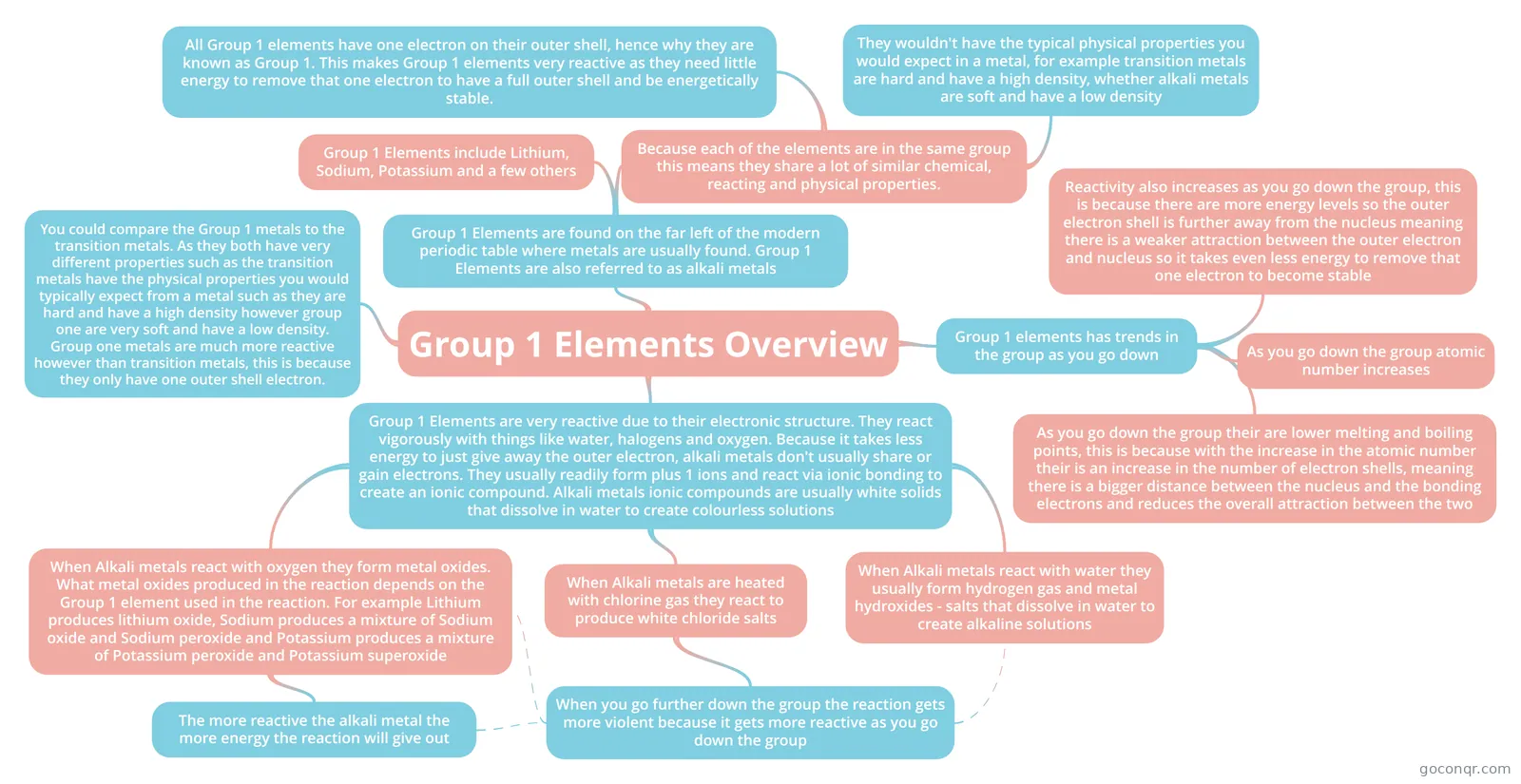
Mind map: Group 1 elements overview
Map content
Group 1 Elements Overview
Group 1 Elements are found on the far left of the modern periodic table where metals are usually found. Group 1 Elements are also referred to as alkali metals
- Group 1 Elements include Lithium, Sodium, Potassium and a few others
- Because each of the elements are in the same group this means they share a lot of similar chemical, reacting and physical properties.
- They wouldn't have the typical physical properties you would expect in a metal, for example transition metals are hard and have a high density, whether alkali metals are soft and have a low density
- All Group 1 elements have one electron on their outer shell, hence why they are known as Group 1. This makes Group 1 elements very reactive as they need little energy to remove that one electron to have a full outer shell and be energetically stable.
Group 1 Elements are very reactive due to their electronic structure. They react vigorously with things like water, halogens and oxygen. Because it takes less energy to just give away the outer electron, alkali metals don't usually share or gain electrons. They usually readily form plus 1 ions and react via ionic bonding to create an ionic compound. Alkali metals ionic compounds are usually white solids that dissolve in water to create colourless solutions
- When Alkali metals react with water they usually form hydrogen gas and metal hydroxides - salts that dissolve in water to create alkaline solutions
- When Alkali metals are heated with chlorine gas they react to produce white chloride salts
- When you go further down the group the reaction gets more violent because it gets more reactive as you go down the group
- When Alkali metals react with oxygen they form metal oxides. What metal oxides produced in the reaction depends on the Group 1 element used in the reaction. For example Lithium produces lithium oxide, Sodium produces a mixture of Sodium oxide and Sodium peroxide and Potassium produces a mixture of Potassium peroxide and Potassium superoxide
- The more reactive the alkali metal the more energy the reaction will give out
Group 1 elements has trends in the group as you go down
- As you go down the group atomic number increases
- Reactivity also increases as you go down the group, this is because there are more energy levels so the outer electron shell is further away from the nucleus meaning there is a weaker attraction between the outer electron and nucleus so it takes even less energy to remove that one electron to become stable
- As you go down the group their are lower melting and boiling points, this is because with the increase in the atomic number their is an increase in the number of electron shells, meaning there is a bigger distance between the nucleus and the bonding electrons and reduces the overall attraction between the two
You could compare the Group 1 metals to the transition metals. As they both have very different properties such as the transition metals have the physical properties you would typically expect from a metal such as they are hard and have a high density however group one are very soft and have a low density. Group one metals are much more reactive however than transition metals, this is because they only have one outer shell electron.
Information
- Description
- GCSE Chemistry Mind Map on Group 1 Elements Overview, created by Rachel Sprague on 03/05/2020.
- Created by
- Rachel Sprague
- Views
- 1
- Rating