
Mind map
8.4 Transport of oxygen in the blood
Map content
8.4 Transport of oxygen in the blood
Role of haemoglobin
- Oxygen bind to haemoglobin to form oxyhaemoglobin
- In respiring tissue O2 dissociates from oxyhaemoglobin
- O2 then diffuses out of the erythrocytes to respiring cells
- Haemoglobin can readily associate with O2 when there's are high conc of O2 and readily dissociate when there's a low conc.
- O2 then diffuses out of the erythrocytes to respiring cells
- In respiring tissue O2 dissociates from oxyhaemoglobin
- Haemoglobin is comprised of 4 sub-units ( 2 alpha glucose, 2 beta glucose)
- Each sub-unit is comprised of 1 polypeptide chain and 1 haem group with an iron ion at the centre
- Each iron ion can reversably bind to O2
- The haem group has an affinity for O2
- Therefore O2 + haemoglobin = oxyhaemoglobin is a reversable reaction
- Each iron ion can reversably bind to O2
- Each sub-unit is comprised of 1 polypeptide chain and 1 haem group with an iron ion at the centre
- Oxygen bind to haemoglobin to form oxyhaemoglobin
Loading O2
- Partial pressure = amount of pressure exerted by a gas relative to the total pressure exerted by all the gases in the mixture.
- Measured in KPa and written as P(x)
- How O2 is loaded
- Haemoglobin doesn't absorb evenly
- At low conc's the sub-units are tightly packed making it difficult for the first O2 to bind.
- After the first O2 has bound there is a conformational change of the haemoglobin - making it easier for the 2nd and 3rd O2's to bind
- Then its difficult for the 4th O2 to associate as the haemoglobin molecule is 'full'
- After the first O2 has bound there is a conformational change of the haemoglobin - making it easier for the 2nd and 3rd O2's to bind
- At low conc's the sub-units are tightly packed making it difficult for the first O2 to bind.
- Haemoglobin doesn't absorb evenly
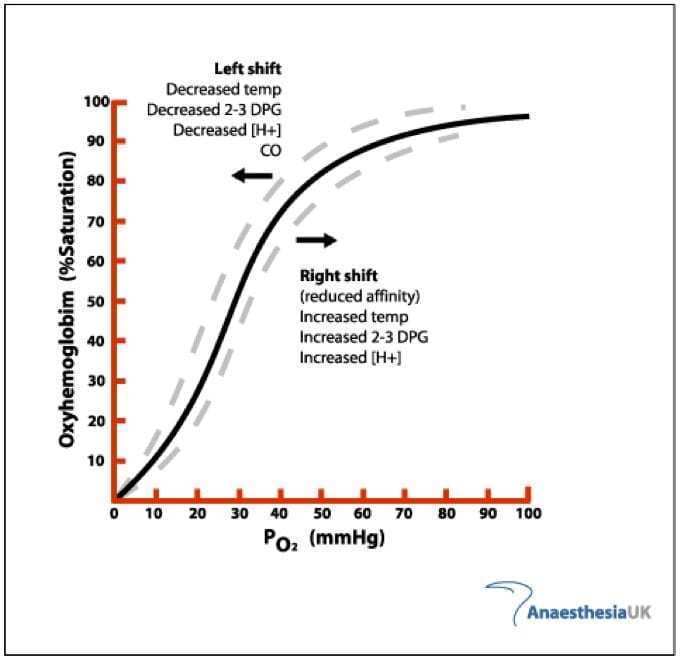
- Oxygen dissociation curve (Sigmoid curve)
- Tissues(low Kpa)
- P(O2) = 2-4 Kpa
- A small decrease in P(O2) leads to a large decrease in % saturation
- Haemoglobin has a low affinity for O2
- A small decrease in P(O2) leads to a large decrease in % saturation
- P(O2) = 2-4 Kpa
- Lungs (high KPa)
- P(O2) = 10-12 KPa
- A large decrease in P(O2) leads to a small decrease in % saturation
- Haemoglobin has a high affinity for O2
- A large decrease in P(O2) leads to a small decrease in % saturation
- P(O2) = 10-12 KPa
- Tissues(low Kpa)
- Remember to read the graph from right to left
- Partial pressure = amount of pressure exerted by a gas relative to the total pressure exerted by all the gases in the mixture.
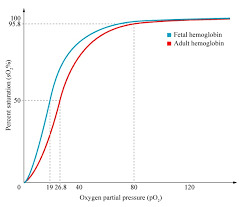
Foetal haemoglobin
- Blood arrives at the placenta, low P(O2) (2-4 Kpa)
- Haemoglobin has a low affinity for O2
- At this point foetal haemoglobin has a higher affinity for O2
- The adult haemoglobin dissociates with O2 releasing it to the placenta tissue when it will readily associate with foetal haemoglobin
- At this point foetal haemoglobin has a higher affinity for O2
- Haemoglobin has a low affinity for O2
- Blood arrives at the placenta, low P(O2) (2-4 Kpa)
Images and files in the map
Information
- Description
- Biology Mind Map on 8.4 Transport of oxygen in the blood, created by Joe Hitchings on 23/05/2020.
- Created by
- Joe Hitchings
- Views
- 19
- Rating