
Mind map
River Processes and Pressures
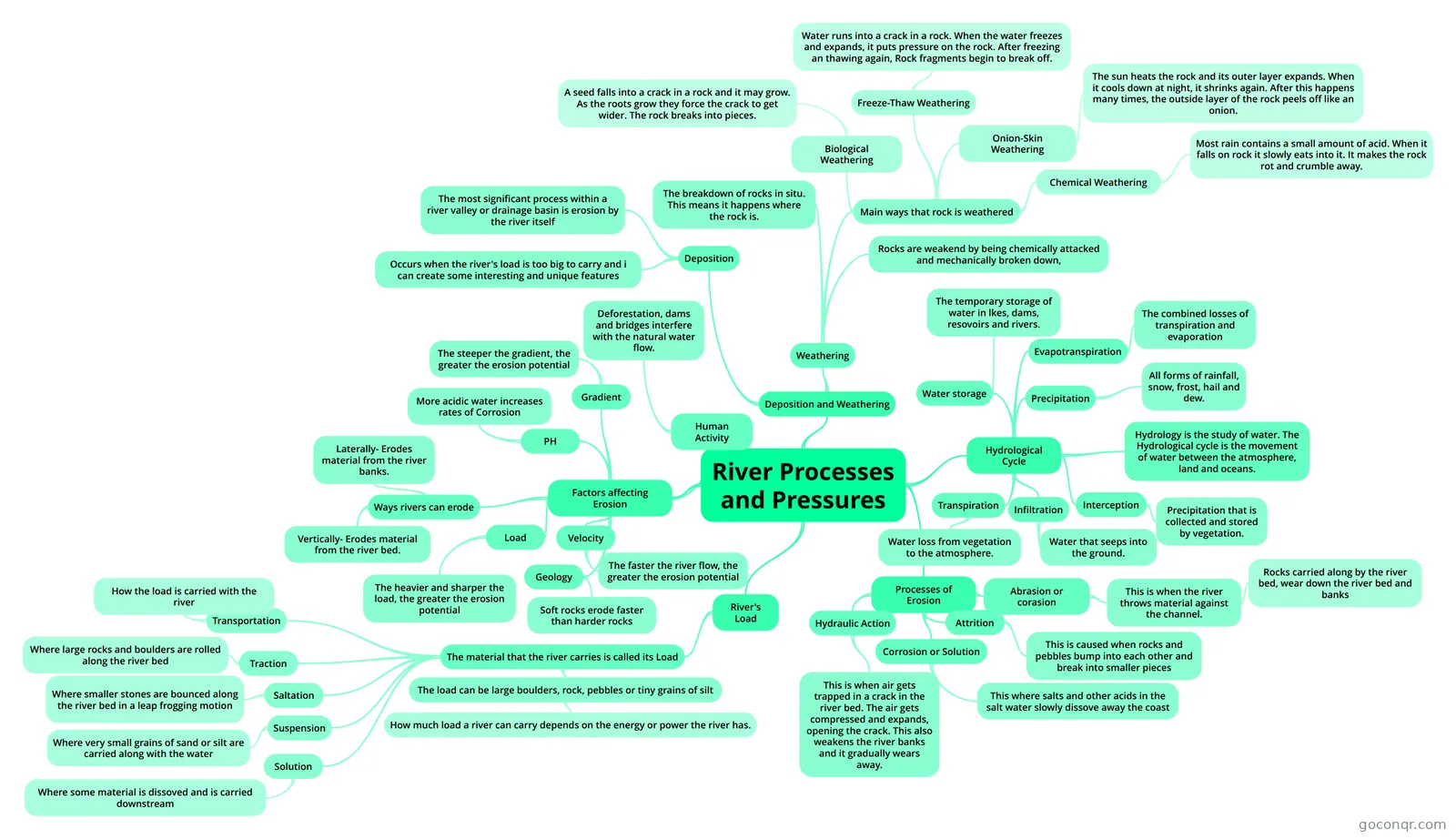
Mind map: River processes and pressures
Map content
River Processes and Pressures
Hydrological Cycle
- Hydrology is the study of water. The Hydrological cycle is the movement of water between the atmosphere, land and oceans.
- Precipitation
- All forms of rainfall, snow, frost, hail and dew.
- Interception
- Precipitation that is collected and stored by vegetation.
- Infiltration
- Water that seeps into the ground.
- Transpiration
- Water loss from vegetation to the atmosphere.
- Evapotranspiration
- The combined losses of transpiration and evaporation
- Water storage
- The temporary storage of water in lkes, dams, resovoirs and rivers.
Processes of Erosion
- Abrasion or corasion
- This is when the river throws material against the channel.
- Rocks carried along by the river bed, wear down the river bed and banks
- This is when the river throws material against the channel.
- Attrition
- This is caused when rocks and pebbles bump into each other and break into smaller pieces
- Corrosion or Solution
- This where salts and other acids in the salt water slowly dissove away the coast
- Hydraulic Action
- This is when air gets trapped in a crack in the river bed. The air gets compressed and expands, opening the crack. This also weakens the river banks and it gradually wears away.
- Abrasion or corasion
Factors affecting Erosion
- Ways rivers can erode
- Vertically- Erodes material from the river bed.
- Laterally- Erodes material from the river banks.
- PH
- More acidic water increases rates of Corrosion
- Human Activity
- Deforestation, dams and bridges interfere with the natural water flow.
- Load
- The heavier and sharper the load, the greater the erosion potential
- Velocity
- The faster the river flow, the greater the erosion potential
- Gradient
- The steeper the gradient, the greater the erosion potential
- Geology
- Soft rocks erode faster than harder rocks
- Ways rivers can erode
River's Load
- The material that the river carries is called its Load
- The load can be large boulders, rock, pebbles or tiny grains of silt
- How much load a river can carry depends on the energy or power the river has.
- Transportation
- How the load is carried with the river
- Traction
- Where large rocks and boulders are rolled along the river bed
- Saltation
- Where smaller stones are bounced along the river bed in a leap frogging motion
- Suspension
- Where very small grains of sand or silt are carried along with the water
- Solution
- Where some material is dissoved and is carried downstream
- The load can be large boulders, rock, pebbles or tiny grains of silt
- The material that the river carries is called its Load
Deposition and Weathering
- Deposition
- Occurs when the river's load is too big to carry and i can create some interesting and unique features
- The most significant process within a river valley or drainage basin is erosion by the river itself
- Weathering
- The breakdown of rocks in situ. This means it happens where the rock is.
- Rocks are weakend by being chemically attacked and mechanically broken down,
- Main ways that rock is weathered
- Chemical Weathering
- Most rain contains a small amount of acid. When it falls on rock it slowly eats into it. It makes the rock rot and crumble away.
- Onion-Skin Weathering
- The sun heats the rock and its outer layer expands. When it cools down at night, it shrinks again. After this happens many times, the outside layer of the rock peels off like an onion.
- Biological Weathering
- A seed falls into a crack in a rock and it may grow. As the roots grow they force the crack to get wider. The rock breaks into pieces.
- Freeze-Thaw Weathering
- Water runs into a crack in a rock. When the water freezes and expands, it puts pressure on the rock. After freezing an thawing again, Rock fragments begin to break off.
- Chemical Weathering
- Deposition
Information
- Description
- AS - Level Geography (Physical Geography) Mind Map on River Processes and Pressures, created by Laura Lui on 28/03/2015.
- Created by
- Laura Lui
- Views
- 0
- Rating