
Mind map
Korean War
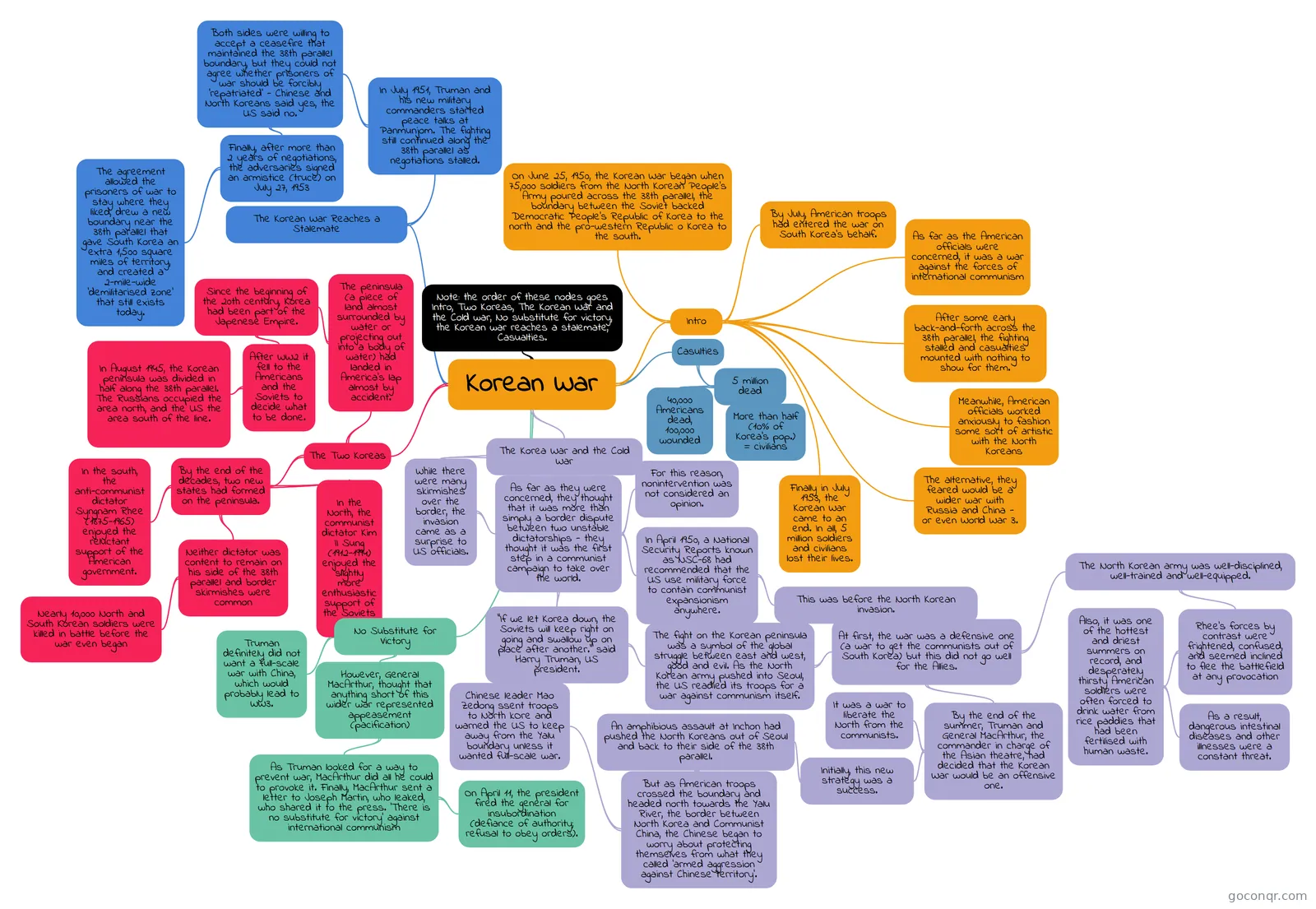
Mind map: Korean War
Map content
Korean War
Intro
- On June 25, 1950, the Korean War began when 75,000 soldiers from the North Korean People's Army poured across the 38th parallel, the boundary between the Soviet backed Democratic People's Republic of Korea to the north and the pro-western Republic o Korea to the south.
- By July, American troops had entered the war on South Korea's behalf.
- As far as the American officials were concerned, it was a war against the forces of international communism
- After some early back-and-forth across the 38th parallel, the fighting stalled and casualties mounted with nothing to show for them.
- Meanwhile, American officials worked anxiously to fashion some sort of artistic with the North Koreans
- The alternative, they feared would be a wider war with Russia and China - or even World War 3.
- Finally in July 1953, the Korean War came to an end. In all, 5 million soldiers and civilians lost their lives.
The Two Koreas
- The peninsula (a piece of land almost surrounded by water or projecting out into a body of water) had landed in America's lap almost by accident.
- Since the beginning of the 20th century, Korea had been part of the Japenese Empire.
- After WW2 it fell to the Americans and the Soviets to decide what to be done.
- In August 1945, the Korean peninsula was divided in half along the 38th parallel. The Russians occupied the area north, and the US the area south of the line.
- After WW2 it fell to the Americans and the Soviets to decide what to be done.
- Since the beginning of the 20th century, Korea had been part of the Japenese Empire.
- By the end of the decades, two new states had formed on the peninsula.
- In the south, the anti-communist dictator Syngnam Rhee (1875-1965) enjoyed the reluctant support of the American government.
- In the North, the communist dictator Kim II Sung (1912-1994) enjoyed the slightly more enthusiastic support of the Soviets
- Neither dictator was content to remain on his side of the 38th parallel and border skirmishes were common
- Nearly 10,000 North and South Korean soldiers were killed in battle before the war even began
- The peninsula (a piece of land almost surrounded by water or projecting out into a body of water) had landed in America's lap almost by accident.
The Korea War and the Cold War
- While there were many skirmishes over the border, the invasion came as a surprise to US officials.
- As far as they were concerned, they thought that it was more than simply a border dispute between two unstable dictatorships - they thought it was the first step in a communist campaign to take over the world.
- For this reason, nonintervention was not considered an opinion.
- In April 1950, a National Security Reports known as NSC-68 had recommended that the US use military force to contain communist expansionism anywhere.
- This was before the North Korean invasion.
- "If we let Korea down, the Soviets will keep right on going and swallow up on place after another." said Harry Truman, US president.
- The fight on the Korean peninsula was a symbol of the global struggle between east and west, good and evil. As the North Korean army pushed into Seoul, the US readied its troops for a war against communism itself.
- At first, the war was a defensive one (a war to get the communists out of South Korea) but this did not go well for the Allies.
- The North Korean army was well-disciplined, well-trained and well-equipped.
- Rhee's forces by contrast were frightened, confused, and seemed inclined to flee the battlefield at any provocation
- Also, it was one of the hottest and driest summers on record, and desperately thirsty American soldiers were often forced to drink water from rice paddies that had been fertilised with human waste.
- As a result, dangerous intestinal diseases and other illnesses were a constant threat.
- Also, it was one of the hottest and driest summers on record, and desperately thirsty American soldiers were often forced to drink water from rice paddies that had been fertilised with human waste.
- Rhee's forces by contrast were frightened, confused, and seemed inclined to flee the battlefield at any provocation
- By the end of the summer, Truman and General MacArthur, the commander in charge of the Asian theatre, had decided that the Korean War would be an offensive one.
- It was a war to liberate the North from the communists.
- Initially, this new strategy was a success.
- An amphibious assault at Inchon had pushed the North Koreans out of Seoul and back to their side of the 38th parallel.
- But as American troops crossed the boundary and headed north towards the Yalu River, the border between North Korea and Communist China, the Chinese began to worry about protecting themselves from what they called 'armed aggression against Chinese territory'.
- Chinese leader Mao Zedong ssent troops to North kOre and warned the US to keep away from the Yalu boundary unless it wanted full-scale war.
- But as American troops crossed the boundary and headed north towards the Yalu River, the border between North Korea and Communist China, the Chinese began to worry about protecting themselves from what they called 'armed aggression against Chinese territory'.
- An amphibious assault at Inchon had pushed the North Koreans out of Seoul and back to their side of the 38th parallel.
- The North Korean army was well-disciplined, well-trained and well-equipped.
- At first, the war was a defensive one (a war to get the communists out of South Korea) but this did not go well for the Allies.
- The fight on the Korean peninsula was a symbol of the global struggle between east and west, good and evil. As the North Korean army pushed into Seoul, the US readied its troops for a war against communism itself.
- As far as they were concerned, they thought that it was more than simply a border dispute between two unstable dictatorships - they thought it was the first step in a communist campaign to take over the world.
- While there were many skirmishes over the border, the invasion came as a surprise to US officials.
Note: the order of these nodes goes Intro, Two Koreas, The Korean War and the Cold war, No substitute for victory, the Korean war reaches a stalemate, Casualties.
No Substitute for Victory
- Truman definitely did not want a full-scale war with China, which would probably lead to WW3.
- However, General MacArthur, thought that anything short of this wider war represented appeasement (pacification)
- As Truman looked for a way to prevent war, MacArthur did all he could to provoke it. Finally, MacArthur sent a letter to Joseph Martin, who leaked, who shared it to the press. 'There is no substitute for victory' against international communism
- On April 11, the president fired the general for insubordination (defiance of authority; refusal to obey orders).
- As Truman looked for a way to prevent war, MacArthur did all he could to provoke it. Finally, MacArthur sent a letter to Joseph Martin, who leaked, who shared it to the press. 'There is no substitute for victory' against international communism
The Korean War Reaches a Stalemate
- In July 1951, Truman and his new military commanders started peace talks at Panmunjom. The fighting still continued along the 38th parallel as negotiations stalled.
- Both sides were willing to accept a ceasefire that maintained the 38th parallel boundary, but they could not agree whether prisoners of war should be forcibly 'repatriated' - Chinese and North Koreans said yes, the US said no.
- Finally, after more than 2 years of negotiations, the adversaries signed an armistice (truce) on July 27, 1953
- The agreement allowed the prisoners of war to stay where they liked, drew a new boundary near the 38th parallel that gave South Korea an extra 1,500 square miles of territory, and created a 2-mile-wide 'demilitarised zone' that still exists today.
- Finally, after more than 2 years of negotiations, the adversaries signed an armistice (truce) on July 27, 1953
- Both sides were willing to accept a ceasefire that maintained the 38th parallel boundary, but they could not agree whether prisoners of war should be forcibly 'repatriated' - Chinese and North Koreans said yes, the US said no.
- In July 1951, Truman and his new military commanders started peace talks at Panmunjom. The fighting still continued along the 38th parallel as negotiations stalled.
Casulties
- 5 million dead
- More than half (1o% of Korea's pop.) = civilians
- 40,000 Americans dead, 100,000 wounded
- 5 million dead
Information
- Description
- Mind Map on Korean War, created by chrisekamm on 09/04/2015.
- Created by
- chrisekamm
- Views
- 3
- Rating