
Mind map
Differences in Achievement in Education
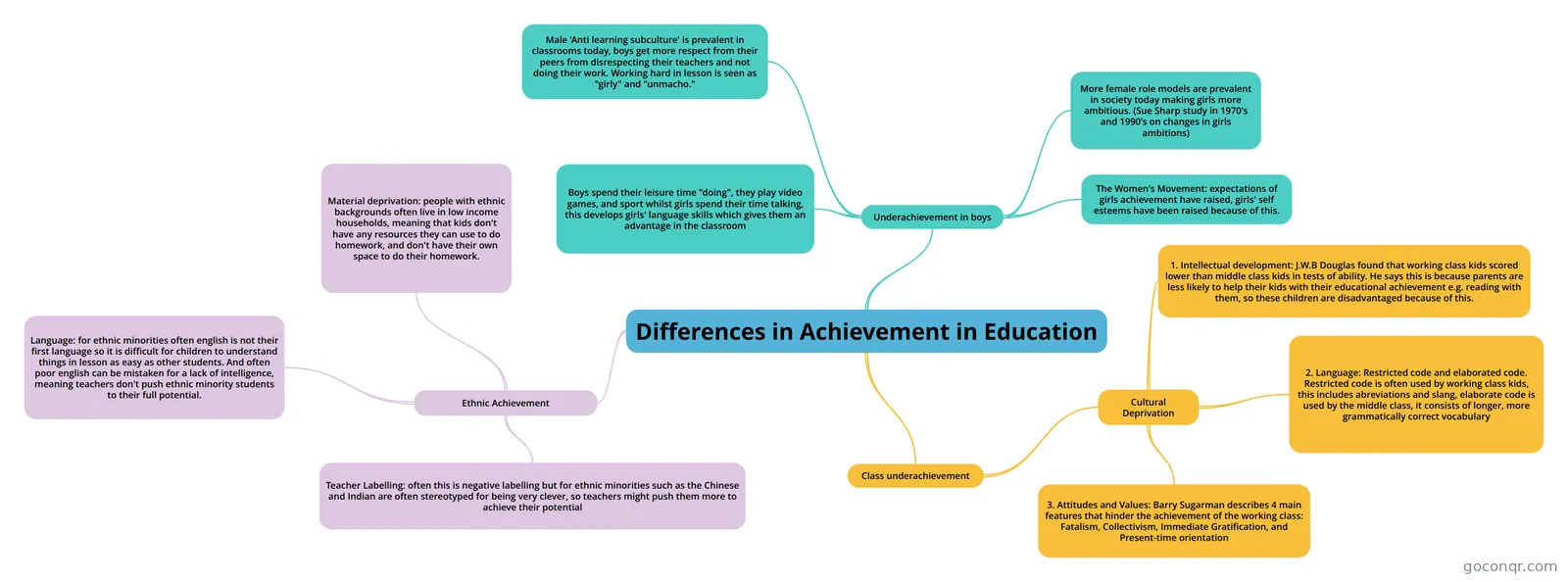
Mind map: differences in achievement in education
Map content
Differences in Achievement in Education
Underachievement in boys
- The Women's Movement: expectations of girls achievement have raised, girls' self esteems have been raised because of this.
- More female role models are prevalent in society today making girls more ambitious. (Sue Sharp study in 1970's and 1990's on changes in girls ambitions)
- Male 'Anti learning subculture' is prevalent in classrooms today, boys get more respect from their peers from disrespecting their teachers and not doing their work. Working hard in lesson is seen as "girly" and "unmacho."
- Boys spend their leisure time "doing", they play video games, and sport whilst girls spend their time talking, this develops girls' language skills which gives them an advantage in the classroom
Class underachievement
- Cultural Deprivation
- 1. Intellectual development: J.W.B Douglas found that working class kids scored lower than middle class kids in tests of ability. He says this is because parents are less likely to help their kids with their educational achievement e.g. reading with them, so these children are disadvantaged because of this.
- 2. Language: Restricted code and elaborated code. Restricted code is often used by working class kids, this includes abreviations and slang, elaborate code is used by the middle class, it consists of longer, more grammatically correct vocabulary
- 3. Attitudes and Values: Barry Sugarman describes 4 main features that hinder the achievement of the working class: Fatalism, Collectivism, Immediate Gratification, and Present-time orientation
- Cultural Deprivation
Ethnic Achievement
- Material deprivation: people with ethnic backgrounds often live in low income households, meaning that kids don't have any resources they can use to do homework, and don't have their own space to do their homework.
- Language: for ethnic minorities often english is not their first language so it is difficult for children to understand things in lesson as easy as other students. And often poor english can be mistaken for a lack of intelligence, meaning teachers don't push ethnic minority students to their full potential.
- Teacher Labelling: often this is negative labelling but for ethnic minorities such as the Chinese and Indian are often stereotyped for being very clever, so teachers might push them more to achieve their potential
Information
- Description
- Mind map of how different factors affect the achievement in: boys, ethnic minorities, and different classes
- Created by
- bethanyrosedean
- Views
- 116
- Tags
- Rating