
Mind map
Knowledge representation
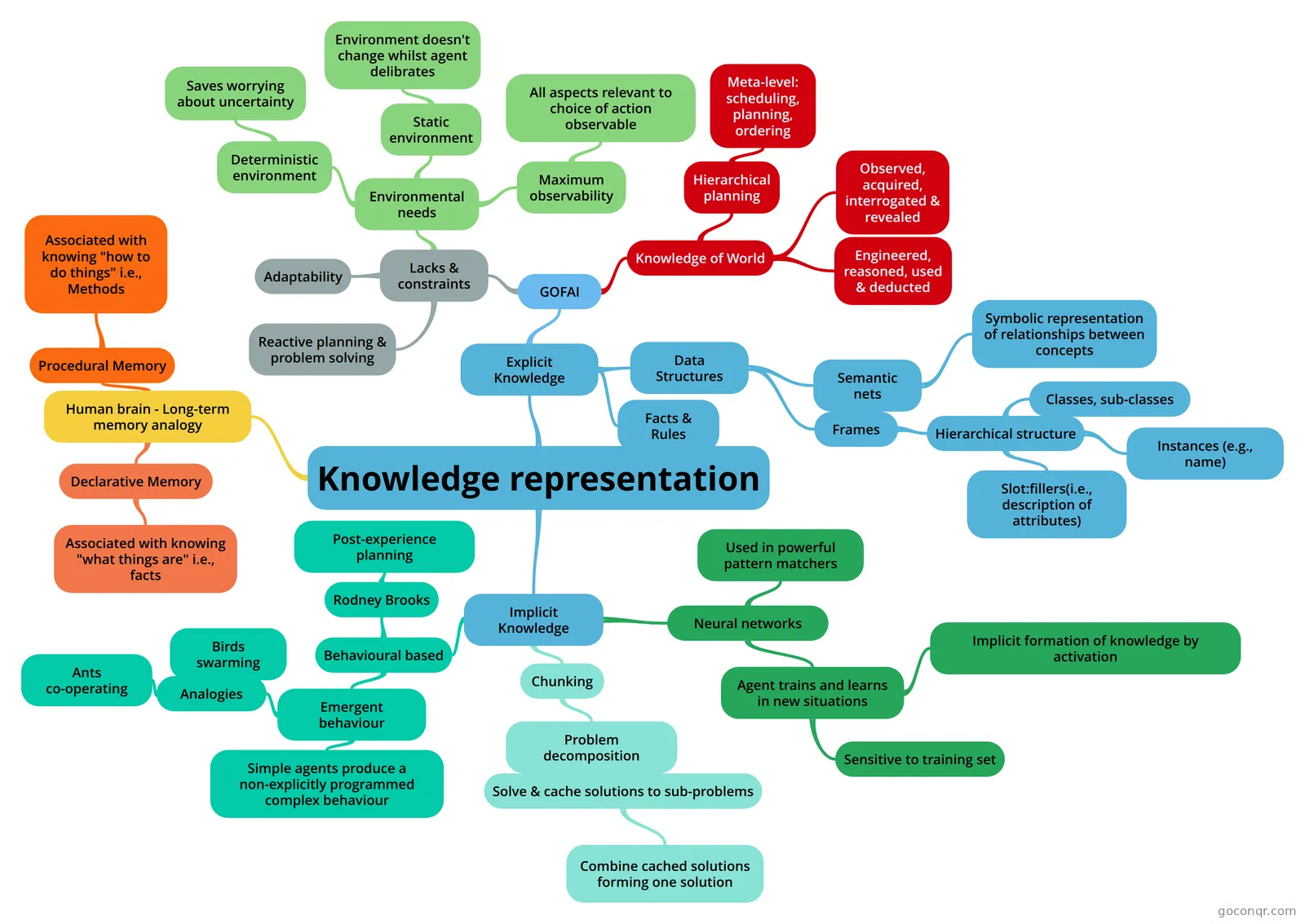
Mind map: Knowledge representation
Map content
Knowledge representation
Human brain - Long-term memory analogy
- Declarative Memory
- Associated with knowing "what things are" i.e., facts
- Procedural Memory
- Associated with knowing "how to do things" i.e., Methods
- Declarative Memory
Implicit Knowledge
- Neural networks
- Used in powerful pattern matchers
- Agent trains and learns in new situations
- Sensitive to training set
- Implicit formation of knowledge by activation
- Behavioural based
- Rodney Brooks
- Post-experience planning
- Emergent behaviour
- Simple agents produce a non-explicitly programmed complex behaviour
- Analogies
- Birds swarming
- Ants co-operating
- Rodney Brooks
- Chunking
- Problem decomposition
- Solve & cache solutions to sub-problems
- Combine cached solutions forming one solution
- Solve & cache solutions to sub-problems
- Problem decomposition
- Neural networks
Explicit Knowledge
- GOFAI
- Knowledge of World
- Observed, acquired, interrogated & revealed
- Engineered, reasoned, used & deducted
- Hierarchical planning
- Meta-level: scheduling, planning, ordering
- Lacks & constraints
- Reactive planning & problem solving
- Environmental needs
- Maximum observability
- All aspects relevant to choice of action observable
- Deterministic environment
- Saves worrying about uncertainty
- Static environment
- Environment doesn't change whilst agent delibrates
- Maximum observability
- Adaptability
- Knowledge of World
- Facts & Rules
- Data Structures
- Semantic nets
- Symbolic representation of relationships between concepts
- Frames
- Hierarchical structure
- Classes, sub-classes
- Instances (e.g., name)
- Slot:fillers(i.e., description of attributes)
- Hierarchical structure
- Semantic nets
- GOFAI