
Mind map
Traveling & the Science Connection
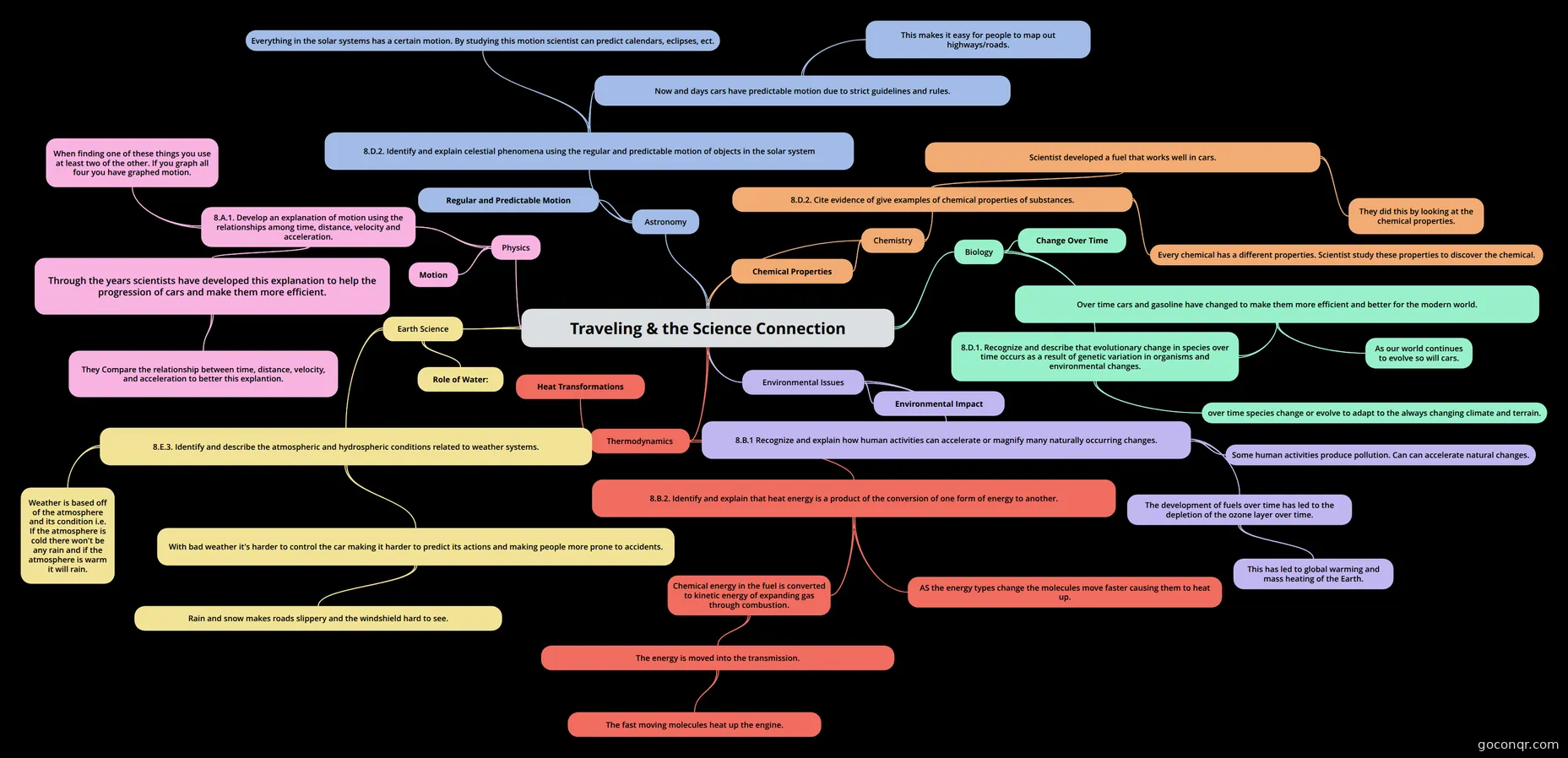
Mind map: Traveling & the science connection
Map content
Traveling & the Science Connection
Thermodynamics
- 8.B.2. Identify and explain that heat energy is a product of the conversion of one form of energy to another.
- Chemical energy in the fuel is converted to kinetic energy of expanding gas through combustion.
- The energy is moved into the transmission.
- The fast moving molecules heat up the engine.
- The energy is moved into the transmission.
- AS the energy types change the molecules move faster causing them to heat up.
- Chemical energy in the fuel is converted to kinetic energy of expanding gas through combustion.
- Heat Transformations
- 8.B.2. Identify and explain that heat energy is a product of the conversion of one form of energy to another.
Earth Science
- 8.E.3. Identify and describe the atmospheric and hydrospheric conditions related to weather systems.
- With bad weather it's harder to control the car making it harder to predict its actions and making people more prone to accidents.
- Rain and snow makes roads slippery and the windshield hard to see.
- Weather is based off of the atmosphere and its condition i.e. If the atmosphere is cold there won't be any rain and if the atmosphere is warm it will rain.
- With bad weather it's harder to control the car making it harder to predict its actions and making people more prone to accidents.
- Role of Water:
- 8.E.3. Identify and describe the atmospheric and hydrospheric conditions related to weather systems.
Astronomy
- 8.D.2. Identify and explain celestial phenomena using the regular and predictable motion of objects in the solar system
- Now and days cars have predictable motion due to strict guidelines and rules.
- This makes it easy for people to map out highways/roads.
- Everything in the solar systems has a certain motion. By studying this motion scientist can predict calendars, eclipses, ect.
- Now and days cars have predictable motion due to strict guidelines and rules.
- Regular and Predictable Motion
- 8.D.2. Identify and explain celestial phenomena using the regular and predictable motion of objects in the solar system
Biology
- 8.D.1. Recognize and describe that evolutionary change in species over time occurs as a result of genetic variation in organisms and environmental changes.
- Over time cars and gasoline have changed to make them more efficient and better for the modern world.
- As our world continues to evolve so will cars.
- over time species change or evolve to adapt to the always changing climate and terrain.
- Over time cars and gasoline have changed to make them more efficient and better for the modern world.
- Change Over Time
- 8.D.1. Recognize and describe that evolutionary change in species over time occurs as a result of genetic variation in organisms and environmental changes.
Chemistry
- 8.D.2. Cite evidence of give examples of chemical properties of substances.
- Scientist developed a fuel that works well in cars.
- They did this by looking at the chemical properties.
- Every chemical has a different properties. Scientist study these properties to discover the chemical.
- Scientist developed a fuel that works well in cars.
- Chemical Properties
- 8.D.2. Cite evidence of give examples of chemical properties of substances.
Physics
- 8.A.1. Develop an explanation of motion using the relationships among time, distance, velocity and acceleration.
- Through the years scientists have developed this explanation to help the progression of cars and make them more efficient.
- They Compare the relationship between time, distance, velocity, and acceleration to better this explantion.
- When finding one of these things you use at least two of the other. If you graph all four you have graphed motion.
- Through the years scientists have developed this explanation to help the progression of cars and make them more efficient.
- Motion
- 8.A.1. Develop an explanation of motion using the relationships among time, distance, velocity and acceleration.
Environmental Issues
- 8.B.1 Recognize and explain how human activities can accelerate or magnify many naturally occurring changes.
- The development of fuels over time has led to the depletion of the ozone layer over time.
- This has led to global warming and mass heating of the Earth.
- Some human activities produce pollution. Can can accelerate natural changes.
- The development of fuels over time has led to the depletion of the ozone layer over time.
- Environmental Impact
- 8.B.1 Recognize and explain how human activities can accelerate or magnify many naturally occurring changes.
Information
- Description
- a concept map on traveling (cars) and its conection to science
- Created by
- hjspurrier
- Views
- 56
- Tags
- Rating