
Mind map
Theories Of Deviance
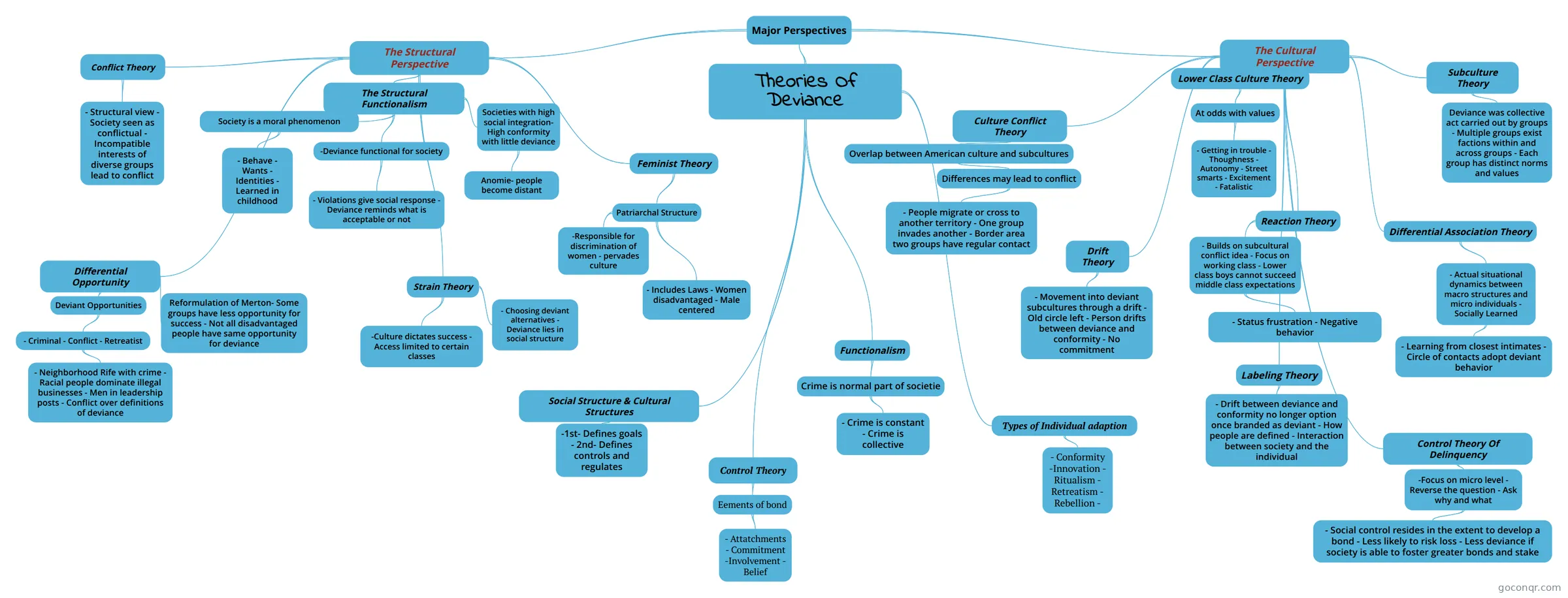
Mind map: Theories of deviance
Map content
Theories Of Deviance
Major Perspectives
- The Structural Perspective
- The Structural Functionalism
- Society is a moral phenomenon
- - Behave - Wants - Identities - Learned in childhood
- Societies with high social integration- High conformity with little deviance
- Anomie- people become distant
- -Deviance functional for society
- - Violations give social response - Deviance reminds what is acceptable or not
- Society is a moral phenomenon
- Strain Theory
- -Culture dictates success - Access limited to certain classes
- - Choosing deviant alternatives - Deviance lies in social structure
- Differential Opportunity
- Reformulation of Merton- Some groups have less opportunity for success - Not all disadvantaged people have same opportunity for deviance
- Deviant Opportunities
- - Criminal - Conflict - Retreatist
- - Neighborhood Rife with crime - Racial people dominate illegal businesses - Men in leadership posts - Conflict over definitions of deviance
- - Criminal - Conflict - Retreatist
- Feminist Theory
- Patriarchal Structure
- -Responsible for discrimination of women - pervades culture
- - Includes Laws - Women disadvantaged - Male centered
- Patriarchal Structure
- Conflict Theory
- - Structural view - Society seen as conflictual - Incompatible interests of diverse groups lead to conflict
- The Structural Functionalism
- The Cultural Perspective
- Control Theory Of Delinquency
- -Focus on micro level - Reverse the question - Ask why and what
- - Social control resides in the extent to develop a bond - Less likely to risk loss - Less deviance if society is able to foster greater bonds and stake
- -Focus on micro level - Reverse the question - Ask why and what
- Subculture Theory
- Deviance was collective act carried out by groups - Multiple groups exist factions within and across groups - Each group has distinct norms and values
- Culture Conflict Theory
- Overlap between American culture and subcultures
- Differences may lead to conflict
- - People migrate or cross to another territory - One group invades another - Border area two groups have regular contact
- Differences may lead to conflict
- Overlap between American culture and subcultures
- Reaction Theory
- - Builds on subcultural conflict idea - Focus on working class - Lower class boys cannot succeed middle class expectations
- - Status frustration - Negative behavior
- - Builds on subcultural conflict idea - Focus on working class - Lower class boys cannot succeed middle class expectations
- Lower Class Culture Theory
- At odds with values
- - Getting in trouble - Thoughness - Autonomy - Street smarts - Excitement - Fatalistic
- At odds with values
- Differential Association Theory
- - Actual situational dynamics between macro structures and micro individuals - Socially Learned
- - Learning from closest intimates - Circle of contacts adopt deviant behavior
- - Actual situational dynamics between macro structures and micro individuals - Socially Learned
- Drift Theory
- - Movement into deviant subcultures through a drift - Old circle left - Person drifts between deviance and conformity - No commitment
- Labeling Theory
- - Drift between deviance and conformity no longer option once branded as deviant - How people are defined - Interaction between society and the individual
- Control Theory Of Delinquency
- The Structural Perspective
Functionalism
- Crime is normal part of societie
- - Crime is constant - Crime is collective
- Crime is normal part of societie
Social Structure & Cultural Structures
- -1st- Defines goals - 2nd- Defines controls and regulates
Types of Individual adaption
- - Conformity -Innovation - Ritualism - Retreatism - Rebellion -
Control Theory
- Eements of bond
- - Attatchments - Commitment -Involvement - Belief
- Eements of bond