
Mind map
SOCIAL CAPITAL
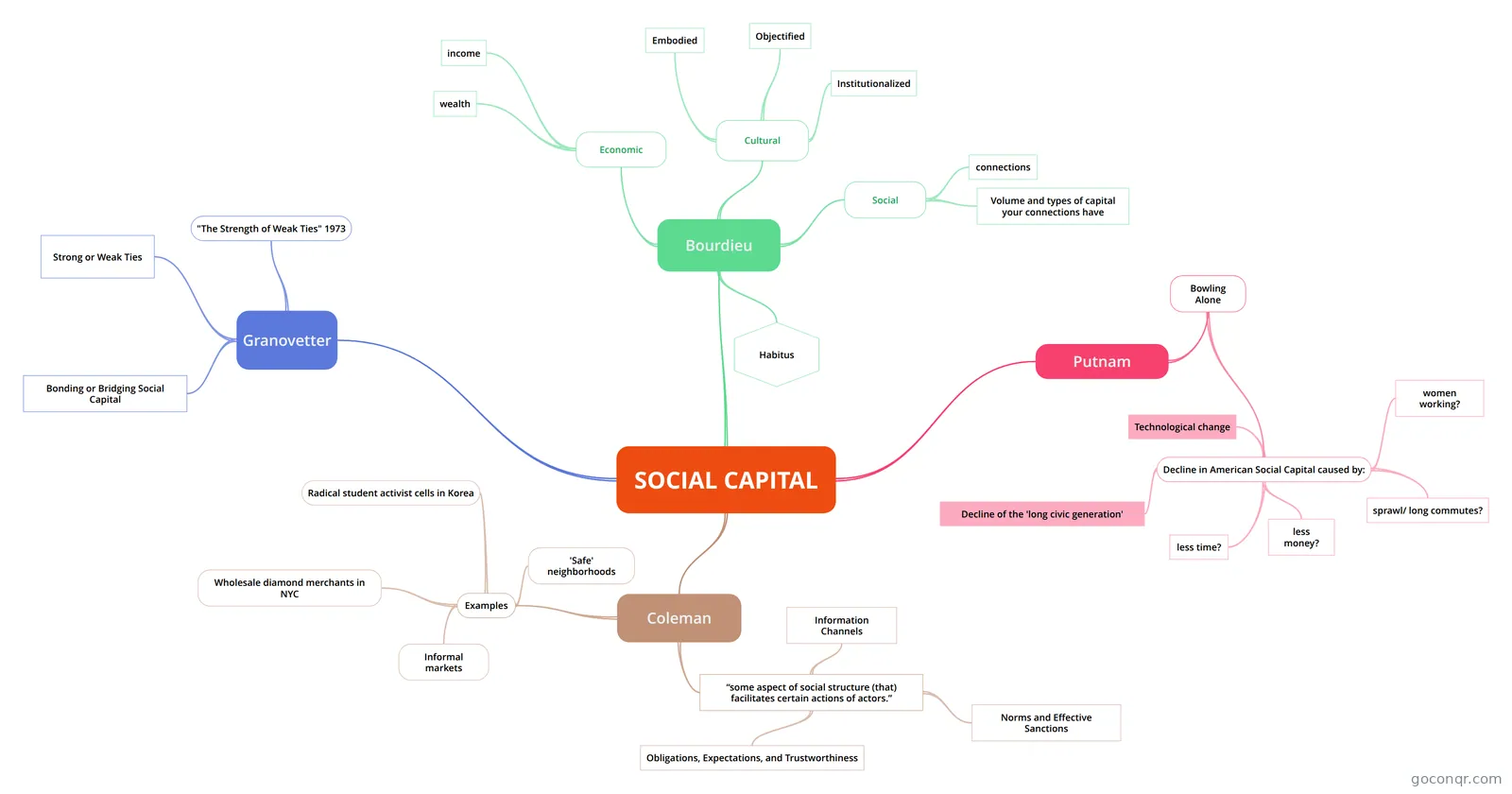
Mind map: social capital
Map content
SOCIAL CAPITAL
Bourdieu
- Economic
- income
- wealth
- Cultural
- Cultural capital/ Education
- Embodied
- Dispositions, attitudes, tastes - learned formally or informally, knowing how to behave appropriate to the situtation
- Objectified
- Actual goods that reflect cultural capital, e.g. lots of books, or fine art painting. Owning them does not mean that you know how to consume them.
- Institutionalized
- Academic credentials, e.g. high school diploma, college degree
- Social
- connections
- Volume and types of capital your connections have
- Habitus
- Habitus (definition from Ritzer 1996: 540) "'mental or cognitive structures' through which people deal with the social world. People are endowed with a series of internalized schemes through which they perceive, understand, appreciate, and evaluate the social world... "
- Economic
Granovetter
- "The Strength of Weak Ties" 1973
- In this article Granovetter showed that who you know can help you get a job but, counterintuitively, links with people who you are not really close to (i.e. weak ties) are most important because they are different from you and have access to different information and networks.
- Strong or Weak Ties
- Bonding or Bridging Social Capital
- Bonding - exclusive bridging - inclusive Bridges connect separate groups who might not have many overlapping members
- "The Strength of Weak Ties" 1973
Coleman
- “some aspect of social structure (that) facilitates certain actions of actors.”
- James Coleman. 1988. 'Social Capital in the Creation of Human Capital' American Journal of Sociology. (94: S95-S120)
- Obligations, Expectations, and Trustworthiness
- Information Channels
- Norms and Effective Sanctions
- Examples
- Wholesale diamond merchants in NYC
- Informal markets
- Radical student activist cells in Korea
- 'Safe' neighborhoods
- “some aspect of social structure (that) facilitates certain actions of actors.”
Putnam
- Bowling Alone
- Bowling Alone: The Collapse and Revival of American Community 2000 Evidence for decline in US social capital, and what he thinks the causes are.
- Decline in American Social Capital caused by:
- less time?
- less money?
- sprawl/ long commutes?
- women working?
- Decline of the 'long civic generation'
- Technological change
- Bowling Alone
Information
- Description
- Overview of concepts in social capital theories, including Bourdieu, Granovetter, Coleman, Putnam
- Created by
- Sarah Egan
- Views
- 263
- Tags
- Rating