
Mind map
Week 8 Lamprey Lecture
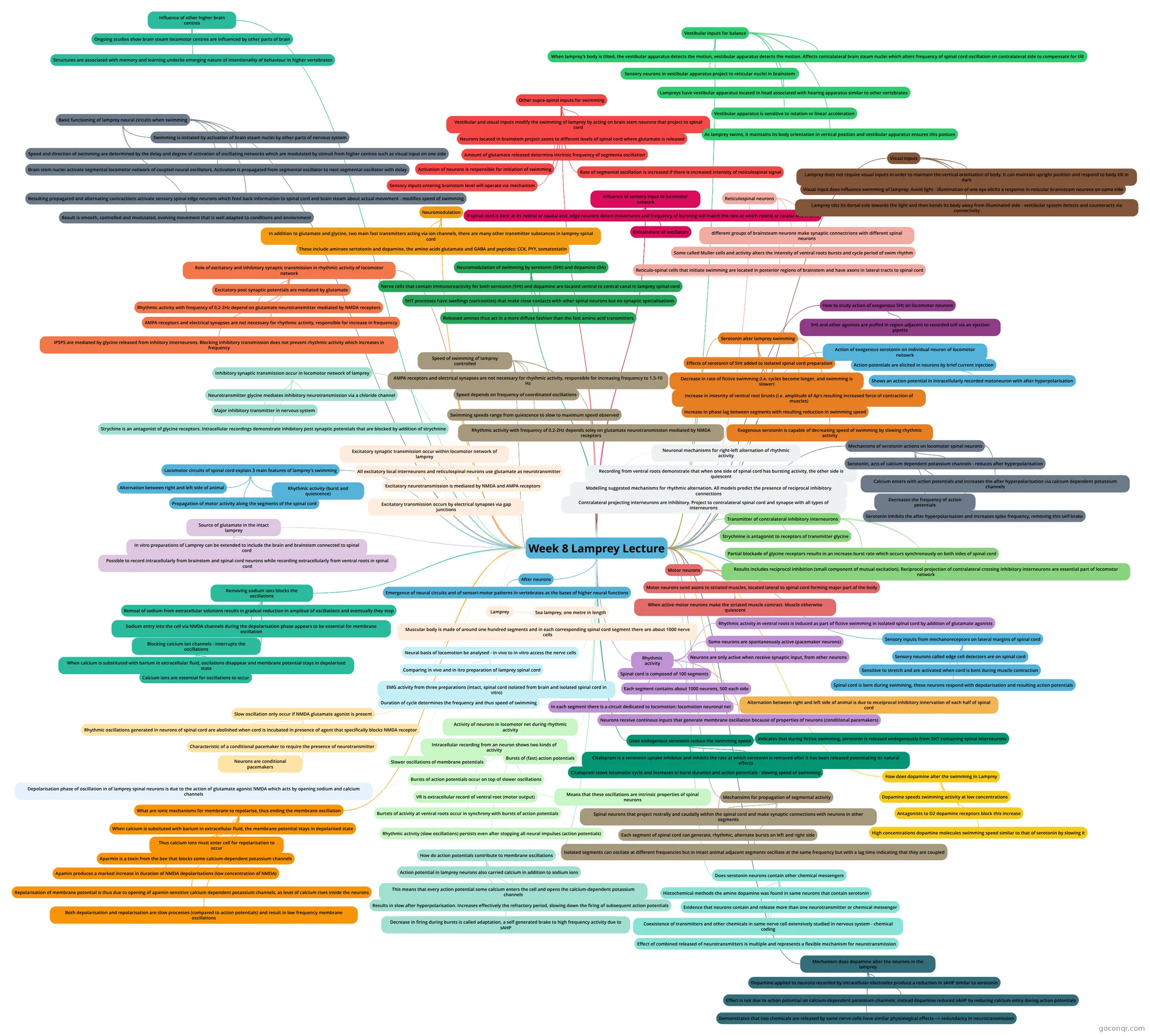
Mind map: Lamprey neural basis of locomotion
Map content
Week 8 Lamprey Lecture
After neurons
- Emergence of neural circuits and of sensori-motor patterns in vertebrates as the bases of higher neural functions
Lamprey
- Sea lamprey, one metre in length
- Muscular body is made of around one hundred segments and in each corresponding spinal cord segment there are about 1000 nerve cells
Neural basis of locomotion be analysed - in vivo to in vitro access the nerve cells
- Comparing in vivo and in itro preparation of lamprey spinal cord
- EMG activity from three preparations (intact, spinal cord isolated from brain and isolated spinal cord in vitro)
- Duration of cycle determines the frequency and thus speed of swimming
Rhythmic activity
- Spinal cord is composed of 100 segments
- Each segment contains about 1000 neurons, 500 each side
- In each segment there is a circuit dedicated to locomotion: locomotion neuronal net
- Rhythmic activity in ventral roots is induced as part of fictive swimming in isolated spinal cord by addition of glutamate agonists
- Some neurons are spontaneously active (pacemaker neurons)
- Neurons are only active when receive synaptic input, from other neurons
- Neurons receive continous inputs that generate membrane oscillation because of properties of neurons (conditional pacemakers)
Motor neurons
- Motor neurons send axons to striated muscles, located lateral to spinal cord forming major part of the body
- When active motor neurons make the striated muscle contract. Muscle otherwise quiescent
Activity of neurons in locomotor net during rhythmic activity
- Intracellular recording from an neuron shows two kinds of activity
- Bursts of (fast) action potentials
- Slower oscillations of membrane potentials
- Bursts of action potentials occur on top of slower oscillations
- VR is extracellular record of ventral root (motor output)
- Burtsts of activity at ventral roots occur in synchrony with bursts of action potentials
- Rhythmic activity (slow oscillations) persists even after stopping all neural impulses (action potentials)
- Means that these oscillations are intrinsic properties of spinal neurons
- Intracellular recording from an neuron shows two kinds of activity
Slow oscillation only occur if NMDA glutamate agonist is present
- Rhythmic oscillations generated in neurons of spinal cord are abolished when cord is incubated in presence of agent that specifically blocks NMDA receptor
- Characteristic of a conditional pacemaker to require the presence of neurotransmitter
- Neurons are conditional pacemakers
Removing sodium ions blocks the oscillations
- Remoal of sodium from extracellular solutions results in gradual reduction in amplitue of oscillations and eventually they stop
- Sodium entry into the cell via NMDA channels during the depolarisation phase appears to be essential for membrane oscillation
- Blocking calcium ion channels - interrupts the oscillations
- When calcium is substituted with barium in extracellular fluid, oscilations disappear and membrane potential stays in depolarised state
- Calcium ions are essential for oscillations to occur
Depolarisation phase of oscillation in of lamprey spinal neurons is due to the action of glutamate agonist NMDA which acts by opening sodium and calcium channels
What are ionic mechanisms for membrane to repolarise, thus ending the membrane oscillation
- When calcium is subsituted with barium in extracellular fluid, the membrane potential stays in depolarised state
- Thus calcium ions must enter cell for repolarisation to occur
- Aparmin is a toxin from the bee that blocks some calcium-dependent potassium channels
- Apamin produces a marked increase in duration of NMDA depolarisations (low concentration of NMDA)
- Repolarisation of membrane potential is thus due to opening of apamin-sensitive calcium dependent potassium channels, as level of calcium rises inside the neurons
- Both depolarisation and repolarisation are slow processes (compared to action potentials) and result in low frequency membrane oscillations
How do action potentials contribute to membrane oscillations
- Action potential in lamprey neurons also carried calcium in addition to sodium ions
- This means that every action potential some calcium enters the cell and opens the calcium-dependent potassium channels
- Results in slow after hyperpolarisation. Increases effectively the refractory period, slowing down the firing of subsequent action potentials
- Decrease in firing during bursts is called adaptation, a self generated brake to high frequency activity due to sAHP
Neuronal mechanisms for right-left alternation of rhythmic activity
- Recording from ventral roots demonstrate that when one side of spinal cord has bursting activity, the other side is quiescent
- Modelling suggested mechanisms for rhythmic alternation. All models predict the presence of reciprocal inhibitory connections
- Contralateral projecting interneurons are inhibitory. Project to contralateral spinal cord and synapse with all types of interneurons
Transmitter of contralateral inhibitory interneurons
- Strychnine is antagonist to receptors of transmitter glycine
- Partial blockade of glycine receptors results in an increase burst rate which occurs synchronously on both sides of spinal cord
- Results includes reciprocol inhibition (small component of mutual excitation). Reciprocol projection of contralateral crossing inhibitory interneurons are essential part of locomotor network
Alternation between right and left side of animal is due to receiprocol inhibitory innervation of each half of spinal cord
Mechansims for propagation of segmental activity
- Each segment of spinal cord can generate, rhythmic, alternate bursts on left and right side
- Isolated segments can oscilate at different frequencies but in intact animal adjacent segments oscillate at the same frequency but with a lag time indicating that they are coupled
- Spinal neurons that project rostrally and caudally within the spinal cord and make synaptic connections with neurons in other segments
Locomotor circuits of spinal cord explain 3 main features of lamprey's swimming
- Rhythmic activity (burst and quiescence)
- Alternation between right and left side of animal
- Propagation of motor activity along the segments of the spinal cord
Source of glutamate in the intact lamprey
- In vitro preparations of Lamprey can be extended to include the brain and brainstem connected to spinal cord
- Possible to record intracellularly from brainstem and spinal cord neurons while recording extracellularly from ventral roots in spinal cord
Excitatory synaptic transmission occur within locomotor network of lamprey
- All excitatory local interneurons and reticulospinal neurons use glutamate as neurotransmitter
- Excitatory neurotransmission is mediated by NMDA and AMPA receptors
- Excitatory transmission occurs by electrical synapses via gap junctions
Inhibitory synaptic transmission occur in locomotor network of lamprey
- Neurotransmitter glycine mediates inhibitory neurotransmission via a chloride channel
- Major inhibitory transmitter in nervous system
- Strychine is an antagonist of glycine receptors. Intracellular recordings demonstrate inhibitory post synaptic potentials that are blocked by addition of strychnine
Role of excitatory and inhibitory synaptic transmission in rhythmic activity of locomotor network
- Excitatory post synaptic potentials are mediated by glutamate
- Rhythmic activity with frequency of 0.2-2Hz depend on glutamate neurotransmitter mediated by NMDA receptors
- AMPA receptors and electrical synapses are not necessary for rhythmic activity, responsible for increase in frequenccy
- IPSPS are mediated by glycine released from inhiitory interneurons. Blocking inhibitory transmission does not prevent rhythmic activity which increases in frequency
Speed of swimming of lamprey controlled
- Speed depends on frequency of coordinated oscillations
- Swimming speeds range from quiescence to slow to maximum speed observed
- Rhythmic activity with frequency of 0.2-2Hz depends soley on glutamate neurotransmission mediated by NMDA receptors
- AMPA receptors and electrical synapses are not necessary for rhythmic activity, responsible for increasing frequency to 1.5-10 Hz
Neuromodulation
- In addition to glutamate and glycine, two main fast transmitters acting via ion channels, there are many other transmitter substances in lamprey spinal cord
- These include aminoes sertotonin and dopamine, the amino acids glutamate and GABA and peptides: CCK, PYY, somatostatin
Neuromodulation of swimming by serotonin (5Ht) and dopamine (DA)
- Nerve cells that contain immunoreactivity for both serotonin (5Ht) and dopamine are located ventral to central canal in lamprey spinal cord
- 5HT processes have swellings (varicosities) that make close contacts with other spinal neurons but no synaptic specialisations
- Released amines thus act in a more diffuse fashion than the fast amino acid transmitters
Serotonin alter lamprey swimming
- Effects of serotonin of 5Ht added to isolated spinal cord preparation
- Decrease in rate of fictive swimming (i.e. cycles become longer, and swimming is slower)
- Increase in intesnity of ventral root brusts (i.e. amplitude of Ap's resulting increased force of contraction of muscles)
- Increase in phase lag between segments with resulting reduction in swimming speed
- Exogenous serotonin is capable of decreasing speed of swimming by slowing rhythmic activity
How to study action of exogenous 5Ht on locomotor neurons
- 5Ht and other agonists are puffed in region adjacent to recorded cell via an ejection pipette
Action of exogenous serotonin on individual neuron of locomotor netowrk
- Action potentials are elicited in neurons by brief current injection
- Shows an action potential in intracellularly recorded motoneuron with after hyperpolarisation
Mechanisms of serotonin actions on locomotor spinal neurons
- Serotonin, acts of calcium dependent potassium channels - reduces after hyperpolarisation
- Calcium enters with action potentials and increases the after hyperpolarisation via calcium dependent potassium channels
- Decreases the frequency of action potentials
- Serotonin inhibits the after hyperpolarisation and increases spike frequency, removing this self-brake
Does endogenous serotonin reduce the swimming speed
- Citalopram is a serotonin uptake inhibitor and inhibits the rate at which serotonin is removed after it has been released potentiating its natural effects
- Citalopram slows locomotor cycle and increases in burst duration and action potentials - slowing speed of swimming
- Indicates that during fictive swimming, serotonin is released endogenously from 5HT containing spinal interneurons
Does serotonin neurons contain other chemical messengers
- Histochemical methods the amine dopamine was found in same neurons that contain serotonin
- Evidence that neurons contain and release more than one neurotransmitter or chemical messenger
- Coexistence of transmitters and other chemicals in same nerve cell extensively studied in nervous system - chemical coding
- Effect of combined released of neurotransmitters is multiple and represents a flexible mechanism for neurotransmission
How does dopamine alter the swimming in Lamprey
- Dopamine speeds swimming activity at low concentrations
- Antagonists to D2 dopamine receptors block this increase
- High concentrations dopamine molecules swimming speed similar to that of serotonin by slowing it
Mechanism does dopamine alter the neurons in the lamprey
- Dopamine applied to neurons recorded by intracellular electrodes produce a reduction in sAHP similar to serotonin
- Effect is not due to action potential on calcium-dependent potassium channels; instead dopamine reduced sAHP by reducing calcium entry during action potentials
- Demonstrates that two chemicals are released by same nerve cells have similar physiological effects --> redundancy in neurotransmission
Sensory inputs from mechanoreceptors on lateral margins of spinal cord
- Sensory neurons called edge cell detectors are on spinal cord
- Sensitive to stretch and are activated when cord is bent during muscle contraction
- Spinal cord is bent during swimming, these neurons respond with depolarisation and resulting action potentials
Influence of sensory input to locomotor network
- If spinal cord is bent at its rostral or caudal end, edge neurons detect movements and frequency of bursting will match the rate at which rostral or caudal end is bent
- Entrainment of oscillators
Other supra-spinal inputs for swimming
- Vestibular and visual inputs modify the swimming of lamprey by acting on brain stem neurons that project to spinal cord
- Neurons located in brainstem project axons to different levels of spinal cord where glutamate is released
- Amount of glutamate released determins intrinsic frequency of segmenta oscillation
- Activation of neurons is responsible for initiation of swimming
- Rate of segmental oscillation is increased if there is increased intensity of reticulospinal signal
- Sensory inputs entering brainstem level will operate via mechanism
Reticulospinal neurons
- different groups of brainsteam neurons make synaptic connectrions with different spinal neurons
- Some called Muller cells and activity alters the intensity of ventral roots bursts and cycle period of swim rhythm
- Reticulo-spinal cells that initiate swimming are located in posterior regions of brainstem and have axons in lateral tracts to spinal cord
Vestibular inputs for balance
- Lampreys have vestibular apparatus located in head associated with hearing apparatus similar to other vertebrates
- Vestibular apparatus is sensitive to rotation or linear acceleration
- As lamprey swims, it maintains its body orientation in vertical position and vestibular apparatus ensures this posture
- Sensory neurons in vestibular apparatus project to reticular nuclei in brainstem
- When lamprey's body is tilted, the vestibular apparatus detects the motion, vestibular apparatus detects the motion. Affects contralateral brain steam nuclei which alters frequency of spinal cord oscillation on contralateral side to compensate for tilt
Visual inputs
- Lamprey does not require visual inputs in order to maintain the vertical orientation of body. It can maintain upright position and respond to body tilt in dark
- Visual input does influence swimming of lamprey. Avoid light - illumination of one eye elicits a response in reticular brainsteam neurons on same side
- Lamprey tilts its dorsal side towards the light and then bends its body away from illuminated side - vestibular system detects and counteracts via connectivity
Basic functioning of lamprey neural circuits when swimming
- Swimming is initiated by activation of brain steam nuclei by other parts of nervous system
- Brain stem nuclei activate segmental locomotor network of coupled neural oscillators. Activation is propagated from segmental oscillator to next segmental oscillator with delay
- Speed and direction of swimming are determined by the delay and degree of activation of oscillating networks which are modulated by stimuli from higher centres such as visual input on one side
- Resulting propagated and alternating contractions activate sensory spinal edge neurons which feed back information to spinal cord and brain steam about actual movement - modifies speed of swimming
- Result is smooth, controlled and modulated, evolving movement that is well adapted to conditions and enviornment
Influence of other higher brain centres
- Ongoing studies show brain steam locomotor centres are influenced by other parts of brain
- Structures are associated with memory and learning underlie emerging nature of intentionality of behaviour in higher vertebrates
Information
- Description
- Universität Neuroscience Mind Map on Week 8 Lamprey Lecture, created by Paras Chrysostomou on 08/05/2016.
- Created by
- Paras Chrysostomou
- Views
- 1
- Rating