Mind map
Learning Styles
Map content
Learning Styles
Each human is different by nature.
- Learning Styles are defined as the understanding that people learn in different ways and each individual's learning style makes reference to the preferential way in which the person retais and comprehends the information.
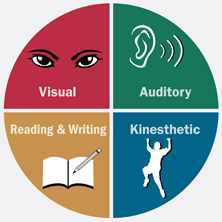
- Neil Fleming's VARK model with Collen Mills collaboration, is established by the preference of students to process information from the sensory point of view.
- Visual: Learning through the use of images, maps and graphic organizers.
- V
- Auditory: through listening and speaking. Learners use repetition and mnemonic devices
- A
- Read and write: Thrpugh words. They translate abstract concepts to words and essays
- R
- Kinesthetic: learning through tactil representations of information.
- K
- Visual: Learning through the use of images, maps and graphic organizers.
- Four-dimensional scheme developed by Honey and Mumford during the mid 1980's.
- Active: Open-mind people who like to have new experiences.They always have to do some activities. They are creative and like to generate ideas, participate and take risks. They learn better in teams, actively involved, trying something different, etc.
- Reflexive: They analyze information before taking any decision. Consider all possible alternatives and learn by watching others. They are patient, careful and prudent, and learn when they research carefully and doing analysis.
- Theoretical: Logical, objective and critical people. Adapt and integrate observations into logical theories and like to analyze. They are deep in their thinking and speaking and also rational and objective in things.
- Pragmatic They practice the ideas they have and look the positive side of things. They like to experiment, be direct, effective and realistic; use of techniques to discover the positive aspect of some advantages to put them inpractice.
- Rita and Kenneth Dunn model describe this learning styles as the way in which 24 different elements, which come from 5 basic stimuli that affect the ability of a person in order to absorb and retain information, values, facts, and concepts.
- Environmental: These elements help create a greater or lesser degree of comfort that fosters in students a willingness to learn.
- Emotional: These elements have a very close relationship with the age of individuals.
- Sociological: Refers to the number of you are involved, it depends on the personality of the person (preference to work individually, or in a small or large group).
- Physiological: Refers to VARK´s model, but also includes three more categories. (Perceptual elements, Intake, Time and Mobility)
- Psychological: This dimension refers to the general strategies students use when attacking learning problems.
- Neil Fleming's VARK model with Collen Mills collaboration, is established by the preference of students to process information from the sensory point of view.
- Learning Styles are defined as the understanding that people learn in different ways and each individual's learning style makes reference to the preferential way in which the person retais and comprehends the information.
Catalina M. Alonso García y DomingoJ. Gallego Gil. Características de los estilos de aprendizaje . 27 de agosto de 2016, de CHAEA Estilos de aprendizaje. http://www.estilosdeaprendizaje.es/menuprinc2.htm
- Dybvig, T. (s.f.). "The Dunn and Dunn Learning Style Model".http://www.teresadybvig.com/learnsty.htm