
Mind map
Social perception
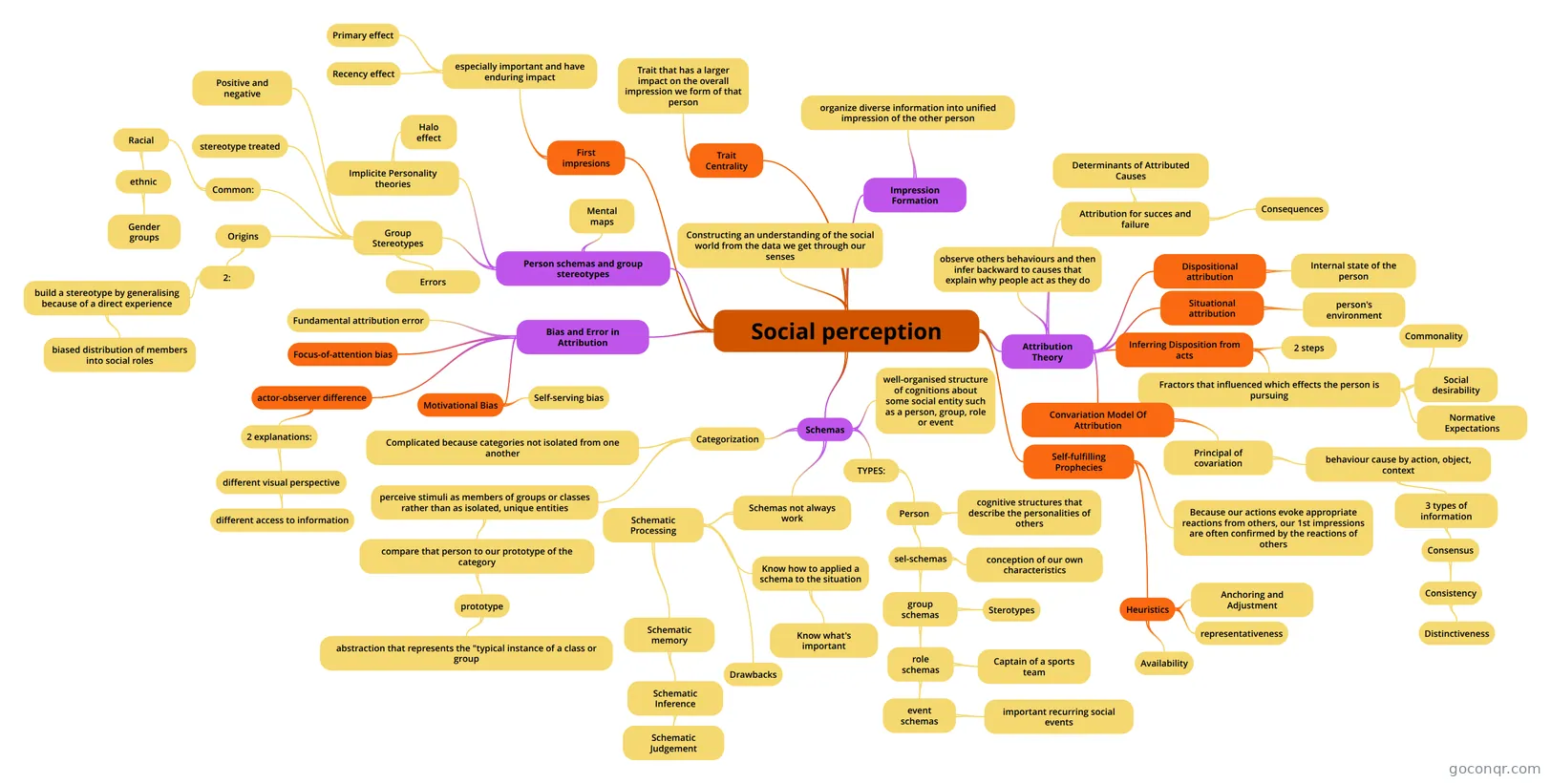
Mind map: Social perception
Map content
Social perception
Constructing an understanding of the social world from the data we get through our senses
Attribution Theory
- observe others behaviours and then infer backward to causes that explain why people act as they do
- Dispositional attribution
- Internal state of the person
- Situational attribution
- person's environment
- Inferring Disposition from acts
- 2 steps
- Fractors that influenced which effects the person is pursuing
- Commonality
- Social desirability
- Normative Expectations
- Convariation Model Of Attribution
- Principal of covariation
- behaviour cause by action, object, context
- 3 types of information
- Consensus
- Consistency
- Distinctiveness
- Consistency
- Consensus
- 3 types of information
- behaviour cause by action, object, context
- Principal of covariation
- Attribution for succes and failure
- Determinants of Attributed Causes
- Consequences
Schemas
- Categorization
- perceive stimuli as members of groups or classes rather than as isolated, unique entities
- compare that person to our prototype of the category
- prototype
- abstraction that represents the "typical instance of a class or group
- prototype
- compare that person to our prototype of the category
- Complicated because categories not isolated from one another
- perceive stimuli as members of groups or classes rather than as isolated, unique entities
- well-organised structure of cognitions about some social entity such as a person, group, role or event
- TYPES:
- Person
- sel-schemas
- group schemas
- role schemas
- event schemas
- important recurring social events
- Captain of a sports team
- event schemas
- Sterotypes
- role schemas
- conception of our own characteristics
- group schemas
- cognitive structures that describe the personalities of others
- sel-schemas
- Person
- Schemas not always work
- Schematic Processing
- Know how to applied a schema to the situation
- Know what's important
- Schematic memory
- Schematic Inference
- Schematic Judgement
- Schematic Inference
- Drawbacks
- Know how to applied a schema to the situation
- Schematic Processing
- Categorization
Person schemas and group stereotypes
- Mental maps
- Implicite Personality theories
- Halo effect
- Group Stereotypes
- Positive and negative
- stereotype treated
- Common:
- Racial
- ethnic
- Gender groups
- ethnic
- Racial
- Origins
- 2:
- build a stereotype by generalising because of a direct experience
- biased distribution of members into social roles
- build a stereotype by generalising because of a direct experience
- 2:
- Errors
Impression Formation
- organize diverse information into unified impression of the other person
Trait Centrality
- Trait that has a larger impact on the overall impression we form of that person
First impresions
- especially important and have enduring impact
- Primary effect
- Recency effect
- especially important and have enduring impact
Self-fulfilling Prophecies
- Because our actions evoke appropriate reactions from others, our 1st impressions are often confirmed by the reactions of others
- Heuristics
- Availability
- representativeness
- Anchoring and Adjustment
Bias and Error in Attribution
- Fundamental attribution error
- Focus-of-attention bias
- actor-observer difference
- 2 explanations:
- different visual perspective
- different access to information
- different visual perspective
- 2 explanations:
- Motivational Bias
- Self-serving bias
Information
- Description
- Psyco Mind Map on Social perception, created by Andrea de Sayve on 14/02/2017.
- Created by
- Andrea de Sayve
- Views
- 97
- Tags
- Rating
More on Social Cognition and Attribution