
Mind map
Gametogenesis and Fertilisation
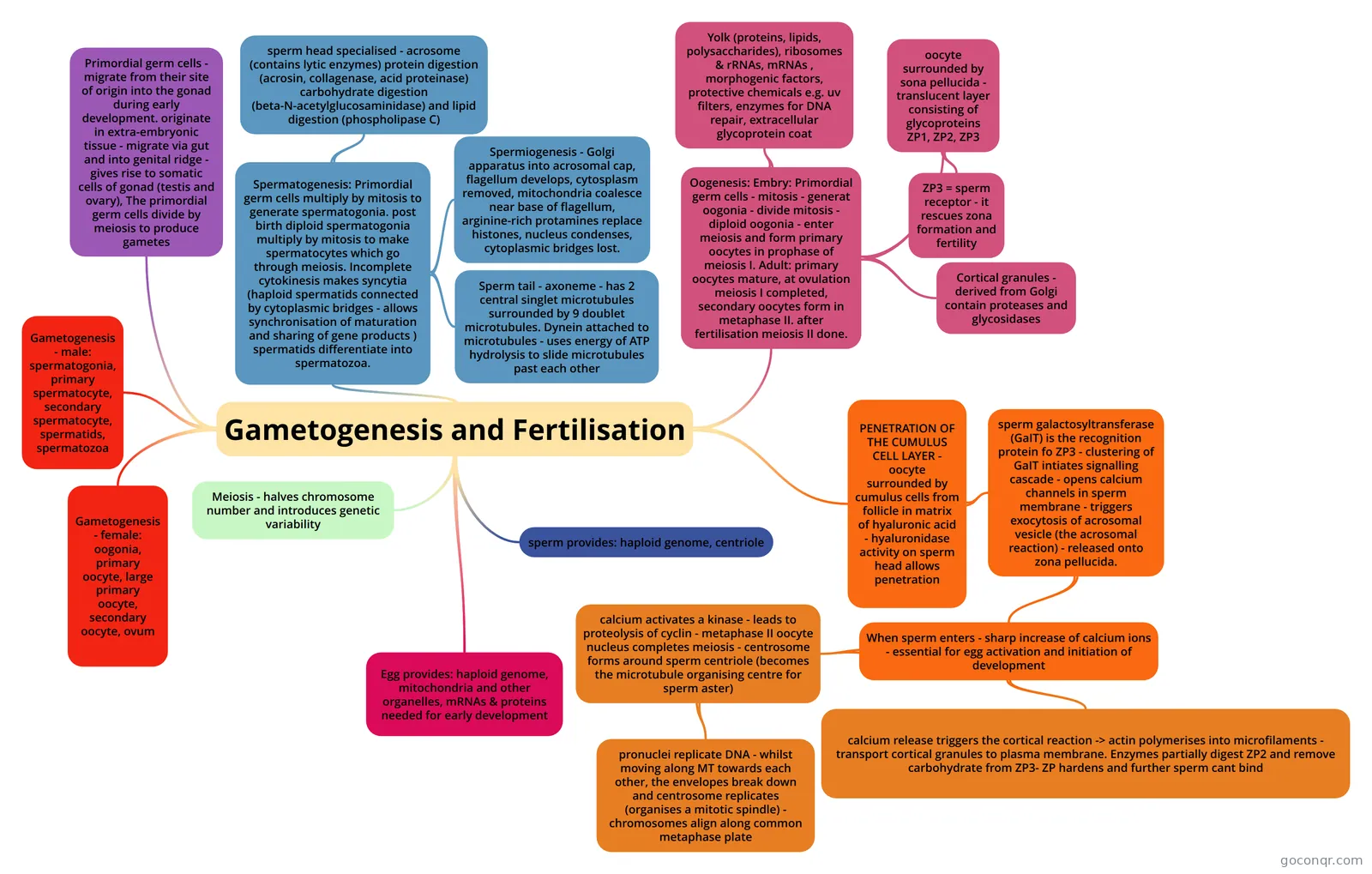
Mind map: Gametogenesis and fertilisation
Map content
Gametogenesis and Fertilisation
Gametogenesis - male: spermatogonia, primary spermatocyte, secondary spermatocyte, spermatids, spermatozoa
Gametogenesis - female: oogonia, primary oocyte, large primary oocyte, secondary oocyte, ovum
Primordial germ cells - migrate from their site of origin into the gonad during early development. originate in extra-embryonic tissue - migrate via gut and into genital ridge - gives rise to somatic cells of gonad (testis and ovary), The primordial germ cells divide by meiosis to produce gametes
Meiosis - halves chromosome number and introduces genetic variability
Spermatogenesis: Primordial germ cells multiply by mitosis to generate spermatogonia. post birth diploid spermatogonia multiply by mitosis to make spermatocytes which go through meiosis. Incomplete cytokinesis makes syncytia (haploid spermatids connected by cytoplasmic bridges - allows synchronisation of maturation and sharing of gene products ) spermatids differentiate into spermatozoa.
- Spermiogenesis - Golgi apparatus into acrosomal cap, flagellum develops, cytosplasm removed, mitochondria coalesce near base of flagellum, arginine-rich protamines replace histones, nucleus condenses, cytoplasmic bridges lost.
- sperm head specialised - acrosome (contains lytic enzymes) protein digestion (acrosin, collagenase, acid proteinase) carbohydrate digestion (beta-N-acetylglucosaminidase) and lipid digestion (phospholipase C)
- Sperm tail - axoneme - has 2 central singlet microtubules surrounded by 9 doublet microtubules. Dynein attached to microtubules - uses energy of ATP hydrolysis to slide microtubules past each other
Oogenesis: Embry: Primordial germ cells - mitosis - generat oogonia - divide mitosis - diploid oogonia - enter meiosis and form primary oocytes in prophase of meiosis I. Adult: primary oocytes mature, at ovulation meiosis I completed, secondary oocytes form in metaphase II. after fertilisation meiosis II done.
- Yolk (proteins, lipids, polysaccharides), ribosomes & rRNAs, mRNAs , morphogenic factors, protective chemicals e.g. uv filters, enzymes for DNA repair, extracellular glycoprotein coat
- oocyte surrounded by sona pellucida - translucent layer consisting of glycoproteins ZP1, ZP2, ZP3
- ZP3 = sperm receptor - it rescues zona formation and fertility
- Cortical granules - derived from Golgi contain proteases and glycosidases
PENETRATION OF THE CUMULUS CELL LAYER - oocyte surrounded by cumulus cells from follicle in matrix of hyaluronic acid - hyaluronidase activity on sperm head allows penetration
- sperm galactosyltransferase (GaIT) is the recognition protein fo ZP3 - clustering of GaIT intiates signalling cascade - opens calcium channels in sperm membrane - triggers exocytosis of acrosomal vesicle (the acrosomal reaction) - released onto zona pellucida.
- When sperm enters - sharp increase of calcium ions - essential for egg activation and initiation of development
- calcium release triggers the cortical reaction -> actin polymerises into microfilaments - transport cortical granules to plasma membrane. Enzymes partially digest ZP2 and remove carbohydrate from ZP3- ZP hardens and further sperm cant bind
- calcium activates a kinase - leads to proteolysis of cyclin - metaphase II oocyte nucleus completes meiosis - centrosome forms around sperm centriole (becomes the microtubule organising centre for sperm aster)
- pronuclei replicate DNA - whilst moving along MT towards each other, the envelopes break down and centrosome replicates (organises a mitotic spindle) - chromosomes align along common metaphase plate
- When sperm enters - sharp increase of calcium ions - essential for egg activation and initiation of development
- sperm galactosyltransferase (GaIT) is the recognition protein fo ZP3 - clustering of GaIT intiates signalling cascade - opens calcium channels in sperm membrane - triggers exocytosis of acrosomal vesicle (the acrosomal reaction) - released onto zona pellucida.
sperm provides: haploid genome, centriole
Egg provides: haploid genome, mitochondria and other organelles, mRNAs & proteins needed for early development
Information
- Description
- Degree Genetics Mind Map on Gametogenesis and Fertilisation, created by Sara Forghani on 05/03/2017.
- Created by
- Sara Forghani
- Views
- 0
- Rating