
Mind map
Lecture 13 - Reptilia
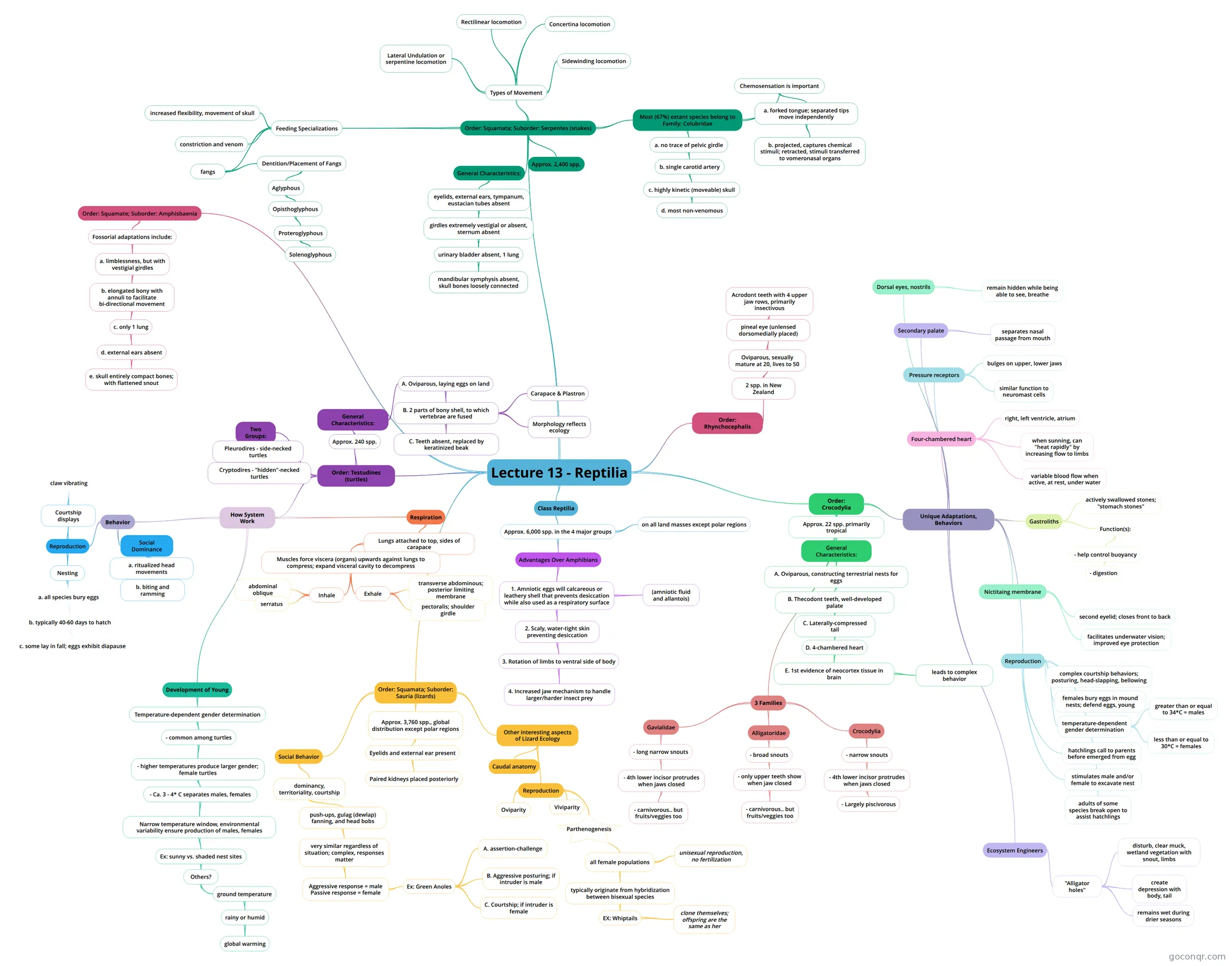
Mind map: Reptilia orders and characteristics
Map content
Lecture 13 - Reptilia
Class Reptilia
- Approx. 6,000 spp. in the 4 major groups
- on all land masses except polar regions
- Advantages Over Amphibians
- 1. Amniotic eggs will calcareous or leathery shell that prevents desiccation while also used as a respiratory surface
- (amniotic fluid and allantois)
- 2. Scaly, water-tight skin preventing desiccation
- 3. Rotation of limbs to ventral side of body
- 4. Increased jaw mechanism to handle larger/harder insect prey
- 3. Rotation of limbs to ventral side of body
- 1. Amniotic eggs will calcareous or leathery shell that prevents desiccation while also used as a respiratory surface
- Approx. 6,000 spp. in the 4 major groups
Order: Testudines (turtles)
- Approx. 240 spp.
- General Characteristics:
- A. Oviparous, laying eggs on land
- B. 2 parts of bony shell, to which vertebrae are fused
- Carapace & Plastron
- Morphology reflects ecology
- C. Teeth absent, replaced by keratinized beak
- B. 2 parts of bony shell, to which vertebrae are fused
- A. Oviparous, laying eggs on land
- General Characteristics:
- Two Groups:
- Pleurodires - side-necked turtles
- Cryptodires - "hidden"-necked turtles
- Pleurodires - side-necked turtles
- How System Work
- Respiration
- Lungs attached to top, sides of carapace
- Muscles force viscera (organs) upwards against lungs to compress; expand visceral cavity to decompress
- Exhale
- transverse abdominous; posterior limiting membrane
- pectoralis; shoulder girdle
- Inhale
- abdominal oblique
- serratus
- Exhale
- Muscles force viscera (organs) upwards against lungs to compress; expand visceral cavity to decompress
- Lungs attached to top, sides of carapace
- Behavior
- Social Dominance
- a. ritualized head movements
- b. biting and ramming
- a. ritualized head movements
- Reproduction
- Courtship displays
- claw vibrating
- Nesting
- a. all species bury eggs
- b. typically 40-60 days to hatch
- c. some lay in fall; eggs exhibit diapause
- b. typically 40-60 days to hatch
- a. all species bury eggs
- Courtship displays
- Social Dominance
- Development of Young
- Temperature-dependent gender determination
- - common among turtles
- - higher temperatures produce larger gender; female turtles
- - Ca. 3 - 4* C separates males, females
- Narrow temperature window, environmental variability ensure production of males, females
- Ex: sunny vs. shaded nest sites
- Others?
- ground temperature
- rainy or humid
- global warming
- rainy or humid
- ground temperature
- Others?
- Ex: sunny vs. shaded nest sites
- Narrow temperature window, environmental variability ensure production of males, females
- - Ca. 3 - 4* C separates males, females
- - higher temperatures produce larger gender; female turtles
- - common among turtles
- Temperature-dependent gender determination
- Respiration
- Approx. 240 spp.
Order: Crocodylia
- Approx. 22 spp. primarily tropical
- General Characteristics:
- A. Oviparous, constructing terrestrial nests for eggs
- B. Thecodont teeth, well-developed palate
- C. Laterally-compressed tail
- D. 4-chambered heart
- E. 1st evidence of neocortex tissue in brain
- leads to complex behavior
- E. 1st evidence of neocortex tissue in brain
- D. 4-chambered heart
- C. Laterally-compressed tail
- B. Thecodont teeth, well-developed palate
- A. Oviparous, constructing terrestrial nests for eggs
- General Characteristics:
- 3 Families
- Alligatoridae
- - broad snouts
- - only upper teeth show when jaw closed
- - carnivorous.. but fruits/veggies too
- - only upper teeth show when jaw closed
- - broad snouts
- Crocodylia
- - narrow snouts
- - 4th lower incisor protrudes when jaws closed
- - Largely piscivorous
- - 4th lower incisor protrudes when jaws closed
- - narrow snouts
- Gavialidae
- - long narrow snouts
- - 4th lower incisor protrudes when jaws closed
- - carnivorous.. but fruits/veggies too
- - 4th lower incisor protrudes when jaws closed
- - long narrow snouts
- Alligatoridae
- Unique Adaptations, Behaviors
- Dorsal eyes, nostrils
- remain hidden while being able to see, breathe
- Secondary palate
- separates nasal passage from mouth
- Pressure receptors
- bulges on upper, lower jaws
- similar function to neuromast cells
- Four-chambered heart
- right, left ventricle, atrium
- variable blood flow when active, at rest, under water
- when sunning, can "heat rapidly" by increasing flow to limbs
- Gastroliths
- actively swallowed stones; "stomach stones"
- Function(s):
- - help control buoyancy
- - digestion
- - help control buoyancy
- Nictitaing membrane
- second eyelid; closes front to back
- facilitates underwater vision; improved eye protection
- Reproduction
- complex courtship behaviors; posturing, head-slapping, bellowing
- females bury eggs in mound nests; defend eggs, young
- temperature-dependent gender determination
- greater than or equal to 34*C = males
- less than or equal to 30*C = females
- hatchlings call to parents before emerged from egg
- stimulates male and/or female to excavate nest
- adults of some species break open to assist hatchlings
- Ecosystem Engineers
- "Alligator holes"
- disturb, clear muck, wetland vegetation with snout, limbs
- create depression with body, tail
- remains wet during drier seasons
- "Alligator holes"
- Dorsal eyes, nostrils
- Approx. 22 spp. primarily tropical
Order: Rhynchocephalis
- 2 spp. in New Zealand
- Oviparous, sexually mature at 20, lives to 50
- pineal eye (unlensed dorsomedially placed)
- Acrodont teeth with 4 upper jaw rows, primarily insectivous
- pineal eye (unlensed dorsomedially placed)
- Oviparous, sexually mature at 20, lives to 50
- 2 spp. in New Zealand
Order: Squamata; Suborder: Sauria (lizards)
- Approx. 3,760 spp., global distribution except polar regions
- Eyelids and external ear present
- Paired kidneys placed posteriorly
- Eyelids and external ear present
- Social Behavior
- dominancy, territoriality, courtship
- push-ups, gulag (dewlap) fanning, and head bobs
- very similar regardless of situation; complex, responses matter
- Aggressive response = male Passive response = female
- Ex: Green Anoles
- A. assertion-challenge
- B. Aggressive posturing; if intruder is male
- C. Courtship; if intruder is female
- Ex: Green Anoles
- Aggressive response = male Passive response = female
- very similar regardless of situation; complex, responses matter
- push-ups, gulag (dewlap) fanning, and head bobs
- dominancy, territoriality, courtship
- Other interesting aspects of Lizard Ecology
- Caudal anatomy
- - dropping of tail to escape predator - effective, but comes with a price * loss of communication * reduced fat storage - come skinks eat autotomized tails
- Reproduction
- Oviparity
- - external development; eggs - ancestral form - low cost; multiple clutches possible
- Viviparity
- - internal development; eggs - derived form - high cost; single clutch only
- Parthenogenesis
- all female populations
- typically originate from hybridization between bisexual species
- EX: Whiptails
- clone themselves; offspring are the same as her
- EX: Whiptails
- unisexual reproduction, no fertilization
- typically originate from hybridization between bisexual species
- all female populations
- Oviparity
- Caudal anatomy
- Approx. 3,760 spp., global distribution except polar regions
Order: Squamate; Suborder: Amphisbaenia
- Fossorial adaptations include:
- a. limblessness, but with vestigial girdles
- b. elongated bony with annuli to facilitate bi-directional movement
- c. only 1 lung
- d. external ears absent
- e. skull entirely compact bones; with flattened snout
- d. external ears absent
- c. only 1 lung
- b. elongated bony with annuli to facilitate bi-directional movement
- a. limblessness, but with vestigial girdles
- Fossorial adaptations include:
Order: Squamata; Suborder: Serpentes (snakes)
- Approx. 2,400 spp.
- General Characteristics:
- eyelids, external ears, tympanum, eustacian tubes absent
- girdles extremely vestigial or absent, sternum absent
- urinary bladder absent, 1 lung
- mandibular symphysis absent, skull bones loosely connected
- urinary bladder absent, 1 lung
- girdles extremely vestigial or absent, sternum absent
- eyelids, external ears, tympanum, eustacian tubes absent
- Most (67%) extant species belong to Family: Colubridae
- a. no trace of pelvic girdle
- b. single carotid artery
- c. highly kinetic (moveable) skull
- d. most non-venomous
- c. highly kinetic (moveable) skull
- b. single carotid artery
- Chemosensation is important
- a. forked tongue; separated tips move independently
- b. projected, captures chemical stimuli; retracted, stimuli transferred to vomeronasal organs
- a. forked tongue; separated tips move independently
- a. no trace of pelvic girdle
- Types of Movement
- Lateral Undulation or serpentine locomotion
- - series of irregular curves, each pressing against object - lateral force canceled by subsequent curve
- Rectilinear locomotion
- - rib muscles lift sections of body off ground, stretch forward - primarily heavy-bodied snakes; slow movement, but useful for stalking
- Concertina locomotion
- - anchor posteriorly with "loops"; stretch forward; anchor anteriorly; draw rear forward - adapted for use in narrow passages -ex: rodent burrows, pipes in your house
- Sidewinding locomotion
- - raise sections of body in "loops", thrust forward and set on ground - force exerted downward - primarily used by desert species
- Lateral Undulation or serpentine locomotion
- Feeding Specializations
- increased flexibility, movement of skull
- - sides move independently; complex; 3-dimensional
- constriction and venom
- - permit taking of larger prey while minimizing risk of injury - shortened vertebrae, truck muscles permit tight lopping by constrictors - cause of death for prey = suffocation Venom: mixture of enzymes, phosphates and other compounds
- fangs
- specialized, enlarged teeth associated with venom glands
- Dentition/Placement of Fangs
- Aglyphous
- no fangs, smaller teeth ex: constrictors
- Opisthoglyphous
- fangs on posterior end of maxilla; smaller teeth in front fangs hollow or solid ex: boomslang, false viper
- Proteroglyphous
- fangs on front of maxilla; smaller teeth behind fangs hollow; permanently erect ex: Coral snakes
- Solenoglyphous
- fangs only teeth on maxilla fangs hollow; moveable; longer ex: viperids
- Aglyphous
- increased flexibility, movement of skull
Information
- Description
- Biology (Vertebrate Natural History) Mind Map on Lecture 13 - Reptilia, created by Allyson Thompson on 22/03/2017.
- Created by
- Allyson Thompson
- Views
- 35
- Tags
- Rating