
Mind map
Judiciary
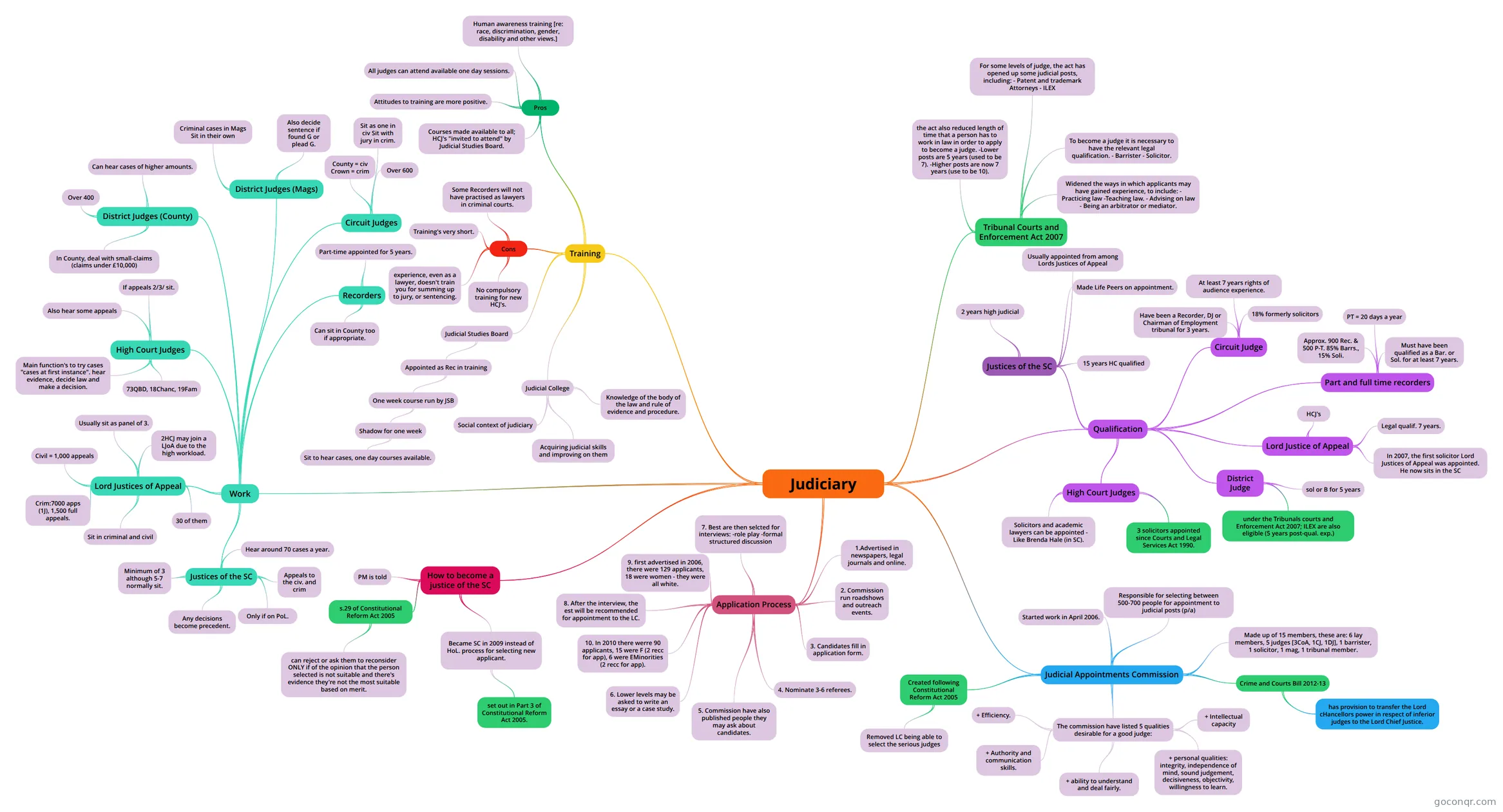
Mind map: Judiciary
Map content
Judiciary
Tribunal Courts and Enforcement Act 2007
- For some levels of judge, the act has opened up some judicial posts, including: - Patent and trademark Attorneys - ILEX
- To become a judge it is necessary to have the relevant legal qualification. - Barrister - Solicitor.
- Widened the ways in which applicants may have gained experience, to include: - Practicing law -Teaching law. - Advising on law - Being an arbitrator or mediator.
- the act also reduced length of time that a person has to work in law in order to apply to become a judge. -Lower posts are 5 years (used to be 7). -Higher posts are now 7 years (use to be 10).
Qualification
- Justices of the SC
- Usually appointed from among Lords Justices of Appeal
- 2 years high judicial
- 15 years HC qualified
- Made Life Peers on appointment.
- Circuit Judge
- Have been a Recorder, DJ or Chairman of Employment tribunal for 3 years.
- At least 7 years rights of audience experience.
- 18% formerly solicitors
- Part and full time recorders
- Approx. 900 Rec. & 500 P-T. 85% Barrs., 15% Soli.
- PT = 20 days a year
- Must have been qualified as a Bar. or Sol. for at least 7 years.
- Lord Justice of Appeal
- HCJ's
- In 2007, the first solicitor Lord Justices of Appeal was appointed. He now sits in the SC
- Legal qualif. 7 years.
- District Judge
- sol or B for 5 years
- under the Tribunals courts and Enforcement Act 2007; ILEX are also eligible (5 years post-qual. exp.)
- High Court Judges
- Solicitors and academic lawyers can be appointed - Like Brenda Hale (in SC).
- 3 solicitors appointed since Courts and Legal Services Act 1990.
- Justices of the SC
Judicial Appointments Commission
- Started work in April 2006.
- Responsible for selecting between 500-700 people for appointment to judicial posts (p/a)
- Made up of 15 members, these are: 6 lay members, 5 judges [3CoA, 1CJ, 1DJ], 1 barrister, 1 solicitor, 1 mag, 1 tribunal member.
- Crime and Courts Bill 2012-13
- has provision to transfer the Lord cHancellors power in respect of inferior judges to the Lord Chief Justice.
- The commission have listed 5 qualities desirable for a good judge:
- + Intellectual capacity
- + personal qualities: integrity, independence of mind, sound judgement, decisiveness, objectivity, willingness to learn.
- + ability to understand and deal fairly.
- + Authority and communication skills.
- + Efficiency.
- Created following Constitutional Reform Act 2005
- Removed LC being able to select the serious judges
Application Process
- 1.Advertised in newspapers, legal journals and online.
- 2. Commission run roadshows and outreach events.
- 3. Candidates fill in application form.
- 4. Nominate 3-6 referees.
- 5. Commission have also published people they may ask about candidates.
- 6. Lower levels may be asked to write an essay or a case study.
- 7. Best are then selcted for interviews: -role play -formal structured discussion
- 8. After the interview, the est will be recommended for appointment to the LC.
- 9. first advertised in 2006, there were 129 applicants, 18 were women - they were all white.
- 10. In 2010 there werre 90 applicants, 15 were F (2 recc for app), 6 were EMinorities (2 recc for app).
How to become a justice of the SC
- Became SC in 2009 instead of HoL. process for selecting new applicant.
- set out in Part 3 of Constitutional Reform Act 2005.
- s.29 of Constitutional Reform Act 2005
- can reject or ask them to reconsider ONLY if of the opinion that the person selected is not suitable and there's evidence they're not the most suitable based on merit.
- PM is told
- Became SC in 2009 instead of HoL. process for selecting new applicant.
Work
- Justices of the SC
- Hear around 70 cases a year.
- Appeals to the civ. and crim
- Only if on PoL.
- Minimum of 3 although 5-7 normally sit.
- Any decisions become precedent.
- Lord Justices of Appeal
- 30 of them
- Sit in criminal and civil
- Crim:7000 apps (1J), 1,500 full appeals.
- Civil = 1,000 appeals
- Usually sit as panel of 3.
- 2HCJ may join a LJoA due to the high workload.
- High Court Judges
- 73QBD, 18Chanc, 19Fam
- Main function's to try cases "cases at first instance". hear evidence, decide law and make a decision.
- Also hear some appeals
- If appeals 2/3/ sit.
- District Judges (County)
- In County, deal with small-claims (claims under £10,000)
- Over 400
- Can hear cases of higher amounts.
- District Judges (Mags)
- Criminal cases in Mags Sit in their own
- Also decide sentence if found G or plead G.
- Circuit Judges
- County = civ Crown = crim
- Over 600
- Sit as one in civ Sit with jury in crim.
- Recorders
- Part-time appointed for 5 years.
- Can sit in County too if appropriate.
- Justices of the SC
Training
- Judicial Studies Board
- Appointed as Rec in training
- One week course run by JSB
- Shadow for one week
- Sit to hear cases, one day courses available.
- Shadow for one week
- One week course run by JSB
- Appointed as Rec in training
- Judicial College
- Knowledge of the body of the law and rule of evidence and procedure.
- Acquiring judicial skills and improving on them
- Social context of judiciary
- Cons
- Training's very short.
- experience, even as a lawyer, doesn't train you for summing up to jury, or sentencing.
- Some Recorders will not have practised as lawyers in criminal courts.
- No compulsory training for new HCJ's.
- Pros
- Courses made available to all; HCJ's "invited to attend" by Judicial Studies Board.
- Attitudes to training are more positive.
- Human awareness training [re: race, discrimination, gender, disability and other views.]
- All judges can attend available one day sessions.
- Judicial Studies Board
Information
- Description
- A level Law Mind Map on Judiciary, created by Joy Lewry on 29/03/2017.
- Created by
- Joy Lewry
- Views
- 18
- Rating