
Mind map
Interactionist view of Crime and deviance
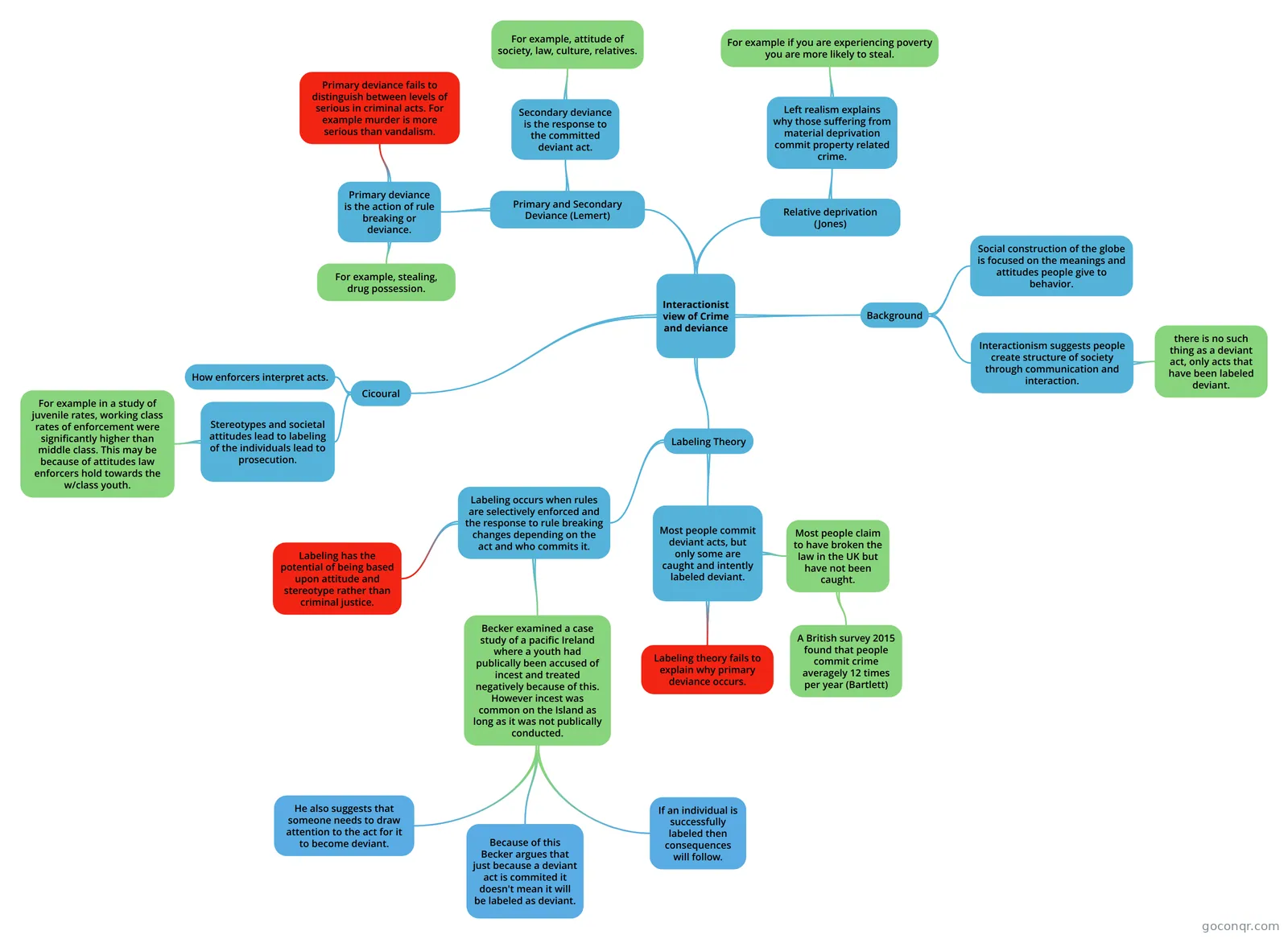
Mind map: Interactionist view of crime and deviance
Map content
Interactionist view of Crime and deviance
Background
- Interactionism suggests people create structure of society through communication and interaction.
- there is no such thing as a deviant act, only acts that have been labeled deviant.
- Social construction of the globe is focused on the meanings and attitudes people give to behavior.
- Interactionism suggests people create structure of society through communication and interaction.
Labeling Theory
- Most people commit deviant acts, but only some are caught and intently labeled deviant.
- Most people claim to have broken the law in the UK but have not been caught.
- A British survey 2015 found that people commit crime averagely 12 times per year (Bartlett)
- Labeling theory fails to explain why primary deviance occurs.
- Most people claim to have broken the law in the UK but have not been caught.
- Labeling occurs when rules are selectively enforced and the response to rule breaking changes depending on the act and who commits it.
- Becker examined a case study of a pacific Ireland where a youth had publically been accused of incest and treated negatively because of this. However incest was common on the Island as long as it was not publically conducted.
- Because of this Becker argues that just because a deviant act is commited it doesn't mean it will be labeled as deviant.
- He also suggests that someone needs to draw attention to the act for it to become deviant.
- If an individual is successfully labeled then consequences will follow.
- Labeling has the potential of being based upon attitude and stereotype rather than criminal justice.
- Becker examined a case study of a pacific Ireland where a youth had publically been accused of incest and treated negatively because of this. However incest was common on the Island as long as it was not publically conducted.
- Most people commit deviant acts, but only some are caught and intently labeled deviant.
Primary and Secondary Deviance (Lemert)
- Primary deviance is the action of rule breaking or deviance.
- For example, stealing, drug possession.
- Primary deviance fails to distinguish between levels of serious in criminal acts. For example murder is more serious than vandalism.
- Secondary deviance is the response to the committed deviant act.
- For example, attitude of society, law, culture, relatives.
- Primary deviance is the action of rule breaking or deviance.
Cicoural
- How enforcers interpret acts.
- Stereotypes and societal attitudes lead to labeling of the individuals lead to prosecution.
- For example in a study of juvenile rates, working class rates of enforcement were significantly higher than middle class. This may be because of attitudes law enforcers hold towards the w/class youth.
Relative deprivation (Jones)
- Left realism explains why those suffering from material deprivation commit property related crime.
- For example if you are experiencing poverty you are more likely to steal.
- Left realism explains why those suffering from material deprivation commit property related crime.
Information
- Description
- A level Sociology (Perspectives of Crime and Deviance ) Mind Map on Interactionist view of Crime and deviance, created by Ellie Bennett on 11/04/2017.
- Created by
- Ellie Bennett
- Views
- 60
- Rating