
Mind map
Unstructured interviews
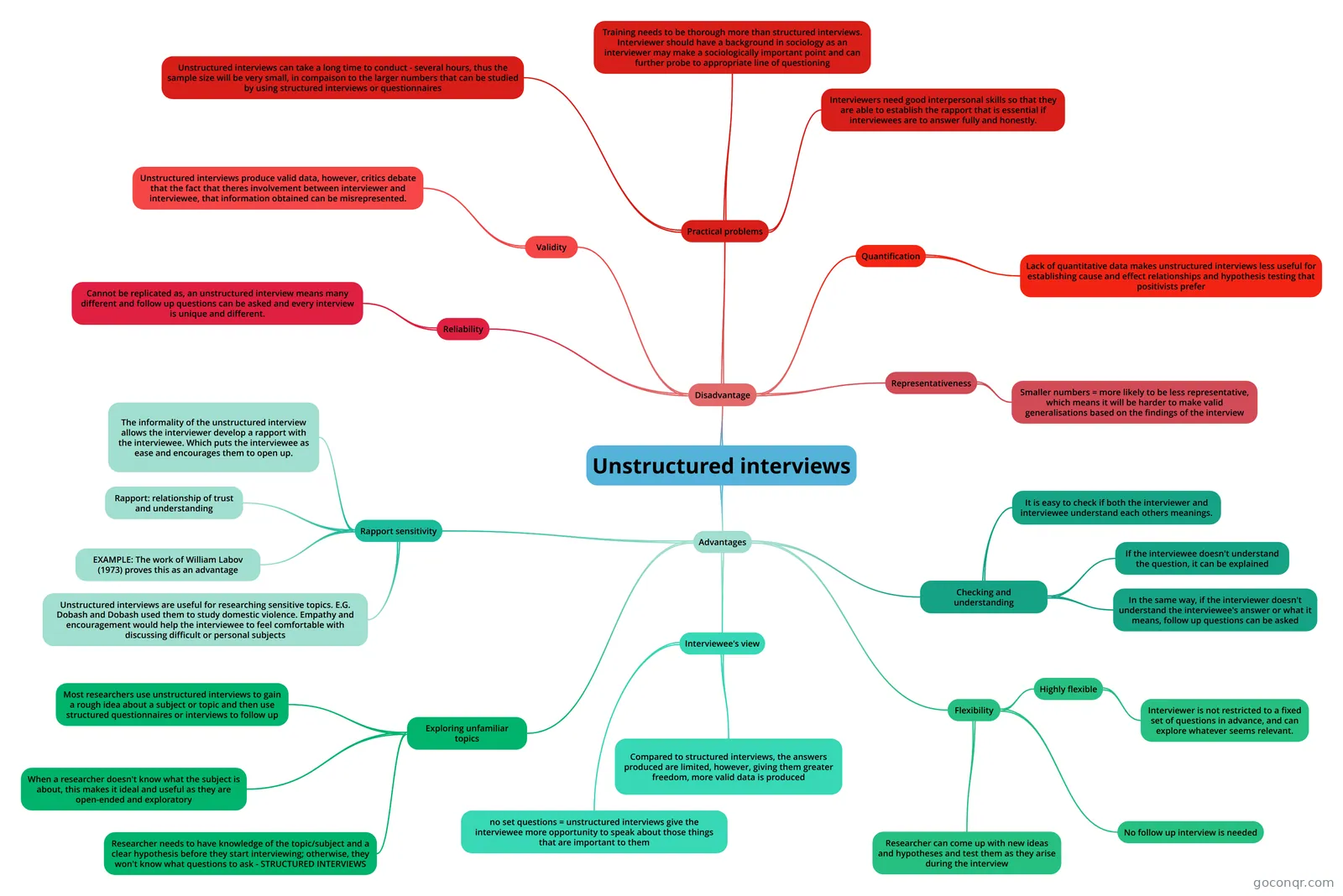
Mind map: Unstructured interviews
Map content
Unstructured interviews
Advantages
- Rapport sensitivity
- Rapport: relationship of trust and understanding
- The informality of the unstructured interview allows the interviewer develop a rapport with the interviewee. Which puts the interviewee as ease and encourages them to open up.
- EXAMPLE: The work of William Labov (1973) proves this as an advantage
- Unstructured interviews are useful for researching sensitive topics. E.G. Dobash and Dobash used them to study domestic violence. Empathy and encouragement would help the interviewee to feel comfortable with discussing difficult or personal subjects
- Interviewee's view
- no set questions = unstructured interviews give the interviewee more opportunity to speak about those things that are important to them
- Compared to structured interviews, the answers produced are limited, however, giving them greater freedom, more valid data is produced
- Checking and understanding
- It is easy to check if both the interviewer and interviewee understand each others meanings.
- If the interviewee doesn't understand the question, it can be explained
- In the same way, if the interviewer doesn't understand the interviewee's answer or what it means, follow up questions can be asked
- Flexibility
- Highly flexible
- Interviewer is not restricted to a fixed set of questions in advance, and can explore whatever seems relevant.
- Researcher can come up with new ideas and hypotheses and test them as they arise during the interview
- No follow up interview is needed
- Highly flexible
- Exploring unfamiliar topics
- Researcher needs to have knowledge of the topic/subject and a clear hypothesis before they start interviewing; otherwise, they won't know what questions to ask - STRUCTURED INTERVIEWS
- When a researcher doesn't know what the subject is about, this makes it ideal and useful as they are open-ended and exploratory
- Most researchers use unstructured interviews to gain a rough idea about a subject or topic and then use structured questionnaires or interviews to follow up
- Rapport sensitivity
Disadvantage
- Practical problems
- Unstructured interviews can take a long time to conduct - several hours, thus the sample size will be very small, in compaison to the larger numbers that can be studied by using structured interviews or questionnaires
- Training needs to be thorough more than structured interviews. Interviewer should have a background in sociology as an interviewer may make a sociologically important point and can further probe to appropriate line of questioning
- Interviewers need good interpersonal skills so that they are able to establish the rapport that is essential if interviewees are to answer fully and honestly.
- Representativeness
- Smaller numbers = more likely to be less representative, which means it will be harder to make valid generalisations based on the findings of the interview
- Reliability
- Cannot be replicated as, an unstructured interview means many different and follow up questions can be asked and every interview is unique and different.
- Quantification
- Lack of quantitative data makes unstructured interviews less useful for establishing cause and effect relationships and hypothesis testing that positivists prefer
- Validity
- Unstructured interviews produce valid data, however, critics debate that the fact that theres involvement between interviewer and interviewee, that information obtained can be misrepresented.
- Practical problems
Information
- Description
- Unstructured interviews - advantages and disadvantages
- Created by
- Sophia Hussain
- Views
- 267
- Tags
- Rating