
Mind map
Smart materials
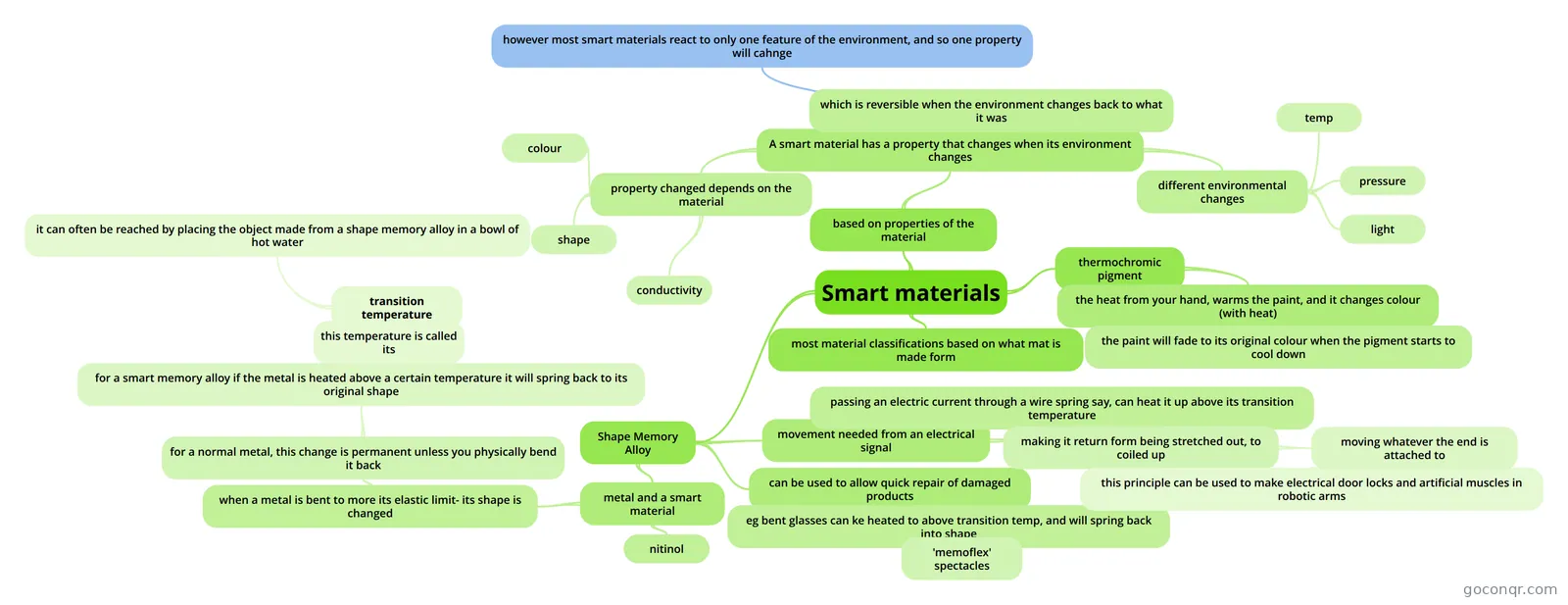
Mind map: Smart materials
Map content
Smart materials
most material classifications based on what mat is made form
based on properties of the material
- A smart material has a property that changes when its environment changes
- which is reversible when the environment changes back to what it was
- different environmental changes
- temp
- pressure
- light
- property changed depends on the material
- colour
- shape
- conductivity
- however most smart materials react to only one feature of the environment, and so one property will cahnge
- A smart material has a property that changes when its environment changes
thermochromic pigment
- the heat from your hand, warms the paint, and it changes colour (with heat)
- the paint will fade to its original colour when the pigment starts to cool down
- the heat from your hand, warms the paint, and it changes colour (with heat)
Shape Memory Alloy
- metal and a smart material
- nitinol
- when a metal is bent to more its elastic limit- its shape is changed
- for a normal metal, this change is permanent unless you physically bend it back
- for a smart memory alloy if the metal is heated above a certain temperature it will spring back to its original shape
- this temperature is called its
- transition temperature
- it can often be reached by placing the object made from a shape memory alloy in a bowl of hot water
- transition temperature
- this temperature is called its
- for a smart memory alloy if the metal is heated above a certain temperature it will spring back to its original shape
- for a normal metal, this change is permanent unless you physically bend it back
- can be used to allow quick repair of damaged products
- eg bent glasses can ke heated to above transition temp, and will spring back into shape
- 'memoflex' spectacles
- eg bent glasses can ke heated to above transition temp, and will spring back into shape
- movement needed from an electrical signal
- passing an electric current through a wire spring say, can heat it up above its transition temperature
- making it return form being stretched out, to coiled up
- moving whatever the end is attached to
- this principle can be used to make electrical door locks and artificial muscles in robotic arms
- moving whatever the end is attached to
- making it return form being stretched out, to coiled up
- passing an electric current through a wire spring say, can heat it up above its transition temperature
- metal and a smart material
Information
- Description
- GCSE CDT (Materials) Mind Map on Smart materials, created by fampulli on 08/06/2014.
- Created by
- fampulli
- Views
- 23
- Rating