
Mind map
Immunology
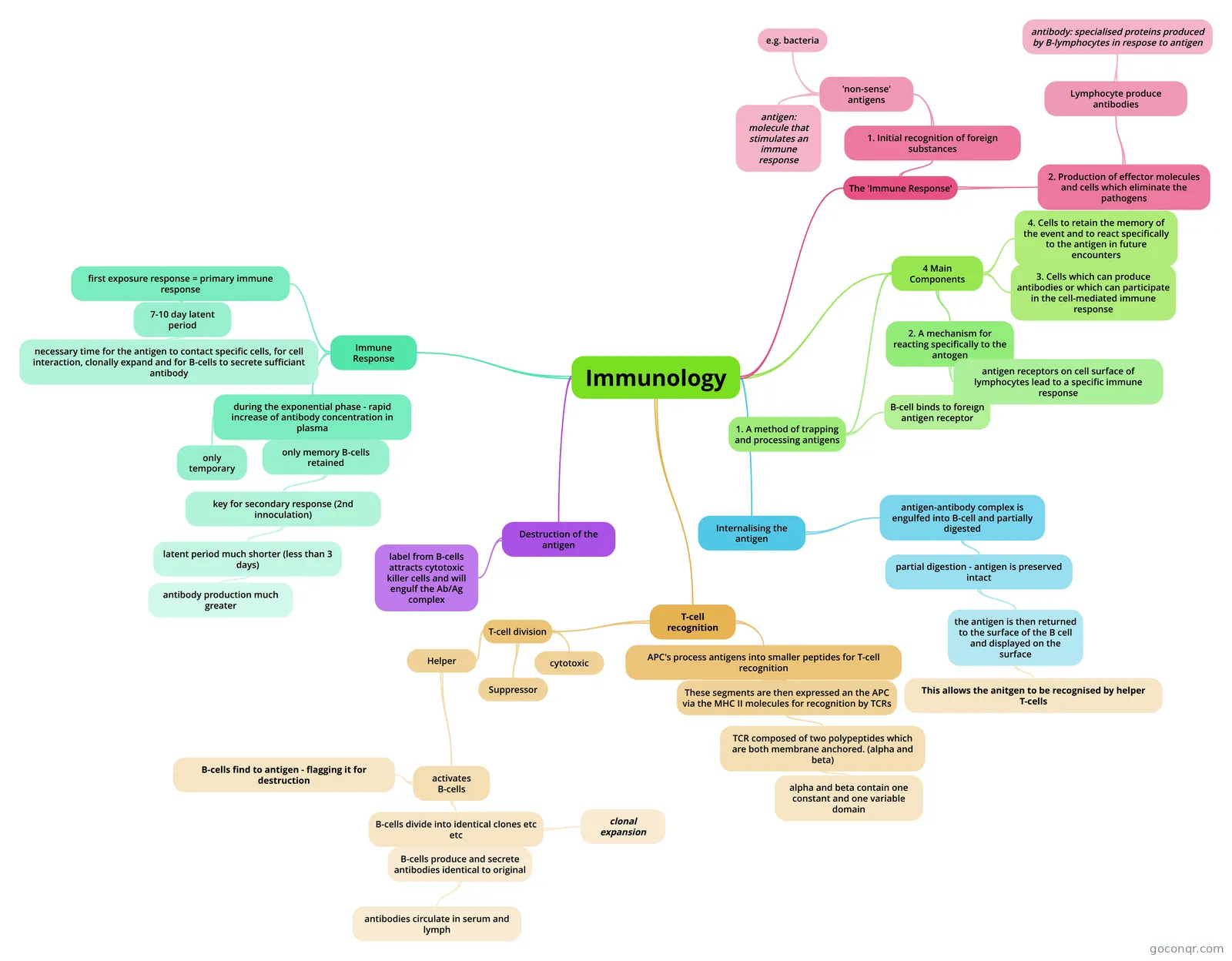
Mind map: Immunology
Map content
Immunology
The 'Immune Response'
- 1. Initial recognition of foreign substances
- 'non-sense' antigens
- antigen: molecule that stimulates an immune response
- e.g. bacteria
- 'non-sense' antigens
- 2. Production of effector molecules and cells which eliminate the pathogens
- Lymphocyte produce antibodies
- antibody: specialised proteins produced by B-lymphocytes in respose to antigen
- Lymphocyte produce antibodies
- 1. Initial recognition of foreign substances
4 Main Components
- 1. A method of trapping and processing antigens
- B-cell binds to foreign antigen receptor
- 2. A mechanism for reacting specifically to the antogen
- antigen receptors on cell surface of lymphocytes lead to a specific immune response
- 3. Cells which can produce antibodies or which can participate in the cell-mediated immune response
- 4. Cells to retain the memory of the event and to react specifically to the antigen in future encounters
- 1. A method of trapping and processing antigens
T-cell recognition
- APC's process antigens into smaller peptides for T-cell recognition
- These segments are then expressed an the APC via the MHC II molecules for recognition by TCRs
- TCR composed of two polypeptides which are both membrane anchored. (alpha and beta)
- alpha and beta contain one constant and one variable domain
- TCR composed of two polypeptides which are both membrane anchored. (alpha and beta)
- These segments are then expressed an the APC via the MHC II molecules for recognition by TCRs
- T-cell division
- Helper
- activates B-cells
- B-cells divide into identical clones etc etc
- clonal expansion
- B-cells produce and secrete antibodies identical to original
- antibodies circulate in serum and lymph
- B-cells find to antigen - flagging it for destruction
- B-cells divide into identical clones etc etc
- activates B-cells
- Suppressor
- cytotoxic
- Helper
- APC's process antigens into smaller peptides for T-cell recognition
Internalising the antigen
- antigen-antibody complex is engulfed into B-cell and partially digested
- partial digestion - antigen is preserved intact
- the antigen is then returned to the surface of the B cell and displayed on the surface
- This allows the anitgen to be recognised by helper T-cells
- the antigen is then returned to the surface of the B cell and displayed on the surface
- partial digestion - antigen is preserved intact
- antigen-antibody complex is engulfed into B-cell and partially digested
Destruction of the antigen
- label from B-cells attracts cytotoxic killer cells and will engulf the Ab/Ag complex
Immune Response
- first exposure response = primary immune response
- 7-10 day latent period
- necessary time for the antigen to contact specific cells, for cell interaction, clonally expand and for B-cells to secrete sufficiant antibody
- 7-10 day latent period
- during the exponential phase - rapid increase of antibody concentration in plasma
- only temporary
- only memory B-cells retained
- key for secondary response (2nd innoculation)
- latent period much shorter (less than 3 days)
- antibody production much greater
- latent period much shorter (less than 3 days)
- key for secondary response (2nd innoculation)
- first exposure response = primary immune response
Information
- Description
- Degree ACAHW&B (Vaccination) Mind Map on Immunology, created by BMcLean on 23/05/2013.
- Created by
- BMcLean
- Views
- 49
- Tags
- Rating