
Mind map
WAVES
Map content
WAVES
- general macroscopic idea- waves, microscopic- particle oscillations/variations.
Properties
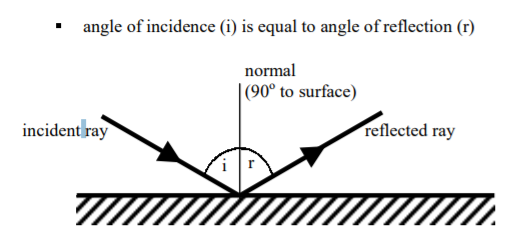
- Reflection: CDB-Mi
- wave changes direction at a boundary between two different media remaining in the original medium.
- we got 1.normal line 2.mirrored surface 3.incident(i) wave OR angle reflected(r) wave OR angle
- law: θi=θr
- law of reflection: θi=θr while f & λ unchanged.
- Refraction: CDB + Cc- Mnew
- waves change direction at boundary between two different media as it changes speed entering new medium. f remains unchanged from source
- Snell's law: sinθi/sinθr=constant at B given pλ
- the ratio of the sine of incident angle to the sine of reflected angle is constant at boundary of two media for wave given particular wavelength.
- constant: refractive index (п): iпr=sinθi/sinθr =vi/vr=λi/λr, 1/(iпr)= rпi
- v1 speed in medium one v2 speed inmedium two
- covention: air п ≈ vacuum п
- Critical angle at θr=90 → θi=θc & TIR(Total internal reflection) at θr>90 → θi>θc
- 1.law of TIR--> law of reflaction: θi=θr. 2.conditions for TIR: (1)θi>θc. (2)(sinθ∝θ, п>1), (therefore) it must travel from a medium of high п to a medium of low п.
- for critical angle: sin90=1, sinθc/sin(θr=90) =sinθc/1= (glass) п air. θc= arcsin(п)= arcsin[1/(air п glass)]
- experi. semi-circular block to determine п by θc
- 1.directing ray of light towards centre of semi-circular block -> ensure light out of block along the boundary.[θr=90°]. 2. carefully measure critical angle. (3. partial light is been reflected)
- appli. optical fibre: c of fine glass s cladding of low п
- Q1: 类似绝缘体的阻塞物叫 cladding used to protect inner glass. Q2: reduced diammeter of inner core: less light(wave) is lost, less change of refraction, less likelihood to fall below the critical angle.
- 1.optical fibre is made of core of fine glass surrounded by cladding with low refractive index. 2. light travels with TIR at core-cladding boundary. 3. wave is being step indexed to make sure it remains inside the core all the time so TIR.
- graph: refractive index across the fibre:形状:对称台阶,中间最高
- convention from car analogy: enter 'lower dense' medium wave be far away from normal line while speeds up, vice versa.
- car analogy left tie, right tie
- Superposition behaviour → Interference phenomenan : TWCP superpose → resultant W D=∑Di
- from superposition to interference: when two waves continuously pass through each other they superpose and produce a resultant wave with a displacement (of each particles in the new wave) equal to sum of individual displacements.
- the principle of superposition demonstrate that the resultant displacement equals sum of displacements at a point. e.g. this is the principle behind Bose cancelling-out headphones.
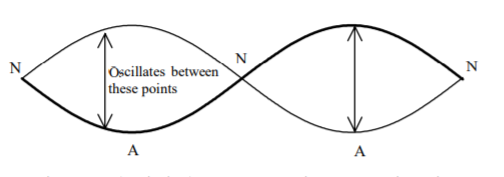
- Stationary wave formation: when 2W c & m T opposit D are superposed, nodes formed by DI & antinodes by CI
- when two waves are of coherent & monochromatic travelling in opposite direction are superposed, they formed a stationary wave. nodes formed by desctructive interference, and antinodes formed by constructive interference.
- (补充) 1.boundry conditions: the ends of nodes/ antinodes.
- Stationary waves: O XM ES, contain n & anti-n
- 1.oscillations(vibrations)(waves) dose not travel through matters. energy is stored by the wave. 2.contains nodes and antinodes.
- Differences between Stationary & Progressive: 1. S stores E, 2. A varies at nodes & antinodes, 3. △φ have two fixed values.
- 1. stationary wave store energy other than transferring energy. 2. at nodes, Amplitude=0. at antinodes, A= #. which means A varies. however for Progressive wave, it has only one fixed value of A. 3. for Stationary it only has two values of △φ.△φ=180 at either sides of a node.△φ=0 between adjacent nodes.however for Progressive △φ varies.
- 3 common types by different boundary conditions
- 2W-> reflected wave superpose the incident wave...
- nodes at ends: nfo= n Harmonics/ loop, λo=2L [v=constant=foλo, L: length of string] e.g. 3 Harmonics/ 3loops= 3fo, λ=1/3λo=2/3L
- one node, one antinode at ends: nfo= n Harmonics/ 高脚杯, λo=4L e.g. 3 Harmonics/ 3个高脚杯: f=3fo, λ=3fo/4L=4/3L (L=3/4λo)
- antinodes at ends: nfo= n Harmonics/ 沙漏, λo=2L e.g. 2 Harmonics/ 2个沙漏= 2fo, λ=2/(2λo)=L
- experiment set-up: sound with wall
- disadvantage: little energy loss in the wall when sound wave is reflected by it, hence the reflected wave is of lower amplitude.
- terms
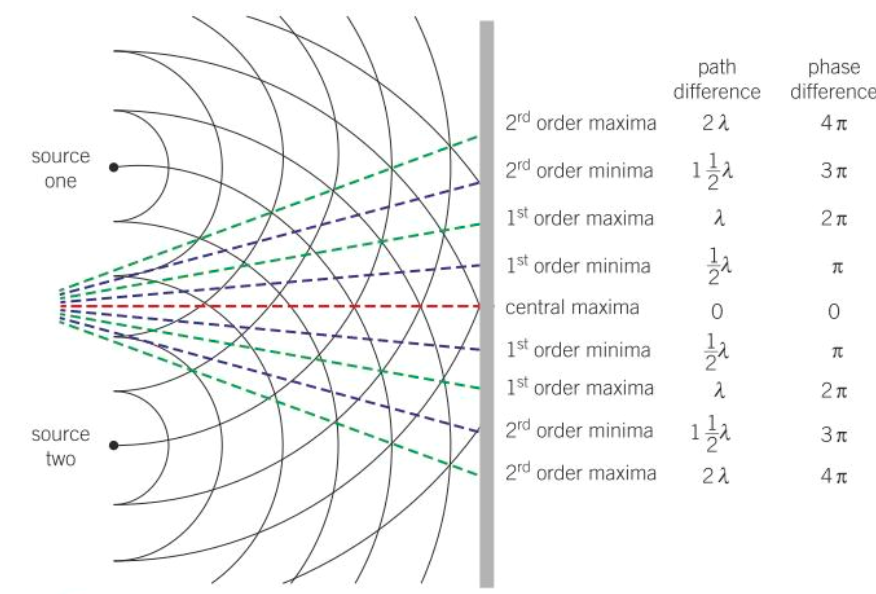
- constructive interference/maxima/reinforcement when 2in phase
- destructive interference/minima/cancellation when 2out of phase
- coherent: 2W maintain constant phase difference
- monochromatic: single wavelength
- experiment set-up: connect 2 with same signal generator and ensure same polarity of wire
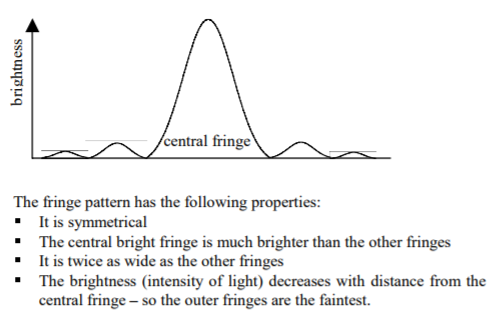
- interference patterns: comprises ESA maximas & minimas, HI occurred c
- comprises evenly spaced alternating maximas and minimas. while highest intensity occurred at the centre.(I∝1/ r^2)
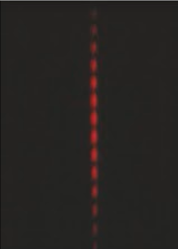
- (in the version of detector) detect a series of alternating high & low sections OR bright &dark bands. while low amplitude from entre to other sides.
- Diffraction: PG/TO S, strong when λ≈a
- 1.when wave pass through a gap or travel around an obstacle, they spread out. v,λ,f do not change. 2.strong/ how much wave can be diffracted at λ≈a which means they are of similar magnitudes. e.g. λ=10^6 ≈ a=10^7. λ=10^6 ≠ a=10^8.
- (补充) 1. it is a property unique to wave. 2. strong: wavefronts 呈扇形, weak: 呈坦克. 3. commonly a≥λ, so in practise we always acquired to narrow a.
- experi. single slit diffraction → I ∝ fringe width ∝ 1/ fringe seperaction ∝ (λ/a)
- 1. (λ/a) in fact is the width of central fringe other than others. but we can consider it as we shorten λ then more fringes/fringes are more concentrated shown on the screen.
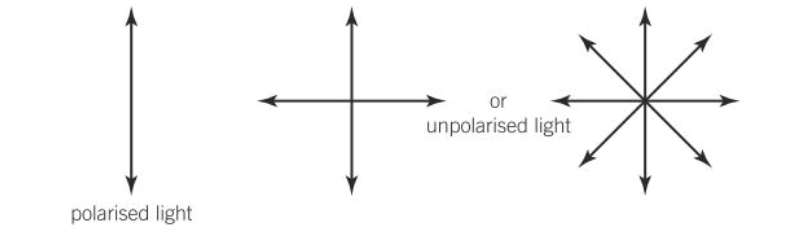
- Plane polarization: POD OPaE → E↓I↓
- (left) particles oscillate along one direction only. oscillation now are parallel to energy transference. resulted in intensity going down and loss in energy.
- (left) wave is confined to a single plane which determined the Direction of particle oscillation and energy propagation.
- appli. polarizer: filter → W with particular orientation TT
- polarizer is the filter that only allow waves with a particular orientation travelling through.
- e.g. clean floor and sea sometimes act as polarizer to the light wave entered into.
- appli + experi. L cannot be plane polarised, used to distinguish L & T
- since longitudinal wave already oscillate in one direction. to test: place a metal grid/polarizer and rotate to see whether it causes zero signal. 90° to wave propagation, intensity falls to zero.
- Reflection: CDB-Mi
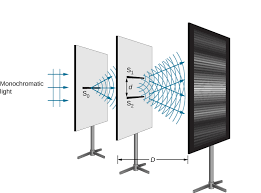
experi. Young's double slits
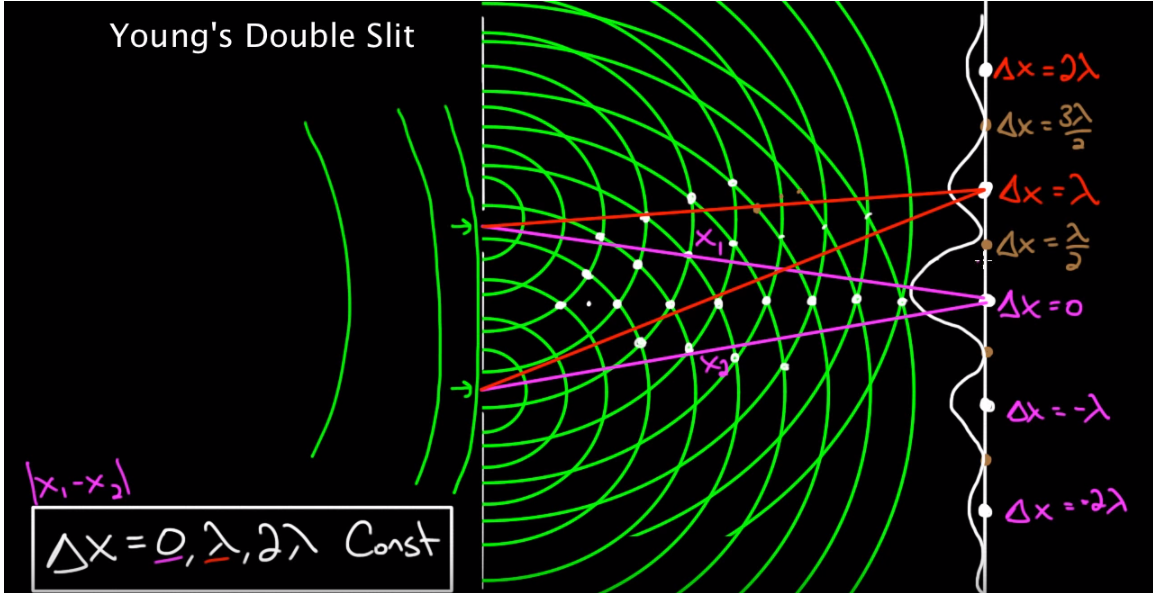
- to describe fully + narrow single slit(S) gives wider diffraction to ensure both slits(S1,S2) are illumunated. paths to S1 and S2 are of constant lengths giving constant phase difference, while they come from monochromatic source. coherent light sources are provided at S1 and S2.
- Young's double slits' equation: λ=ax/D
- a. slit seperation x. fringe seperation D. slits-to-screen distance λ: wavelength of monochromatic wave
- in practise we simply measure the distance between several bright fringes. like we measure 10, which means we see the length from first cnetre to 10th centre. so divide such by 9 to figure out the width of one fringe.
- Young's fringes formation
- how do they formed: 1.+ narrow single slit S to give wider diffraction to ensure both slits S1 & S2 are illuminated. 2.light wave is diffracted when they pass through S1 & S2. [while path to S are of constant lengths, given constant path and phase difference.and 2 come from monochromatic source.] 3. (therefore)diffracted waves can overlap/superpose and interfer. 4.bright bands are formed as constructive interference occurs where the path length from two slits to the screen differ by nλ. & dark bands are formed as destructive interference occurs where the path length from two slits to the screen differ by (n+1/2)λ.
experiment common apparatus: laser (wave nature of light), ripple tank (wave nature of water), signal generator (to produce sounds)
- water wave entres 'low dense medium' speeds up,λr↑shown wavefronts. so how to change speed of wave, change depth of water??
Waveform motion
- motion of particles: move from their equilibrium position to a new position. force between particles: displaced particles experience a restoring force from its neighbours in medium.[and be pulled back to original position.]
- Progressive waves: OME
- 1. oscillations (vibrations) travel through matter (medium). 2. transfer energy from one place to another, but not matter.
- e.g. sound. sound energy transfered to your ears. oscillation travels to your ears. other than air particles.
- particles oscillations/variations string disturbance/displacement to wave/energy propagation
- 2 types
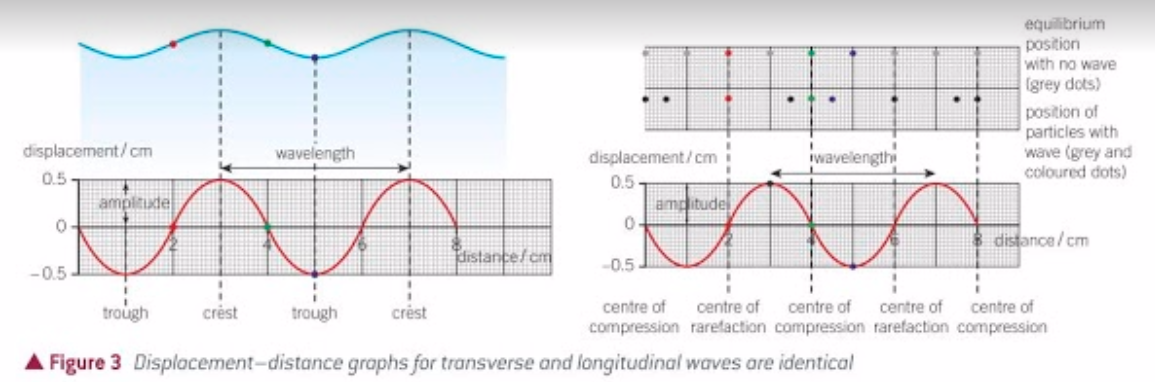
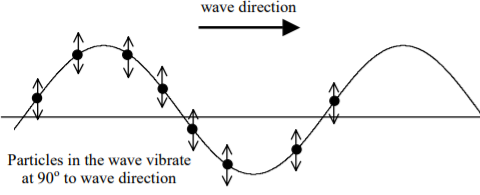
- Transverse wave: OPeE, contain p & t
- oscillations/ vibrations are perpendicular to the direction of energy transfer. contain peaks and troughts.
- motion of particles: ... each particles vibrate at 90° to the direction of energy transfer.
- e.g. 1.EM waves 2.waves on stretched strings
- EM waves: source from E & M OR
- source from electric and magnetic fields oscillating at right angles to each other. EM radiation/light.
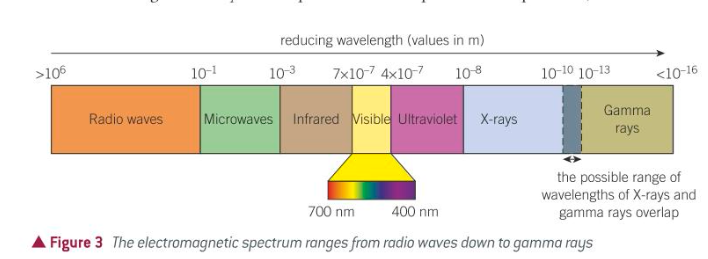
- Electromagnetic spectrum(λ↑): Giant Xylophones Usually Lie In Music Rooms
- e.g. what is infrarad: part of EM spectrum with range λ from 7×10^-7 to 10^-3
- properties complement
- v=c=3×10^8 in vacuum
- since transverse can be polarised
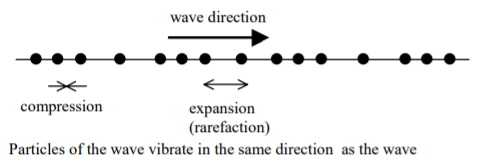
- Longitudinal wave: OPaE, contain c & r
- oscillations are parallel to the directions of energy transfer. contain compressions and rarefractions: regions where particles are closet or further apart from each others.
- Transverse wave: OPeE, contain p & t
- (energy transference) Intensity(I): P/A= E/ (t)(4πr^2)
- we call it Brightness for light wave, to be bright or dim, strong or weak.
- I∝E∝(Amplitude)^2, I∝1/(r^2)
- 1.E is directly proportional to A^2. 2.inverse-square law: when wave spreads out,d OR r↑. Energy↓while I↓.
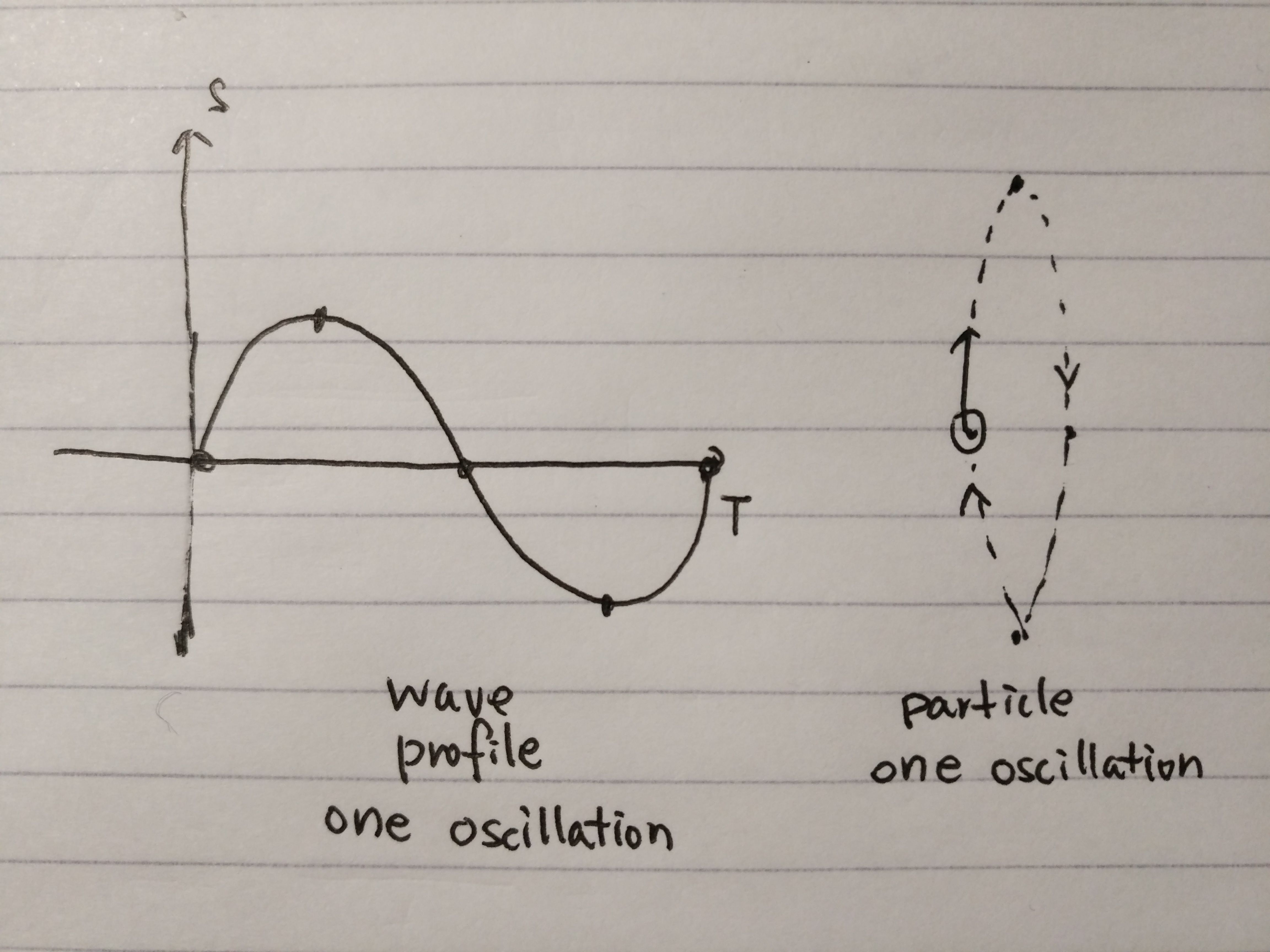
- wave profile: graph of s-D: snapshots of the wave
- some constants to find
- some constants to find. varies for different waves.
- s: OP → EP [m]
- displacement from its current position to equilibrium position=(distance from its current to equilibrium in a particle oscillating direction).
- nodes
- points of no vibration=min displacement. T P interfer destructively.
- antinodes
- points of maximum vibration=max displacement. T P interfer constructively.
- A: max s from EP [m]
- maximum displacement from its equilibrium position.
- λ: min D of 2 points in phase [m]
- minimum displacement between two points in phase on the wave.
- e.g. two peaks, two compressions.
- half-wavelength can be found as peaks to troughts.
- T: time taken WM λ past a given point [s]
- Time taken for wave to move one whole wavelength past a given point. (equals to time taken for particles to complete one oscillation.)
- f: # λ/s [Hz]
- frequency: number of wavelength travelled by a wave per seconds.
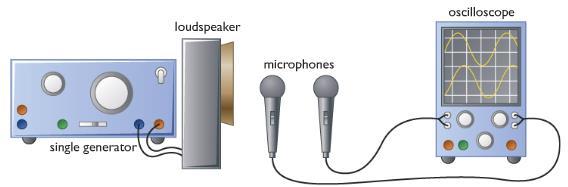
- experi. Oscilloscope to determine f of sound: Amplitude in voltage verse timebase
- f(p.d.)= f(s) 1/f(p.d.)= T= timebase * N for soundwave<-->microphone (y)amplitude in voltage against (x)timebase
- c=fλ [ms-1]
- speed=distance/time, derived as wave travels a distance of λ in a time interval T. c=λ/T=λf
- s-t graph of SHM: gradient gives speed
- phase (φ)
- phase angle: 定位方式, SHM position. 0 90 180 270 360 OR in rads
- phase difference (△φ)
- difference between phase positiona of particles along a wave (OR on different waves).
- 2π phase difference= 1λ path difference
- out of phase: φ=(2k+1)π =(k+1/2)λ
- particles are oscillating completely out of step with each other. e.g. one at max positive displacement while the other at max neg displacement at the same time.
- in phase: φ=2kπ =kλ
- particles are oscillating perfectly in step with each other. e.g. they both reach their max positive displacement at the same time.
- some constants to find
- + 2 way representations
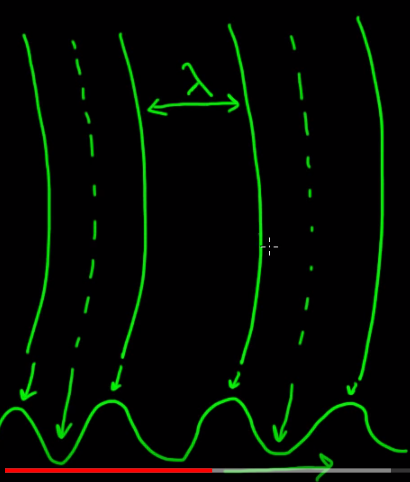
- wavefronts: a line joing points all in phase
- a way to show wavepath: a series of wavefronts λ=△gap, v=fλ:v ∝ λ, f(source) it is perpendicular to direction of wave motion/ energy transference.
- ray: path of wave propagation
- a way to show wavepath: it shows the direction of wavepath/ energy tranference
- wavefronts: a line joing points all in phase
Images and files in the map
Information
- Description
- OCR A OCRA PHYSICS Mind Map on WAVES, created by C D on 24/11/2017.
- Created by
- C D
- Views
- 0
- Rating