
Mind map
Viruses
Map content
Viruses
Structure
- Ways to classify
- Helical e.g tobacco mosaic
- Icosahedral e.g. adenovirus
- Enveloped e.g. influenza
- Complex e.g. T4 bacteriophage
- Genome - viral nucleic acid
- Types
- RNA
- DNA
- ss
- Linear
- Circular
- ds
- Single
- Multiple
- Function
- Synthesis of viral components and viral enzymes for replication and assembly of a virion.
- Types
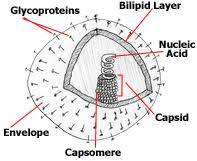
- Capsid - Protein coat
- Capsid + viral nucleic acid = nucleocapsid
- Protects, attaches and introduces viral genome into host cells
- Protein Subunits - capsomeres
- Nucleocapsid
- capsid + nucleic acid (genome)
- Envelope
- Lipid bilayer
- Phospholipids
- Glycoproteins
- Derived from host cell membranes by budding
- Virus incorporates its own proteins - appearing as glycoprotein spikes
- in most animal viruses
- Presence?
- Yes - enveloped virus
- No - naked virus
- Lipid bilayer
- Ways to classify
Viral replication
- Bacteriophages - viruses that only infect bacteria
- Lytic
- Lyse the host bacterium
- E.g. T4 Bacteriophage (ds DNA)
- Lytic life cycle
- 1. Attachment
- attachment sites on tail fibres recognise and adsorb to complementary receptor sites on bacterial surface
- Viral specificity: specific strains of bacteriophages can only adsorb to specific strains of host bacteria
- most adsorb to cell wall (but some attach to flagella/pili)
- 2. Penetration
- Phage TAIL releases lysozyme
- digests bacterial cell wall, allowing release of molecules
- molecules trigger a change in shape of phage base plate
- initiating contraction of tail sheath
- which drives hollow core tube through cell wall
- initiating contraction of tail sheath
- molecules trigger a change in shape of phage base plate
- digests bacterial cell wall, allowing release of molecules
- tip of core reaches plasma membrane --> phage DNA injected into bacterial cell
- empty capsid remains outside cell
- Phage TAIL releases lysozyme
- 3. Replication
- Early replication: Phage genes expressed Enzymes produced to hydrolyse bacterium’s DNA to nucleotides. Phage takes complete control of host cell macromolecular synthesising machinery to replicate its own genome. Early proteins digest host cell genome. Late replication: Uses bacteria’s metabolic machinery + resources to express phage enzymes and phage components (late proteins)
- Eclipse period
- Period when complete, infective virions are not yet present in host cell
- only separate components e.g. DNA, protein present
- Phage enzymes take over host cell's macromolecular synthesising machinery
- Host cell DNA degraded into nucleotides
- Nucleotides from host cell's degraded DNA used to synthesise many copies of phage DNA
- viral DNA escapes degradation due to DNA methylation
- early proteins
- Host cell DNA degraded into nucleotides
- Phage DNA immediately transcribed
- synthesise mRNA using host RNA polymerase
- Biosynthesis of viral proteins
- uses bacterium's metabolic machinery
- synthesise phage enzymes and phage structural components
- late proteins
- uses bacterium's metabolic machinery
- 4. Maturation
- Phage DNA + capsid assemble into DNA-filled head
- Head, tail, tail fibres assembled independently, joined in specific sequence
- tail fibres to tail, then head to tail
- 5. Release
- phage lysozyme breaks down bacterial cell wall
- host cell plasma membrane lyses
- newly formed mature phage virions released, ready to infect other cells and repeat cycle
- 1. Attachment
- Lytic life cycle
- Temperate
- Incorporates its DNA into the host bacterium's DNA and becomes a prophage
- E.g. Lambda bacteriophage (ds DNA)
- Lysogenic life cycle
- 3. Replication
- linear phage DNA circularises
- inserted into host cell genome by integrase
- integrase binds at attachment site sequences of viral DNA and host cell DNA, forming lambda integrase protein complex
- catalysis of double strand breakage and rejoining
- integrase dissociates --> phage DNA integrated into bacterial chromosome
- catalysis of double strand breakage and rejoining
- integrated DNA = prophage
- prophage gene expression repressed by phage repressor proteins
- genes directing synthesis and release of new virions are not transcribed
- phage DNA not synthesised
- genes directing synthesis and release of new virions are not transcribed
- prophage DNA replicates along with bacterial chromosome
- prophage remains latent in all progeny cells
- prophage gene expression repressed by phage repressor proteins
- integrase binds at attachment site sequences of viral DNA and host cell DNA, forming lambda integrase protein complex
- inserted into host cell genome by integrase
- linear phage DNA circularises
- 4. Spontaneous induction
- cellular proteases activated
- Repressor proteins destroyed
- prophage no longer repressed
- prophage excised, enters lytic cycle
- 5. Maturation - same as lytic
- 1. Attachment - same as Lytic
- 2. Penetration - same as lytic
- 6. Release - same as lytic
- 3. Replication
- Lysogenic life cycle
- Host cells immune to re-infection by same phage
- capable of specialised transduction
- phage packages adjacent bacterial DNA together with its own viral DNA in same capsid, transferred to new bacterial cell along with prophage when virion infects a new cell.
- Lytic
- Animal viruses
- Influenza (ss RNA)
- Structure
- Genome
- 8 different segments of ss RNA associated with nucleoproteins
- 3 RNA segments code for 3 different polymerases
- 3 polymerases form RNA-dependent RNA polymerase enzyme complex
- or RNA replicase
- Function: replication and transcription of viral genome
- 3 polymerases form RNA-dependent RNA polymerase enzyme complex
- Other 5 segments
- haemmagglutinin
- impt for recognition and attachment to host cell
- neuraminidase
- impt for leaving host cell
- nucleoprotein, matrix protein M1, non-structural proteins
- haemmagglutinin
- 3 RNA segments code for 3 different polymerases
- negative strand genome
- sequence of viral genome is complementary to sequence of viral mRNA
- 8 different segments of ss RNA associated with nucleoproteins
- Capsid - Present
- Envelope
- Embedded with haemagglutinin (glycoprotein) and neuraminidase (enzyme)
- diff types of h and n give rise to diff strains of influenza
- Embedded with haemagglutinin (glycoprotein) and neuraminidase (enzyme)
- Genome
- Replication cycle
- 1. Attachment
- Protruding glycoproteins bind specific receptor molecules on host cell
- Humans - haemagglutinin on influenza binds sialic acid receptor on host cell membrane
- Protruding glycoproteins bind specific receptor molecules on host cell
- 2. Penetration and uncoating
- Virus enters by endocytosis
- Host plasma membrane invaginates and pinches off
- Virus placed in endocytic vesicle/endosome
- Vesicle fuses with lysosome --> pH of environment lowered --> viral envelope stimulated to fuse with lipid bilayer of vesicle membrane
- Virus placed in endocytic vesicle/endosome
- Nucleocapsid released into cytoplasm
- Capsid degraded by cellular enzymes
- Helical nucleoprotein enters nucleus of cell
- Capsid degraded by cellular enzymes
- Host plasma membrane invaginates and pinches off
- Virus enters by endocytosis
- 3. Replication
- Viral genome used as template to synthesise viral mRNA (+ strand RNA)
- catalysed by viral RNA-dependent RNA polymerase
- mRNA acts as template for synthesis of new viral RNA genome
- mRNA strands exit nucleus to cytosol and rER
- translated into viral structural components e.g. glycoproteins and capsid proteins
- mRNA strands exit nucleus to cytosol and rER
- Viral genome used as template to synthesise viral mRNA (+ strand RNA)
- 4. Maturation
- Viral glycoproteins transported out of ER, incorporated into plasma membrane
- Associate with capsid proteins
- viral genome associates with all other proteins to form helical nucleoprotein
- interaction with capsid proteins--> budding initiated
- Viral glycoproteins transported out of ER, incorporated into plasma membrane
- 5. Release by budding
- Evagination - each new virus buds from cell
- host cell may/may not lyse
- new viruses acquire host membrane with viral glycoproteins embedded
- neuraminidase facilitates release
- Cleaves sialic acid and progeny virions from cell surface
- Evagination - each new virus buds from cell
- 1. Attachment
- Structure
- HIV - Retrovirus (ss RNA)
- Structure
- Genome
- 2 copies of ss RNA
- tightly bound to nucleocapsid proteins (nucleoprotein in HIV)
- both positive strands
- genome has same sequence as viral mRNA
- 3 major genes 5'-gag-pol-env-3'
- gag: structural proteins
- capsid
- matrix
- nucleocapsid protein
- pol: viral enzymes
- integrase
- reverse transcriptase
- HIV protease
- env: glycoproteins
- gp120
- gp41
- gag: structural proteins
- 2 copies of ss RNA
- Capsid
- conical-shaped
- contains reverse transcriptase, integrase and protease
- Envelope
- embedded with gp120 and gp41
- Have specific conformation allowing virus to bind certain receptors on T4 helper cells
- embedded with gp120 and gp41
- Genome
- Replication cycle
- 2. Penetration and uncoating
- gp41 helps fuse viral envelope with host cell membrane
- Capsid released into cell, leaving envelope behind
- Capsid + nucleocapsid protein degraded
- viral enzymes and RNA released into host cell cytoplasm
- gp41 helps fuse viral envelope with host cell membrane
- 3. Replication
- Step 1
- Viral reverse transcriptase catalyses conversion of viral RNA into DNA
- First, DNA strand complementary to viral RNA strand is synthesised
- RNA-DNA hybrid formed
- Step 2
- Viral DNA enters host cell nucleus --> integrated into host's genetic material
- becomes provirus
- may remain latent for years afterwards
- catalysed by integrase
- Activation of host cell --> viral DNA transcribed into viral RNA
- serves as mRNA
- Viral DNA enters host cell nucleus --> integrated into host's genetic material
- Step 3
- mRNA exits nucleus into cytoplasm
- translated into viral polyproteins
- gp120 & gp41 made in ER
- transported by vesicles to plasma membrane
- mRNA exits nucleus into cytoplasm
- Step 1
- 4. Maturation
- Polyproteins and HIV RNA genome assemble at inner surface of host cell's plasma membrane
- 1. Attachment
- virus must contact cell with CD4 protein on surface
- T lymphocytes/T- helper cells
- macrophages
- gp120 binds complementary CD4 receptors on cells, with the help of co-receptor
- virus must contact cell with CD4 protein on surface
- 5. Release
- virus buds off/evaginates
- Viral envelope derived from host cell membrane
- HIV protease cleaves polyproteins into functional proteins
- structural proteins
- viral enzymes
- mature virions
- 2. Penetration and uncoating
- Structure
- Influenza (ss RNA)
- Difference between prophage and provirus: Prophage is DNA that has been integrated into prokaryote's genetic material. Provirus is DNA that has entered a eukaryotic cell's nucleus and is integrated into the host cell's genome.
- Bacteriophages - viruses that only infect bacteria
Variation
- Antigenic drift
- accumulation of mutations in genes encoding surface glycoproteins
- Influenza: Haemagglutinin and neuraminidase
- surface antigens/glycoproteins have different conformations
- Results from
- RNA-dependent RNA polymerase: lack of proof-reading ability
- Virus: Fast/high rate of replication
- Virus is ss RNA, no backup for replication
- accumulation of mutations in genes encoding surface glycoproteins
- Antigenic shift
- When a bird strain and a human strain of the same virus infect a single cell of an intermediate host e.g. a pig, genetic reassortment can occur. When new viruses are assembled in the host cell, they can have new combinations of RNA segments. Sometimes genetic reassortment produces viruses with new antigens. Host becomes susceptible to the virus if the host does not have antibodies that recognises these modified antigens once infected.
- Results from
- 2 ot more different strains of a virus/different viruses combine to form a new subtype
- having a mixture of surface antigens of the original types.
- segmented RNA genome allows for reassortment
- the segments of genes that code for haemagglutinin and neuraminidase,
- 2 ot more different strains of a virus/different viruses combine to form a new subtype
- sudden and major change in the surface antigens of a virus
- genetic reassortment, conferring phenotypic change
- http://www.virology.ws/2009/06/29/reassortment-of-the-influenza-virus-genome/
- host cell forms new viruses combining surface antigens of the two different strains that infect the same cell
- may further evolve to spread from person to person
- genetic reassortment, conferring phenotypic change
- enables strains to jump from species to species
- mostly influenza
- How immune system recognises viruses
- antigens are on virus particles
- antibodies and other receptors are in our immune systems
- immune receptors are virus-specific --> recognise and bind to antigens on viruses
- body produces more after an infection --> re-infection prevented --> acquired immunity
- antigens constantly mutate to produce new forms --> no longer specific to receptors --> no longer bind --> evade immunity
- body produces more after an infection --> re-infection prevented --> acquired immunity
- Note COMPARISON TABLE
- Antigenic drift
Types
- Naked viruses - only nucleocapsid
- Enveloped viruses
Characteristics
Images and files in the map

Information
- Description
- Year 6 Biology (Viruses) Mind Map on Viruses, created by Steph Lee on 28/11/2017.
- Created by
- Steph Lee
- Views
- 24
- Tags
- Rating