
Mind map
Gene Expression
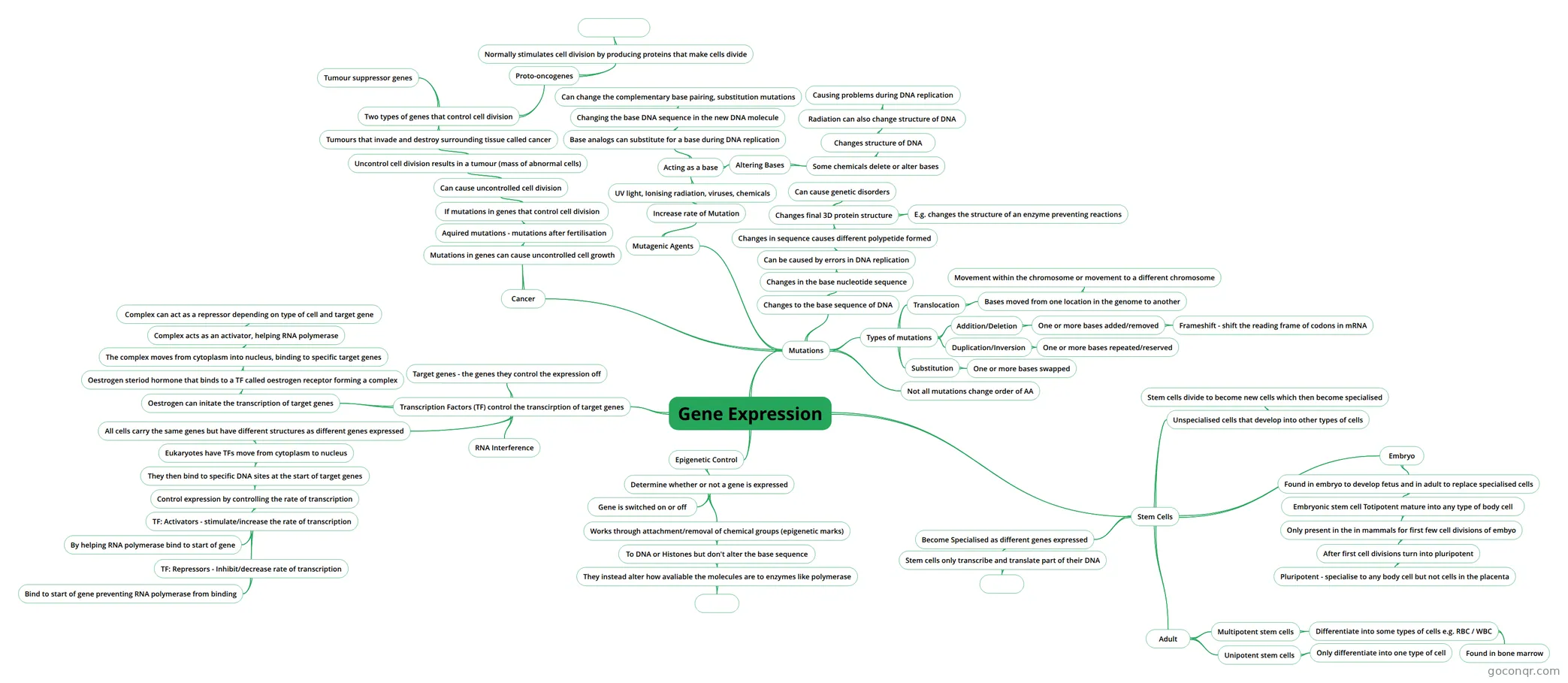
Mind map: Gene expression
Map content
Gene Expression
Mutations
- Changes to the base sequence of DNA
- Changes in the base nucleotide sequence
- Can be caused by errors in DNA replication
- Changes in sequence causes different polypetide formed
- Changes final 3D protein structure
- E.g. changes the structure of an enzyme preventing reactions
- Can cause genetic disorders
- Changes final 3D protein structure
- Changes in sequence causes different polypetide formed
- Can be caused by errors in DNA replication
- Changes in the base nucleotide sequence
- Types of mutations
- Substitution
- One or more bases swapped
- Addition/Deletion
- One or more bases added/removed
- Frameshift - shift the reading frame of codons in mRNA
- One or more bases added/removed
- Duplication/Inversion
- One or more bases repeated/reserved
- Translocation
- Bases moved from one location in the genome to another
- Movement within the chromosome or movement to a different chromosome
- Bases moved from one location in the genome to another
- Substitution
- Not all mutations change order of AA
- Mutagenic Agents
- Increase rate of Mutation
- UV light, Ionising radiation, viruses, chemicals
- Acting as a base
- Altering Bases
- Some chemicals delete or alter bases
- Changes structure of DNA
- Radiation can also change structure of DNA
- Causing problems during DNA replication
- Radiation can also change structure of DNA
- Changes structure of DNA
- Some chemicals delete or alter bases
- Base analogs can substitute for a base during DNA replication
- Changing the base DNA sequence in the new DNA molecule
- Can change the complementary base pairing, substitution mutations
- Changing the base DNA sequence in the new DNA molecule
- Altering Bases
- Acting as a base
- UV light, Ionising radiation, viruses, chemicals
- Increase rate of Mutation
- Cancer
- Mutations in genes can cause uncontrolled cell growth
- Aquired mutations - mutations after fertilisation
- If mutations in genes that control cell division
- Can cause uncontrolled cell division
- Uncontrol cell division results in a tumour (mass of abnormal cells)
- Tumours that invade and destroy surrounding tissue called cancer
- Two types of genes that control cell division
- Proto-oncogenes
- Normally stimulates cell division by producing proteins that make cells divide
- Normally stimulates cell division by producing proteins that make cells divide
- Tumour suppressor genes
- Proto-oncogenes
- Two types of genes that control cell division
- Tumours that invade and destroy surrounding tissue called cancer
- Uncontrol cell division results in a tumour (mass of abnormal cells)
- Can cause uncontrolled cell division
- If mutations in genes that control cell division
- Aquired mutations - mutations after fertilisation
- Mutations in genes can cause uncontrolled cell growth
- Changes to the base sequence of DNA
Stem Cells
- Unspecialised cells that develop into other types of cells
- Stem cells divide to become new cells which then become specialised
- Embryo
- Found in embryo to develop fetus and in adult to replace specialised cells
- Embryonic stem cell Totipotent mature into any type of body cell
- Only present in the in mammals for first few cell divisions of embyo
- After first cell divisions turn into pluripotent
- Pluripotent - specialise to any body cell but not cells in the placenta
- After first cell divisions turn into pluripotent
- Only present in the in mammals for first few cell divisions of embyo
- Embryonic stem cell Totipotent mature into any type of body cell
- Found in embryo to develop fetus and in adult to replace specialised cells
- Adult
- Multipotent stem cells
- Differentiate into some types of cells e.g. RBC / WBC
- Found in bone marrow
- Differentiate into some types of cells e.g. RBC / WBC
- Unipotent stem cells
- Only differentiate into one type of cell
- Multipotent stem cells
- Become Specialised as different genes expressed
- Stem cells only transcribe and translate part of their DNA
- Stem cells only transcribe and translate part of their DNA
- Unspecialised cells that develop into other types of cells
Epigenetic Control
- Determine whether or not a gene is expressed
- Gene is switched on or off
- Works through attachment/removal of chemical groups (epigenetic marks)
- To DNA or Histones but don't alter the base sequence
- They instead alter how avaliable the molecules are to enzymes like polymerase
- They instead alter how avaliable the molecules are to enzymes like polymerase
- To DNA or Histones but don't alter the base sequence
- Determine whether or not a gene is expressed
Transcription Factors (TF) control the transcirption of target genes
- All cells carry the same genes but have different structures as different genes expressed
- Eukaryotes have TFs move from cytoplasm to nucleus
- They then bind to specific DNA sites at the start of target genes
- Control expression by controlling the rate of transcription
- TF: Activators - stimulate/increase the rate of transcription
- By helping RNA polymerase bind to start of gene
- TF: Repressors - Inhibit/decrease rate of transcription
- Bind to start of gene preventing RNA polymerase from binding
- TF: Activators - stimulate/increase the rate of transcription
- Control expression by controlling the rate of transcription
- They then bind to specific DNA sites at the start of target genes
- Eukaryotes have TFs move from cytoplasm to nucleus
- Target genes - the genes they control the expression off
- Oestrogen can initate the transcription of target genes
- Oestrogen steriod hormone that binds to a TF called oestrogen receptor forming a complex
- The complex moves from cytoplasm into nucleus, binding to specific target genes
- Complex acts as an activator, helping RNA polymerase
- Complex can act as a repressor depending on type of cell and target gene
- Complex acts as an activator, helping RNA polymerase
- The complex moves from cytoplasm into nucleus, binding to specific target genes
- Oestrogen steriod hormone that binds to a TF called oestrogen receptor forming a complex
- RNA Interference
- All cells carry the same genes but have different structures as different genes expressed
Information
- Description
- A2 Biology (Section 8) Mind Map on Gene Expression, created by Dominic Weston on 05/03/2018.
- Created by
- Dominic Weston
- Views
- 12
- Rating