
Mind map
AQA GCSE Biology B1.2 Coordination and control
Map content
AQA GCSE Biology B1.2 Coordination and control
Nerves and hormones
- The nervous system and hormones allow us to respond to external changes.
- They also help us control the conditions inside our bodies.
- Hormones are used in some types of contraception and fertility treatment.
- They also help us control the conditions inside our bodies.
- The nervous system and hormones allow us to respond to external changes.
The Nervous system
- The nervous system enables humans to react to their surroundings and to coordinate their behaviour.
- Cells called receptors detect stimuli (changes in the environment)
- Receptors and the stimuli they can detect include:
- Receptors in the eye which are sensitive to light
- Receptors in the ears which are sensitive to sound.
- Receptors on the tongue and in the nose which are sensitive to chemicals and enable us to taste and smell
- Receptors in the ears which are sensitive to changes in position and enable us to balance
- Receptors in the skin which are sensitive to touch, pressure, pain and temperature changes.
- Receptors in the ears which are sensitive to changes in position and enable us to balance
- Receptors on the tongue and in the nose which are sensitive to chemicals and enable us to taste and smell
- Receptors in the ears which are sensitive to sound.
- Receptors in the eye which are sensitive to light
- Light receptor cells, like most animal cells have a nucelous, cytoplasm and cell membrane.
- The brain and the spinal cord form the central nervous system (CNS)
- Nerves contain nuerons.
- Sensory nuerons carry impulses from receptors to the CNS
- Motor nuerons carry impulses from the CNS to the effector organs which may be muscles or glands.
- The muscles repsond by contracting.
- The glands respond by secreting chemicals.
- Motor nuerons carry impulses from the CNS to the effector organs which may be muscles or glands.
- Sensory nuerons carry impulses from receptors to the CNS
- Nerves contain nuerons.
- Receptors and the stimuli they can detect include:
- Cells called receptors detect stimuli (changes in the environment)
- The nervous system enables humans to react to their surroundings and to coordinate their behaviour.
Reflex actions
- Reflex actions are automatic and rapid
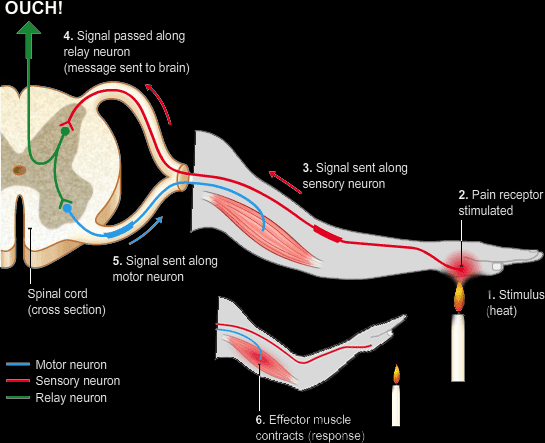
- They often involve sensory, relay and motor nuerons.
- In a simple reflex action:
- A receptor detects a stimulus (e.g a sharp pain)
- Electrical impulses are transmitted from the receptor, along the sensory neuron to the CNS
- At the synapse (a junction between 2 neurons) between the sensory and the relay neuron in the CNS, a chemical diffuses across the gap which causes the impulse to be sent along the relay neuron.
- A chemical is then released at the synapse between the relay neuron and the motor neuron in the CNS which causes the impulses to be transmitted along the motor neuron to the effector that brings about the response.
- The effector is either a muscle or a gland; if it is a muscle is the impulse causes it to contract but if it is a gland the response is to secretes chemicals.
- A chemical is then released at the synapse between the relay neuron and the motor neuron in the CNS which causes the impulses to be transmitted along the motor neuron to the effector that brings about the response.
- At the synapse (a junction between 2 neurons) between the sensory and the relay neuron in the CNS, a chemical diffuses across the gap which causes the impulse to be sent along the relay neuron.
- Electrical impulses are transmitted from the receptor, along the sensory neuron to the CNS
- The sequence from receptor to effector is called a reflex arc
- A receptor detects a stimulus (e.g a sharp pain)
- In a simple reflex action:
- They often involve sensory, relay and motor nuerons.
- REFLEX ARC
- Reflex actions are automatic and rapid
Control in the human body
- internal conditions that are controlled include:
- The water content of the body ~ water leaves the body via the lungs when we breathe out and via the skin when we sweat to cool us down, the excess water is lost via the kidneys in urine
- The ion content of the body ~ ions are lost via the skin when we sweat and via the kidneys in urine
- Temperature ~ to maintain the temperature at which enzymes work best
- Blood sugar levels ~ to provide cells with constant energy, controlled by the pancreas
- Temperature ~ to maintain the temperature at which enzymes work best
- The ion content of the body ~ ions are lost via the skin when we sweat and via the kidneys in urine
- The water content of the body ~ water leaves the body via the lungs when we breathe out and via the skin when we sweat to cool us down, the excess water is lost via the kidneys in urine
- Hormones
- Many processes within the body are controlled by chemical substances called hormones
- Hormones are secreted by glands and are usually transported to their target organs by the bloodstream
- Hormones regulate the functions of many organs and cells
- For example the monthly release of an egg from a woman's ovaries and the changes in the thickness of the lining of her womb are controlled by hormones secreted by the pituitary gland and by the ovaries.
- Several hormones are involved in the menstrual cycle of a woman
- Hormones are involved in promoting the release of an egg:
- Follicle Stimulating Hormone (FSH) is secreted by the pituitary gland and causes the egg to mature in the ovaries.
- It also stimulates the ovaries to produce hormones including oestrogen.
- Luteinising hormone (LH) is made by the puitary gland and stimulates the release of a mature egg from the ovaries (Ovulation)
- Oestrogen is produced by the ovaries and inhibits the further production of FSH.
- It also stimulates the production of LH and stimulates the womb lining to develop to receive the fertilised egg
- Oestrogen is produced by the ovaries and inhibits the further production of FSH.
- Luteinising hormone (LH) is made by the puitary gland and stimulates the release of a mature egg from the ovaries (Ovulation)
- It also stimulates the ovaries to produce hormones including oestrogen.
- Follicle Stimulating Hormone (FSH) is secreted by the pituitary gland and causes the egg to mature in the ovaries.
- The menstrual cycle takes around 28 days with ovulation happening about 14 days into the cycle
- Hormones are involved in promoting the release of an egg:
- Several hormones are involved in the menstrual cycle of a woman
- For example the monthly release of an egg from a woman's ovaries and the changes in the thickness of the lining of her womb are controlled by hormones secreted by the pituitary gland and by the ovaries.
- The artificial control of fertility
- Oral contraceptives contain hormones such as Oestrogen and progesterone to inhibit the production of FSH
- This means that no eggs mature
- The first birth control pills contained large amounts of oestrogen, which resulted in women suffering significant side effects.
- Now, birth control pills contain a much lower dose of oestrogen, or are progesterone only.
- Progesterone only pills have fewer side effects.
- Now, birth control pills contain a much lower dose of oestrogen, or are progesterone only.
- The first birth control pills contained large amounts of oestrogen, which resulted in women suffering significant side effects.
- This means that no eggs mature
- IVF
- It stands for In Vitro Fertilisation
- IVF involves giving a women FSH and LH to stimulate the maturation of several eggs.
- The eggs are collected from the mother and fertilised with sperm from the father
- The fertilised eggs develop into embryos and when they are at the stage of being tiny balls of cells, one or two are inserted into the woman's uterus (womb)
- The eggs are collected from the mother and fertilised with sperm from the father
- IVF involves giving a women FSH and LH to stimulate the maturation of several eggs.
- It stands for In Vitro Fertilisation
- Oral contraceptives contain hormones such as Oestrogen and progesterone to inhibit the production of FSH
- Many processes within the body are controlled by chemical substances called hormones
- internal conditions that are controlled include:
Control in plants
- Plants are sensitive to light, moisture and gravity
- Plant shoots grow TOWARDS light. This response is called PHOTOTROPISM
- The shoot is positively phototropic and grows towards the light enabling the plant to photosynthesize more.
- The root is negatively phototropic and grows away from light
- Plants grow down TOWARDS gravity. This is called GRAVITROPISM or GEOTROPSIM.
- The shoots are negatively geotropic and so grow against the force of gravity.
- The roots are positively geotropic and so grow in the direction of gravity.
- Roots also grow TOWARDS water. This response is called HYDROTROPISM.
- A chemical called Auxin controls a plant's responses to light and gravity.
- Cells at the tips of stems and roots produce auxin.
- It slows down growth in roots.
- It speeds up growth in stems.
- Unequal distribution of auxin causes unequal growth.
- This results in bending of the shoot or root.
- When light comes from above, auxin spreads out evenly down the stem. The stem grows straight.
- When light comes from one side, the auxin spreads down the SHADED side of the stem
- Auxin makes the cells grow FASTER. This causes the stem to bend towards the light.
- When light comes from one side, the auxin spreads down the SHADED side of the stem
- If a plant is laid on its side, auxin gathers in the lower half of the stem and root.
- Auxin in the roots SLOWS DOWN the growth of root cells
- The root curves downwards.
- Auxin that has spread the the side of the stem SPEEDS UP the growth of stem cells.
- The stem curves upwards.
- Auxin that has spread the the side of the stem SPEEDS UP the growth of stem cells.
- The root curves downwards.
- Auxin in the roots SLOWS DOWN the growth of root cells
- When light comes from above, auxin spreads out evenly down the stem. The stem grows straight.
- This results in bending of the shoot or root.
- Cells at the tips of stems and roots produce auxin.
- Plant shoots grow TOWARDS light. This response is called PHOTOTROPISM
- Using plant hormones
- Plant hormones can be used by farmers and gardeners.
- Weed killers are used to kill unwanted plants on lawns.
- When cuttings are taken from plants, hormones are used to encourage the roots to grow before the cutting is planted.
- Some hormones are used to encourage fruit to ripen.
- If plant hormones are used incorrectly they can cause damage to the environment, e.g. weedkillers may harm other more useful plants.
- Some hormones are used to encourage fruit to ripen.
- When cuttings are taken from plants, hormones are used to encourage the roots to grow before the cutting is planted.
- Weed killers are used to kill unwanted plants on lawns.
- Plant hormones can be used by farmers and gardeners.
- Plants are sensitive to light, moisture and gravity
Images and files in the map
Information
- Description
- GCSE Biology Mind Map on AQA GCSE Biology B1.2 Coordination and control, created by Katie Nunn on 29/11/2014.
- Created by
- Katie Nunn
- Views
- 164
- Tags
- Rating