
Mind map
Brain
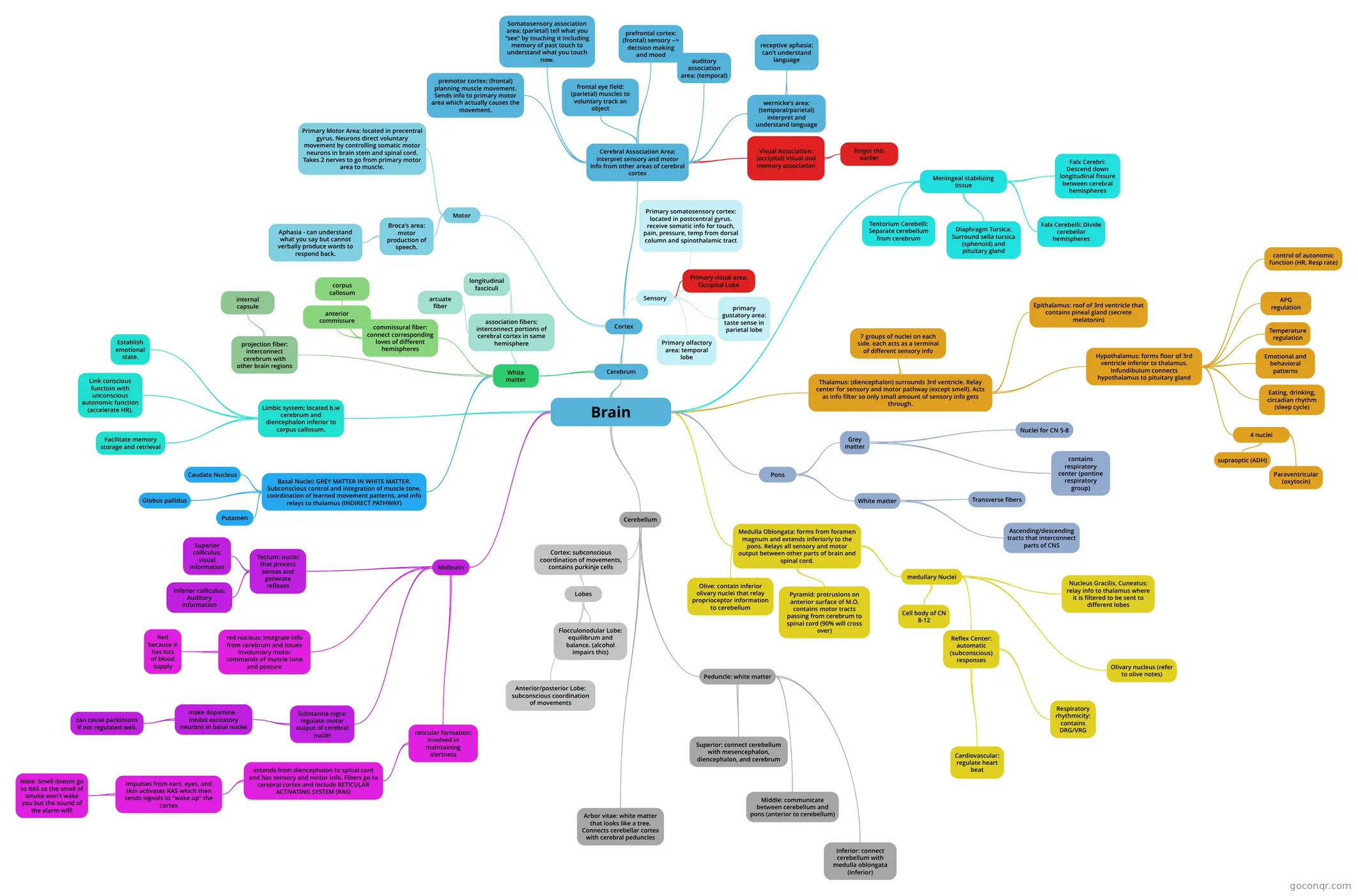
Mind map: brain anatomy
Map content
Brain
Cerebrum
- Cortex
- Sensory
- Primary somatosensory cortex: located in postcentral gyrus. receive somatic info for touch, pain, pressure, temp from dorsal column and spinothalamic tract
- Primary visual area: Occipital Lobe
- primary gustatory area: taste sense in parietal lobe
- Primary olfactory area: temporal lobe
- Motor
- Primary Motor Area: located in precentral gyrus. Neurons direct voluntary movement by controlling somatic motor neurons in brain stem and spinal cord. Takes 2 nerves to go from primary motor area to muscle.
- Broca's area: motor production of speech.
- Aphasia - can understand what you say but cannot verbally produce words to respond back.
- Cerebral Association Area: interpret sensory and motor info from other areas of cerebral cortex
- Somatosensory association area: (parietal) tell what you "see" by touching it including memory of past touch to understand what you touch now.
- prefrontal cortex: (frontal) sensory --> decision making and mood
- auditory association area: (temporal)
- wernicke's area: (temporal/parietal) interpret and understand language
- receptive aphasia: can't understand language
- premotor cortex: (frontal) planning muscle movement. Sends info to primary motor area which actually causes the movement.
- frontal eye field: (parietal) muscles to voluntary track an object
- Visual Association: (occipital) Visual and memory association
- forgot this earlier
- Sensory
- White matter
- association fibers: interconnect portions of cerebral cortex in same hemisphere
- arcuate fiber
- longitudinal fasciculi
- commissural fiber: connect corresponding loves of different hemispheres
- corpus callosum
- anterior commissure
- projection fiber: interconnect cerebrum with other brain regions
- internal capsule
- Basal Nuclei: GREY MATTER IN WHITE MATTER. Subconscious control and integration of muscle tone, coordination of learned movement patterns, and info relays to thalamus (INDIRECT PATHWAY)
- Caudate Nucleus
- Putamen
- Globus pallidus
- association fibers: interconnect portions of cerebral cortex in same hemisphere
- Cortex
Midbrain
- Tectum: nuclei that process senses and generate reflexes
- Superior colliculus: visual information
- Inferior colliculus: Auditory information
- red nucleus: integrate info from cerebrum and issues involuntary motor commands of muscle tone and posture
- Red because it has lots of blood supply
- reticular formation: involved in maintaining alertness
- extends from diencephalon to spinal cord and has sensory and motor info. Fibers go to cerebral cortex and include RETICULAR ACTIVATING SYSTEM (RAS)
- Impulses from ears, eyes, and skin activates RAS which then sends signals to "wake up" the cortex
- Note: Smell doesnt go to RAS so the smell of smoke won't wake you but the sound of the alarm will!
- Impulses from ears, eyes, and skin activates RAS which then sends signals to "wake up" the cortex
- extends from diencephalon to spinal cord and has sensory and motor info. Fibers go to cerebral cortex and include RETICULAR ACTIVATING SYSTEM (RAS)
- Substantia nigra: regulate motor output of cerebral nuclei
- make dopamine - inhibit excitatory neurons in basal nuclei
- can cause parkinsons if not regulated well.
- make dopamine - inhibit excitatory neurons in basal nuclei
- Tectum: nuclei that process senses and generate reflexes
Cerebellum
- Arbor vitae: white matter that looks like a tree. Connects cerebellar cortex with cerebral peduncles
- Peduncle: white matter
- Superior: connect cerebellum with mesencephalon, diencephalon, and cerebrum
- Middle: communicate between cerebellum and pons (anterior to cerebellum)
- Inferior: connect cerebellum with medulla oblongata (inferior)
- Cortex: subconscious coordination of movements, contains purkinje cells
- Lobes
- Anterior/posterior Lobe: subconscious coordination of movements
- Flocculonodular Lobe: equilibrum and balance. (alcohol impairs this)
- Lobes
Pons
- Grey matter
- Nuclei for CN 5-8
- contains respiratory center (pontine respiratory group)
- White matter
- Ascending/descending tracts that interconnect parts of CNS
- Transverse fibers
- Grey matter
Medulla Oblongata: forms from foramen magnum and extends inferiorly to the pons. Relays all sensory and motor output between other parts of brain and spinal cord.
- Pyramid: protrusions on anterior surface of M.O. contains motor tracts passing from cerebrum to spinal cord (90% will cross over)
- Olive: contain inferior olivary nuclei that relay proprioceptor information to cerebellum
- medullary Nuclei
- Nucleus Gracilis, Cuneatus: relay info to thalamus where it is filtered to be sent to different lobes
- Olivary nucleus (refer to olive notes)
- Reflex Center: automatic (subconscious) responses
- Respiratory rhythmicity: contains DRG/VRG
- Cardiovascular: regulate heart beat
- Cell body of CN 8-12
Meningeal stabilizing tissue
- Falx Cerebri: Descend down longitudinal fissure between cerebral hemispheres
- Falx Cerebelli: Divide cerebellar hemispheres
- Tentorium Cerebelli: Separate cerebellum from cerebrum
- Diaphragm Tursica: Surround sella tursica (sphenoid) and pituitary gland
Limbic system: located b.w cerebrum and diencephalon inferior to corpus callosum.
- Establish emotional state.
- Link conscious function with unconscious autonomic function (accelerate HR).
- Facilitate memory storage and retrieval
Thalamus: (diencephalon) surrounds 3rd ventricle. Relay center for sensory and motor pathway (except smell). Acts as info filter so only small amount of sensory info gets through.
- 7 groups of nuclei on each side. each acts as a terminal of different sensory info
- Epithalamus: roof of 3rd ventricle that contains pineal gland (secrete melatonin)
- Hypothalamus: forms floor of 3rd ventricle inferior to thalamus. Infundibulum connects hypothalamus to pituitary gland
- control of autonomic function (HR, Resp rate)
- APG regulation
- Temperature regulation
- Emotional and behavioral patterns
- Eating, drinking, circadian rhythm (sleep cycle)
- 4 nuclei
- supraoptic (ADH)
- Paraventricular (oxytocin)
Information
- Description
- Mind Map on Brain, created by Nikhil Dhall on 11/12/2014.
- Created by
- Nikhil Dhall
- Views
- 69
- Rating