
Mind map
Chemistry
Map content
Chemistry
History of the Atom
- John Dalton described atoms as indestructible and all atoms of given elements are identical
- Not all atoms of an element are identical as atoms of the same element can have different numbers of neutrons
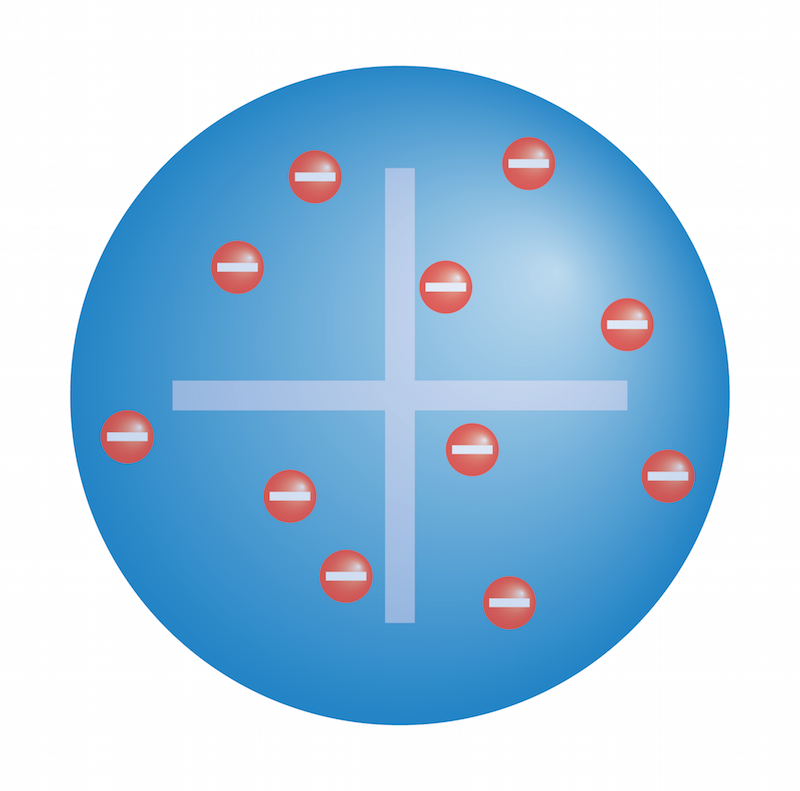
- JJ Thompson discovered the electron and created the plum pudding model of an atom
- JJ Thompson thought that electrons were surrounded by a positively charged soup which balanced out the negative charge
- Rutherford carried out the Gold Foil Test, which proved that there was a nucleus in the centre of the atom and was orbited by electrons
- Bohr's experiment was the same as Rutherfords as the worked together on it
- Bohr discovered that you can have more electrons in the outer shell than in the inner shell
- Chadwick discovered the neutron, which helps to neutralise the protons and electrons. it was difficult to detect as there was no charge being emitted
Isotopes
- Atoms of the same element always have the same atomic number/number of protons
- Isotopes are atoms of the same element with the same number of protons and electrons but a different number of neutrons
- When an atom loses a neutron it has physical differences - its density changes but because the number of electrons hasn't changed the chemical properties are the same
Ions
- Ions are electrically charged particles. They can be single particles or a group of particles
- Metal atoms lose electrons to form positive ions and non-metal atoms gain electrons to form a negative ion.
- The number of electrons gained or lost is the same as the charge of the ion. Chlorine atoms gain 1 electron to become Cl- when oxygen atoms gain 2 electrons to become O2-.
- Atoms with a full outer shell (8 electrons) are stable
- An ionic compound is a chemical compound that consists of ions that are bonded electrically. Overall these compounds are neutral
- Lithium + Sulfur = Lithium Sulphide Calcium + Carbon = Calcium Carbonate Potassium + Nitrogen = Potassium Nitrate
- Ionic compounds are giant structures of ion, held together in a lattice by electrostatic forces known as ionic bonds
- Ionic Compounds
- An Ionic compound is a giant structure of ions
- they have a regular repeating pattern called a giant ionic lattice
- They are bonded by an electrostatic charge
- Ionic compounds are solids at room temperature
- Some ionic compounds are soluble in water
- Some ionic compounds don't conduct electricity but do in water
- They don't conduct electricity in ethanol
- They have a high melting and boiling point
- Increased amount of kinetic energy can overcome the bonds
- Some are overcome in melting but all are overcome in boiling
- They conduct electricity in solution
- They contain charged particles
- Water molecules have charges which pull the cation and anion apart
- Anion = Negative Ion Cation = Positive Ion
- TIP TO REMEMBER Anion = Negative Ion A Negative ION
Reactivity Groups 1 and 7
- Group 1
- Group 1 metals react by losing an electron
- Reactivity increases as the atoms get bigger down the group
- The bigger the atom the harder is is to hold onto the last electron on the outer shell
- This is because the bigger distance between the nucleus and electron, the weaker the electrostatic force
- It also happens because the inner shells block the force
- Group 7
- Group 7 metals react by gaining 1 electron
- The reactivity decreases as the atoms get bigger down he group
- The fewer shells there are the closer the outer shell is to the nucleus, making the electrostatic force stronger
- Group 1
Covalent Bonding
- The covalent bonds are formed when 2 atoms of non-metal elements share a pair of electrons so that they can have a full outer shell
- The atoms are held together by the electrostatic attraction between positive charges on their nuclei and negative charges on their shared electrons
- The electron arrangement is then like the nearest noble gas
- Most of the compounds of non-metals with non-metals have simple molecular structures although form giant covalent structures
- Giant Covalent Structures
- Atoms that share electrons can form giant covalent structures or macromolecules
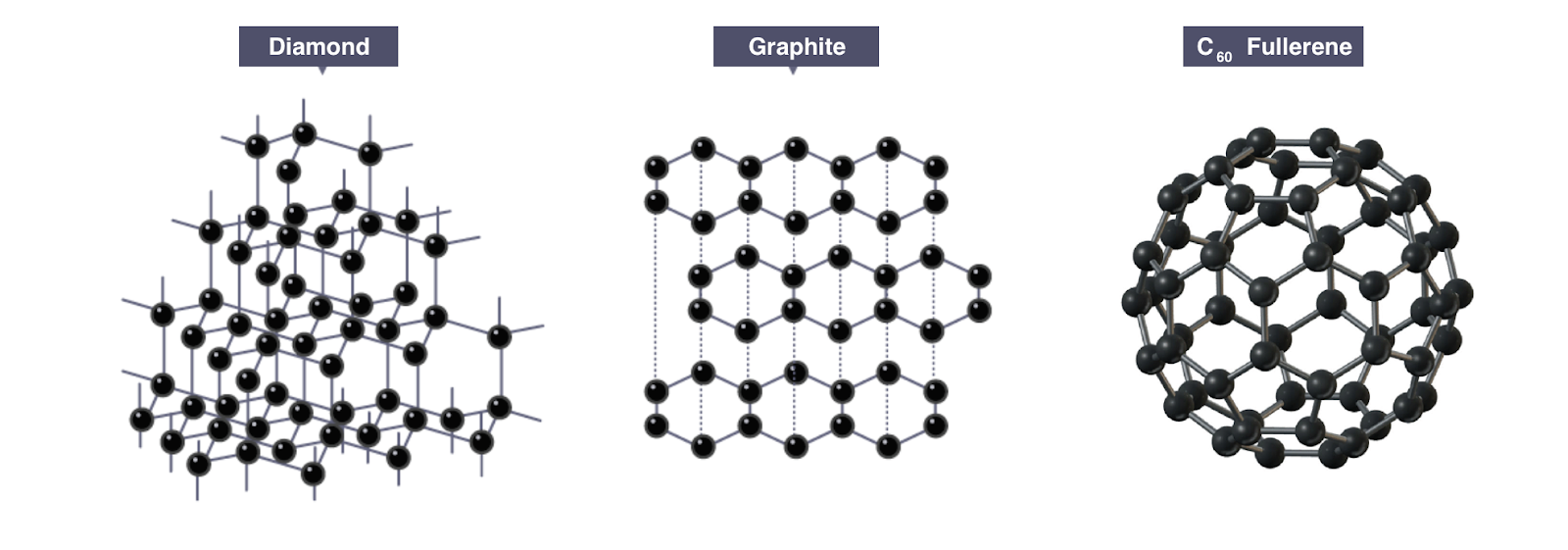
- Diamond, Graphite and Silicon Dioxide are examples of giant covalent structures
- All atoms in these structures link to each other via strong covalent bonds which means they have a very high melting point
- Allotropes are forms of an element that exist in the same state but have different properties
- Diamond, Graphite and fullerenes are all allotropes of carbon
Hydrocarbons
- A hydrocarbon is a compound made from carbon and hydrogen atoms only
- Most of the hydrocarbons in crude oil are saturated hydrocarbons called alkenes
- Saturated means that all the carbon - carbon bonds are single covalent bonds
- The Homologuos series is a series of compounds that have the same general formula but different lengths
Fractional Distillation
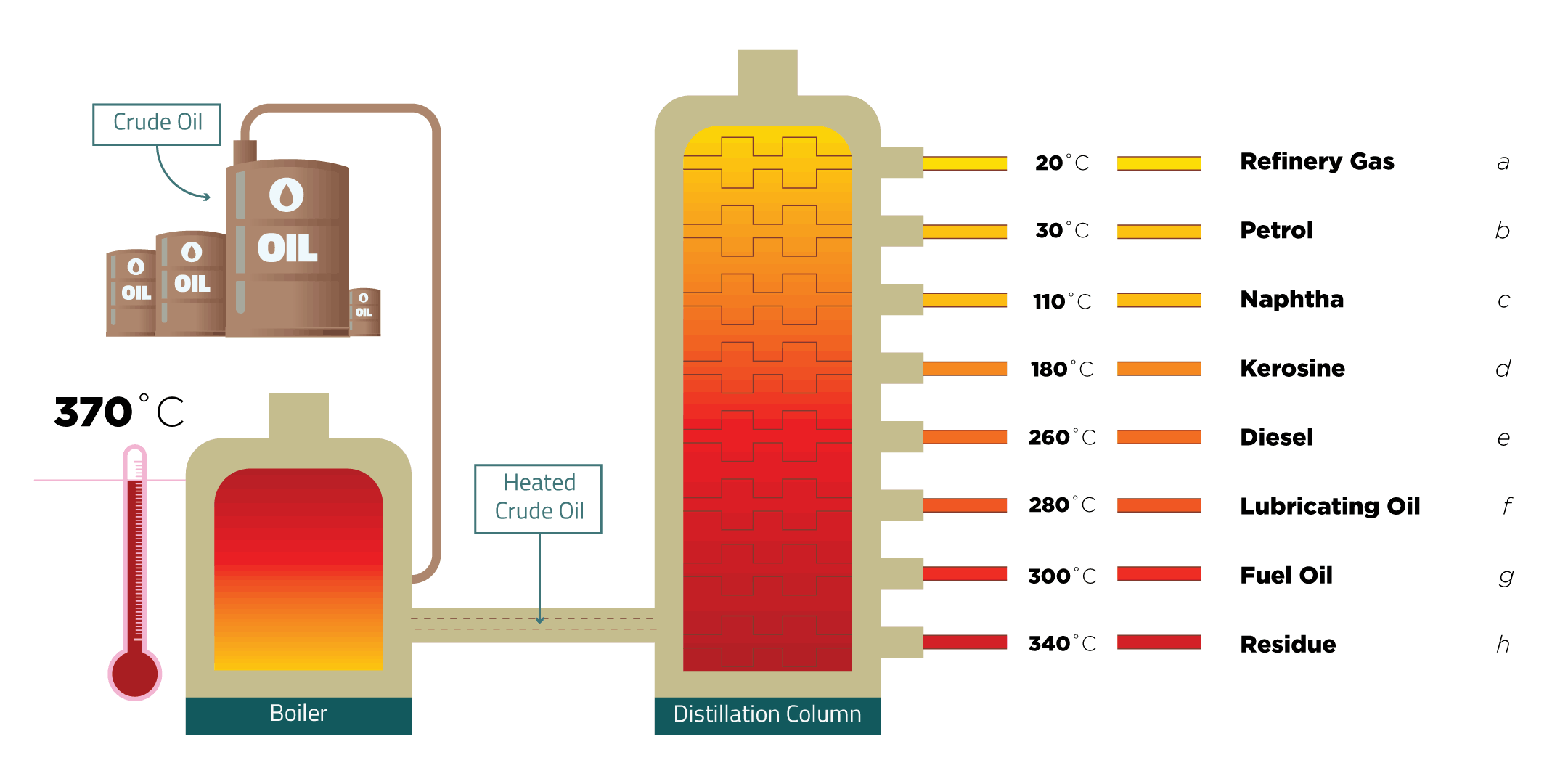
- The hydrocarbons are separated into factions with similar numbers of carbon atoms
- The column is hot at the top and cold at the bottom
- The oil is heated
- This process is called fractional distillation
- - Boiling point increases - Viscosity increases -Flammability decreases - Volatility decreases
Alkenes
- Alkenes react with hydrogen, water and halogens by the addition of atoms across the C=C double bond so that the C=C becomes a C-C
- Hydrogenation is the addition of hydrogen to an alkene in the presence of a nickel catalyst to produce a corresponding alkene
- Hydration is the addition of water to an alkene that takes place by reaction with steam in the presence of a catalyst and high temperature to produce an alcohol
- The addition of a halogen to an alkene to produce a saturated hydro
- Alkenes react with bromine waterm turning it from orange to colourless. Bromine water tests for the presence of unsaturated compounds
Alcohols
- A functional group determines how a group of compounds will typically react
- Alcohols form a homologuos series that contain the function group OH (Hydroxyl Group)
- Alcohols are flammable. They burn in air to produce Carbon Dioxide and Water
- Short chain alcohols have relatively low boiling points as they have weaker intermolecular forces
- They dissolve completely to form a neutral solution
- They can be oxidised to form carboxylic acids
- Ethanol is the main alcohol in alcoholic drinks. It is not as toxic as methanol but still damages the liver and brain
- Methylated spirits are a poisonous mix of ethanol and methanol and is used as fuel
Carboxylic Acids
- In the presence of an oxidising agent alcohols are oxidised to form carboxylic acids
- During the reaction the potassium diochromate turns from orange to green
- Esters
- Esters have a functional group of COO
- Produced during an esterification reaction between an alcohol and a carboxylic acid.
- An esterification reaction is also a condensation reaction and water is released
- Esters are volatile compounds
- They have distinctive smells and are used as flavourings and perfume
- Small chain esters dissolve in water. They have a Ph close to neutral
Images and files in the map
Information
- Description
- End of Year Chemistry (End of Year Revision) Mind Map on Chemistry, created by James Lehmann-Russell on 04/05/2019.
- Created by
- James Lehmann-Russell
- Views
- 0
- Rating