
Mind map
Situation Ethics
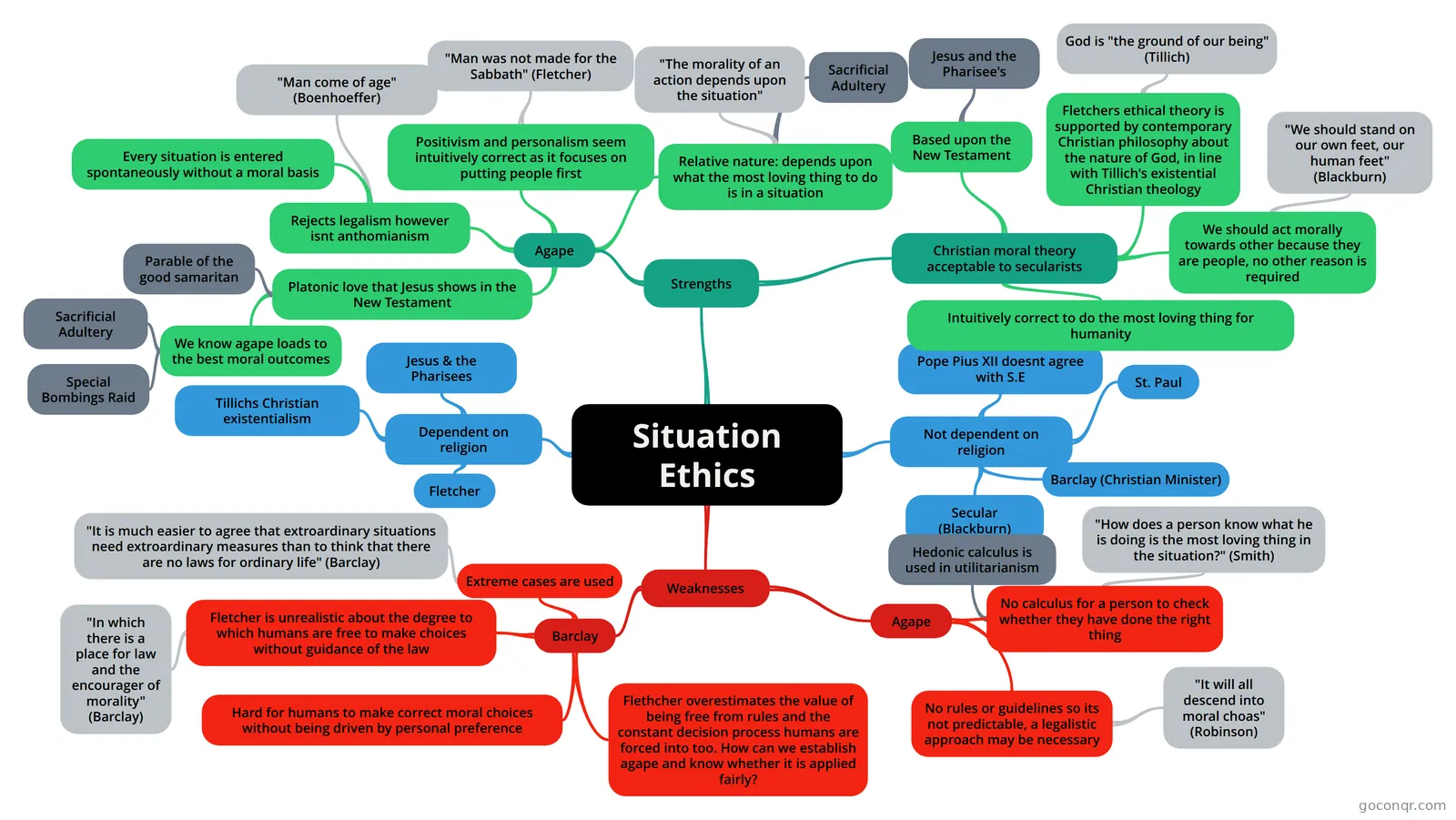
Mind map: Situation ethics
Map content
Situation Ethics
Dependent on religion
- Jesus & the Pharisees
- Tillichs Christian existentialism
- Fletcher
Not dependent on religion
- Pope Pius XII doesnt agree with S.E
- St. Paul
- Barclay (Christian Minister)
- Secular (Blackburn)
Strengths
- Agape
- Platonic love that Jesus shows in the New Testament
- Parable of the good samaritan
- We know agape loads to the best moral outcomes
- Sacrificial Adultery
- Special Bombings Raid
- Rejects legalism however isnt anthomianism
- Every situation is entered spontaneously without a moral basis
- "Man come of age" (Boenhoeffer)
- Positivism and personalism seem intuitively correct as it focuses on putting people first
- "Man was not made for the Sabbath" (Fletcher)
- Relative nature: depends upon what the most loving thing to do is in a situation
- "The morality of an action depends upon the situation"
- Sacrificial Adultery
- Platonic love that Jesus shows in the New Testament
- Christian moral theory acceptable to secularists
- Based upon the New Testament
- Jesus and the Pharisee's
- Fletchers ethical theory is supported by contemporary Christian philosophy about the nature of God, in line with Tillich's existential Christian theology
- God is "the ground of our being" (Tillich)
- We should act morally towards other because they are people, no other reason is required
- "We should stand on our own feet, our human feet" (Blackburn)
- Intuitively correct to do the most loving thing for humanity
- Based upon the New Testament
- Agape
Weaknesses
- Barclay
- Extreme cases are used
- "It is much easier to agree that extroardinary situations need extroardinary measures than to think that there are no laws for ordinary life" (Barclay)
- Fletcher is unrealistic about the degree to which humans are free to make choices without guidance of the law
- "In which there is a place for law and the encourager of morality" (Barclay)
- Hard for humans to make correct moral choices without being driven by personal preference
- Flethcher overestimates the value of being free from rules and the constant decision process humans are forced into too. How can we establish agape and know whether it is applied fairly?
- Extreme cases are used
- Agape
- No calculus for a person to check whether they have done the right thing
- Hedonic calculus is used in utilitarianism
- "How does a person know what he is doing is the most loving thing in the situation?" (Smith)
- No rules or guidelines so its not predictable, a legalistic approach may be necessary
- "It will all descend into moral choas" (Robinson)
- No calculus for a person to check whether they have done the right thing
- Barclay
Information
- Description
- A Levels Ethics Mind Map on Situation Ethics, created by shawn1398wheeler on 24/02/2015.
- Created by
- shawn1398wheeler
- Views
- 3
- Rating