
Mind map
B6d Summary
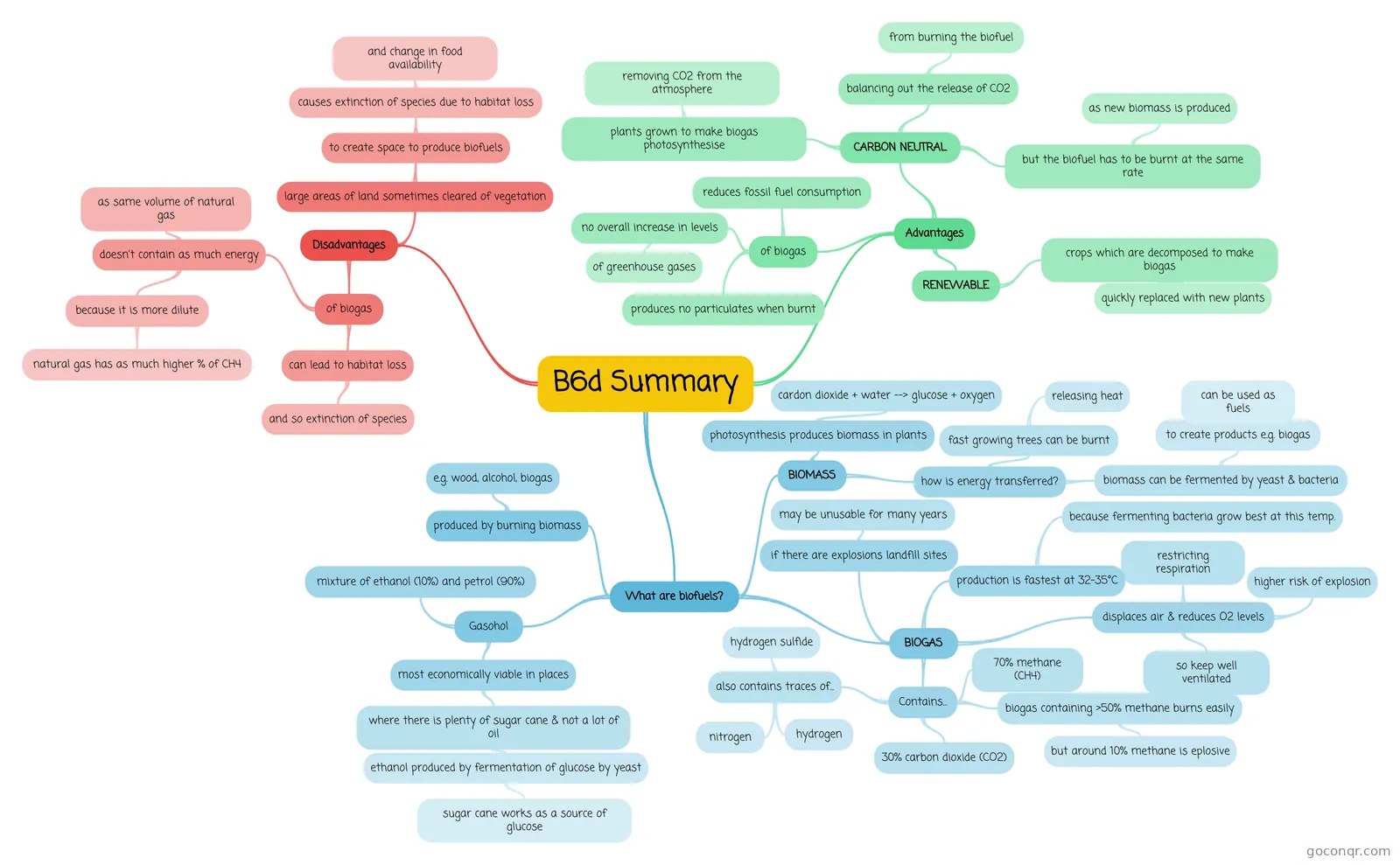
Mind map: biofuels summary
Map content
B6d Summary
What are biofuels?
- produced by burning biomass
- e.g. wood, alcohol, biogas
- BIOMASS
- photosynthesis produces biomass in plants
- cardon dioxide + water --> glucose + oxygen
- how is energy transferred?
- fast growing trees can be burnt
- releasing heat
- biomass can be fermented by yeast & bacteria
- to create products e.g. biogas
- can be used as fuels
- to create products e.g. biogas
- fast growing trees can be burnt
- photosynthesis produces biomass in plants
- BIOGAS
- Contains...
- 70% methane (CH4)
- 30% carbon dioxide (CO2)
- also contains traces of...
- hydrogen
- nitrogen
- hydrogen sulfide
- biogas containing >50% methane burns easily
- but around 10% methane is eplosive
- displaces air & reduces O2 levels
- restricting respiration
- so keep well ventilated
- higher risk of explosion
- if there are explosions landfill sites
- may be unusable for many years
- production is fastest at 32-35°C
- because fermenting bacteria grow best at this temp.
- Contains...
- Gasohol
- mixture of ethanol (10%) and petrol (90%)
- most economically viable in places
- where there is plenty of sugar cane & not a lot of oil
- ethanol produced by fermentation of glucose by yeast
- sugar cane works as a source of glucose
- ethanol produced by fermentation of glucose by yeast
- where there is plenty of sugar cane & not a lot of oil
- produced by burning biomass
Advantages
- RENEWABLE
- crops which are decomposed to make biogas
- quickly replaced with new plants
- crops which are decomposed to make biogas
- CARBON NEUTRAL
- plants grown to make biogas photosynthesise
- removing CO2 from the atmosphere
- balancing out the release of CO2
- from burning the biofuel
- but the biofuel has to be burnt at the same rate
- as new biomass is produced
- plants grown to make biogas photosynthesise
- of biogas
- reduces fossil fuel consumption
- produces no particulates when burnt
- no overall increase in levels
- of greenhouse gases
- RENEWABLE
Disadvantages
- of biogas
- doesn't contain as much energy
- as same volume of natural gas
- because it is more dilute
- natural gas has as much higher % of CH4
- can lead to habitat loss
- and so extinction of species
- doesn't contain as much energy
- large areas of land sometimes cleared of vegetation
- to create space to produce biofuels
- causes extinction of species due to habitat loss
- and change in food availability
- causes extinction of species due to habitat loss
- to create space to produce biofuels
- of biogas