
Mind map
"Hope" is the thing with feathers
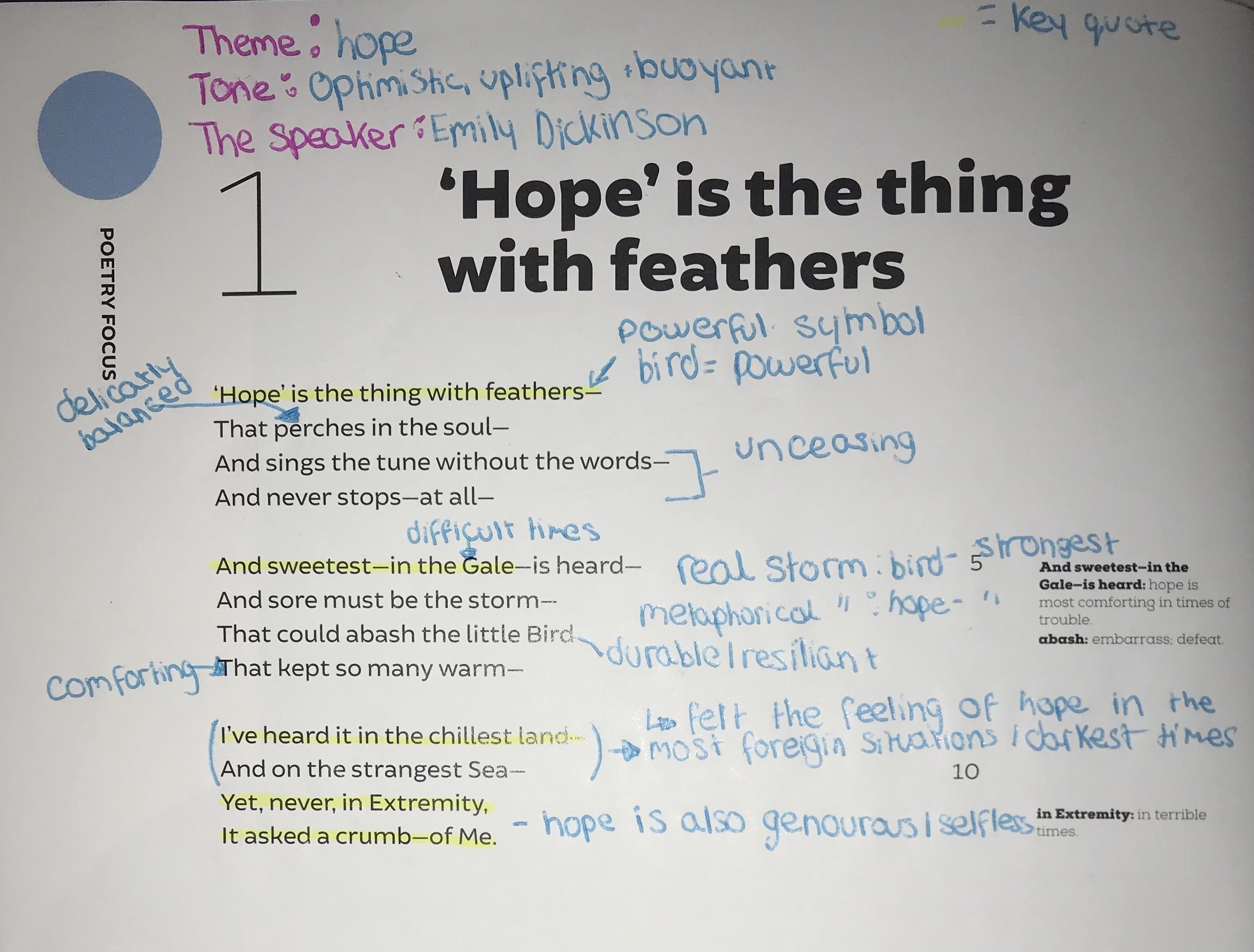
Map content
"Hope" is the thing with feathers
The Poem.
- Theme: hope Tone: optimistic, uplifting, buoyant Meaning of poem: Extended metaphor of the little bird and hope. (delicate but strong, sweet but resiliant.
- Key Quotes: "Hope" is the thing with feathers. And sweetest-in the Gale-. I've heard it in the chillest land-. Yet, never, in Extremity,/ It asked a crumb- of Me.
- https://www.youtube.com/watch?v=j3VWZJmuvhg
- First Stanza The first word is given special emphasis with speech marks (inverted commas, quotation marks) as if the poet wants to define that elusive word "Hope", and she does so with metaphor. Hope has feathers and it can, like a bird, perch in the human soul. Feathers are soft and gentle to the touch but they are also strong in flight, even on tiny birds. And feathers are made up of complex individual fibres; unity is strength. The imagery here grows stronger as the reader progresses. Not only is Hope feathery, it can sing. It sits on a perch and sings the whole time. But the song is special for there are no words, no diction for anyone to understand rationally. It's as if Hope is pure song, pure feeling, a deep seated longing that can take flight at any time. The song is endless. Note the double dash emphasis on - at all - and the stanza break which brings extra attention to these two little words.
- Second Stanza The first line is unusual in the use of the double dash - there are two distinct pauses which the reader has to be careful with. Hope is always singing as we know from the first stanza but it sings the sweetest when the going gets rough, when the Gale starts to blow. So, when life is hard and things are thrown at us, the pressure relentless, there is Hope, singing through the chaos and mayhem. Note the first mention of the bird in line 7. It would take a hellish storm to embarrass or disconcert this bird (sore - angry and abash - embarrass) which protects many people from adverse situations. Hope is difficult to disturb, even when life seems hard.
- Third Stanza The personal pronoun I appears for the first time, indicating a personal connection to this subject perhaps? Emily Dickinson thought of herself as a little bird (a wren) so the link is direct. The speaker has heard the bird during the hardest, coldest times, when emotions are churning and life surreal. But even when things are extreme Hope is still there and never asks for anything. Hope gives us much but never asks for a crumb in return. It is all inspirational, yet slightly mysterious. Hope wells up in the heart and soul yet who knows where it comes from? Philosophy, religion, psychology and even metaphor are not sufficient - there is an abstract nature to Hope. It can give us strength to carry on in the most adverse of conditions. Its voice can be heard, despite the noise at the height of the storm.
- Analysis of Hope Is The Thing With Feathers Hope Is The Thing With Feathers is a short poem with three stanzas, each one a quatrain. Rhyme The rhyme scheme is abcb, the second and fourth lines rhyme full except for the half rhyme in the first stanza, soul/all. 2nd stanza - note the additional full rhyme of lines 1 and 3 (heard/bird) which helps tighten the mid section of the poem and places emphasis on the bird's ability to sing sweeter. Syntax Emily Dickinson used a lot of dashes in her poetry and this poem has a total of 15, which creates unusual syntax - the way the clauses fit together with punctuation, meter (metre in UK) and enjambment. It's as if, for every breath she took whilst creating and reading through her lines, she wrote a dash, instead of, say, a comma. In addition, certain phrases are enclosed in a separate double dash, which places particular emphasis on meaning. Note: - at all - in the first stanza, and -in the Gale - in the second, plus - never - in the final stanza
- Third Stanza The personal pronoun I appears for the first time, indicating a personal connection to this subject perhaps? Emily Dickinson thought of herself as a little bird (a wren) so the link is direct. The speaker has heard the bird during the hardest, coldest times, when emotions are churning and life surreal. But even when things are extreme Hope is still there and never asks for anything. Hope gives us much but never asks for a crumb in return. It is all inspirational, yet slightly mysterious. Hope wells up in the heart and soul yet who knows where it comes from? Philosophy, religion, psychology and even metaphor are not sufficient - there is an abstract nature to Hope. It can give us strength to carry on in the most adverse of conditions. Its voice can be heard, despite the noise at the height of the storm.
- Second Stanza The first line is unusual in the use of the double dash - there are two distinct pauses which the reader has to be careful with. Hope is always singing as we know from the first stanza but it sings the sweetest when the going gets rough, when the Gale starts to blow. So, when life is hard and things are thrown at us, the pressure relentless, there is Hope, singing through the chaos and mayhem. Note the first mention of the bird in line 7. It would take a hellish storm to embarrass or disconcert this bird (sore - angry and abash - embarrass) which protects many people from adverse situations. Hope is difficult to disturb, even when life seems hard.
- First Stanza The first word is given special emphasis with speech marks (inverted commas, quotation marks) as if the poet wants to define that elusive word "Hope", and she does so with metaphor. Hope has feathers and it can, like a bird, perch in the human soul. Feathers are soft and gentle to the touch but they are also strong in flight, even on tiny birds. And feathers are made up of complex individual fibres; unity is strength. The imagery here grows stronger as the reader progresses. Not only is Hope feathery, it can sing. It sits on a perch and sings the whole time. But the song is special for there are no words, no diction for anyone to understand rationally. It's as if Hope is pure song, pure feeling, a deep seated longing that can take flight at any time. The song is endless. Note the double dash emphasis on - at all - and the stanza break which brings extra attention to these two little words.
- https://www.youtube.com/watch?v=j3VWZJmuvhg
- Key Quotes: "Hope" is the thing with feathers. And sweetest-in the Gale-. I've heard it in the chillest land-. Yet, never, in Extremity,/ It asked a crumb- of Me.
- Theme: hope Tone: optimistic, uplifting, buoyant Meaning of poem: Extended metaphor of the little bird and hope. (delicate but strong, sweet but resiliant.