
Mind map
C1
Map content
C1
Fundamental ideas
- All substances are made from atoms
- Atom
- The smallest part of an element that can still be recognised as the element
- Atom
- Element
- Shells
- Electron
- -
- Equal number
- -
- Electron
- Nucleus
- Proton
- +
- Equal number
- +
- Neutron
- 0
- Proton
- Shells
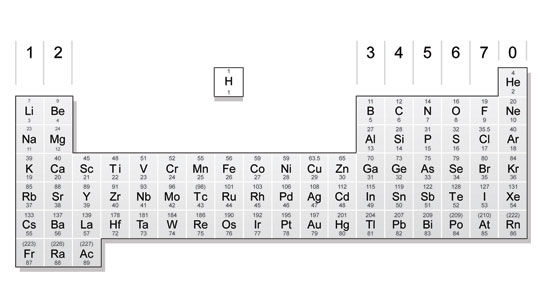
- Section of the periodic table - image from google search - GCSE periodic table
- All substances are made from atoms
Limestone
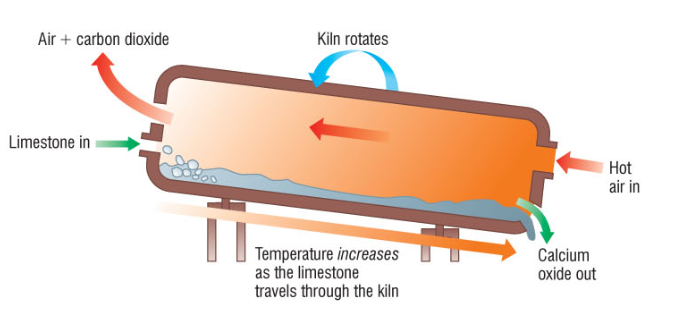
- GCSE AQA Chemistry textbook image
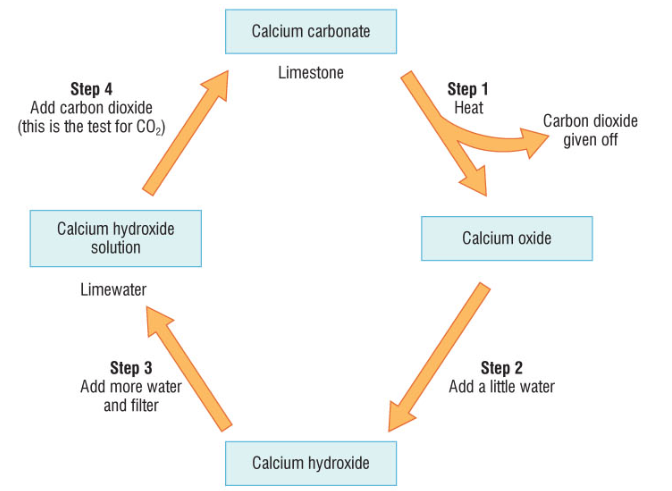
- GCSE AQA Chemistry Textbook image
- To make lots of CaO it is done in a
- Lime kiln
- Put crushed limestone in
- Heat strongly with hot air
- Waste products (CO₂) leave out the top
- Lime kiln
- Rotary kiln
- Heated in a rotating drum
- Helps to decompose quickly
- Limestone throughly mixed with hot air
- Calcium carbonate
- Can be quarried and used as building materials
- Decomposed by heating
- Thermal decomposition
- Make:
- Calcium oxide
- Reacts with water
- Calcium hydroxide
- Alkali
- Used to neutralise acids
- Alkali
- Calcium hydroxide
- Reacts with water
- Carbon dioxide
- Limewater
- Cloudy
- CaOH in water reacts with CO₂
- Carbonates react with acids to produce
- CO₂
- Salt
- H₂O
- Limewater
- Calcium oxide
- Limestone is damaged by:
- Acid rain
- Limestone
- Heated with clay to make
- Cement
- Mixed with sand to make
- Mortar
- Mixed with sand and aggregate to make
- Concrete
- Mixed with sand to make
- Cement
- Heated with clay to make
Metals
- Ore
- Contains enough metal to make it economical to extract the metal
- Mined and may be concentrated before the metal is extracted and purified
- Unreactive metals such as gold are found in the Earth as the metal itself
- But most as found as compounds that require chemical reactions to extract the metal
- Extracted
- Metals less reactive than C can be extracted from their oxides by reduction
- Metals more reactive than C can be extracted by copper-rich ores by smelting
- Copper can be purified by electrolysis
- Supply is limited
- Copper can be purified by electrolysis
- New ways of extracting copper from low-grade ores
- Traditional mining impacts
- Phytomining
- Uses plants to absorb metal compounds and the plants are burned to produce ash that contains metal compounds
- Bioleaching
- Uses bacteria to produce leachate solutions that contain metal compounds
- Copper can be obtained from solutions of copper salts by electrolysis or displacement using scrap iron
- Cannot be extracted from their oxides by reduction with C
- Too expensive because
- Too many stages in the process
- Large amount of energy needed
- Titainium
- Denser than Al
- Don't corrode
- Light
- Strong
- High melting point
- C reacts making it brittle
- Aluminium
- Don't corrode
- Good heat conductor
- Light
- Strong
- Malleuble
- Shiny
- Silvery
- Too expensive because
- We should recycle metals because extracting them uses limited resources and is expensive in terms of energy and effects on the environment
- Alloys
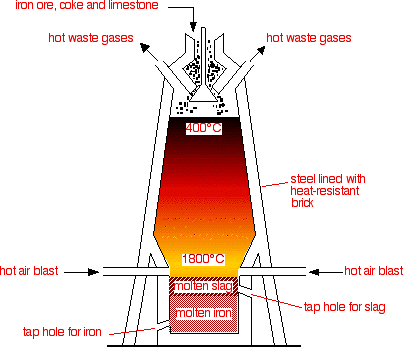
- Google searched image - Blast Furnace
- Iron from the blast furnace contains about 96% iron
- Impurities make it brittle so it has limited uses
- Steels are alloys
- Low-carbon steels are easily shaped
- High-carbon steels are hard
- Stainless steels are resistant to corrosion
- Pure Cu, Au, Fe are too soft for many uses
- Alloyed to make them harder
- Transition metals - Cu
- Good conductor of heat and electricity
- Not react with water
- Ore
Crude oil
- Is a mixture of a very large number of compounds
- Can be separated using distillation
- Hydrocarbons
- Most are saturated, AlkAnes
- CnH₂n+2
- High boiling point
- Low viscosity
- Flammable
- Hydrocarbon fuels
- Most fuels including coal, contain carbon and/or hydrogen may also contain some sulfur
- Gases released into the atmosphere
- CO₂
- H₂O vapour
- CO
- SO₂
- Particulates
- Oxides of nitrogen
- Gases released into the atmosphere
- The combustion of hydrocarbon fuel releases energy
- During combustion the carbon and hydrogen in the fuels are oxidised
- Sulfur dioxide and oxides of nitrogen
- Acid rain
- Sulphur can be removed from the fuels before they are burned e.g. in vehicles
- Can be removed from the waste gases after combustion e.g. power stations
- Carbon dioxide
- Global warming
- Solid particulates
- Global dimming
- Biofuels
- Biodiesel
- Bioethanol
- Are produced from plant material
- Ethical issues
- More people are needed to produce these fuels
- Increased income for farmers
- Reduce fuel prices due to the limit in demand for fossil fuels
- Most fuels including coal, contain carbon and/or hydrogen may also contain some sulfur
- Most are saturated, AlkAnes
- May be separated into fractions
- By allowing it to evaporate and then condense at a number of different temperatures
- Fractional distillation
- By allowing it to evaporate and then condense at a number of different temperatures
- More about crude oil
- Cracking
- Hydrocarbons can be cracked to produce smaller more useful molecules
- Involves heating hydrocarbons to vaporise them
- The vapours are either passed over a
- Hot catalyst
- Mixed with steam and heated to a very high temperature
- So thermal decomposition can occur
- The products include
- AlkAnes
- Alkenes
- CnH₂n
- React with bromine water
- Colourless
- Some products are used as fuel
- Polymers
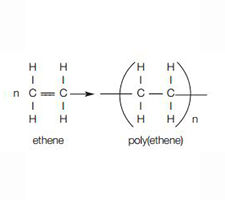
- Polymerisation
- Small chain monomers
- Long chain molecules - Polymers
- AQA image
- Have useful applications
- Shape memory polymers
- Waterproof coatings
- Non-biodegradable
- Not broken down by microbes
- Problems with waste disposal
- Plastic bags are being made from polymers and cornstarch so that they can break down more easily
- Been developed
- Polymerisation
- Ethanol
- Can be produced by hydration of ethene with steam in the presence of a catalyst
- Fermentation with yeast using renewable resources
- Sugar -> carbon dioxide + ethanol
- Cracking
- Is a mixture of a very large number of compounds
Plant oils
- Vegetable oil
- Rich in oils that can be extracted by
- Nuts
- Seeds
- Fruit
- Pressing
- Distillation
- Water and other impurities are removed
- Provide lots of energy
- Lots of nutrients
- Higher boiling point than water
- Cook foods at higher temperatures
- Quicker cooking
- Different flavours
- Increases the energy released when it's eaten
- Rich in oils that can be extracted by
- Emulsions
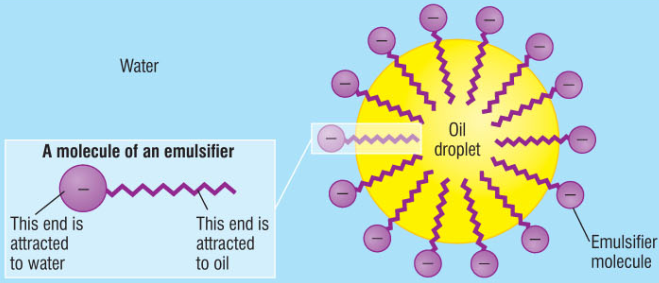
- Chemistry GCSE AQA Textbook image page 91
- Oils do not dissolve in water
- Used to produce emulsions
- Emulsions are thicker than water
- Used to produce emulsions
- Provide better
- Texture
- Coating ability
- Appearance
- Hydrophobic
- 'tail'
- Long hydrocarbon chain
- Dissolve in oil
- Tiny droplets
- Hydrophillic
- 'head'
- Carry a charge
- Charged by the 'heads'
- Tiny oil droplets repel each other
- They spread out throughout
- Tiny oil droplets repel each other
- Saturated and unsaturated oils
- Vegetable oil
- Hardened
- Reacting with hydrogen
- Adds the C+C bonds
- Nickel catalyst
- 60˚C
- They have higher melting points
- Solids at room temperature
- Useful as spreads
- Reacting with hydrogen
- Unsaturated
- C=C
- Detected using bromine water
- Hardened
- Vegetable oil
- Vegetable oil
Earth and atmosphere
- Earth
- Crust
- Between 5km and 50km
- Average 6km thick under the oceans
- About 35km under continental areas
- Solid rock
- Between 5km and 50km
- Core
- Inner
- Solid rock
- 1,300km
- Outer
- Liquid iron and nickel (metal)
- 2,200km
- Inner
- Mantle
- 2,850km
- Behaves like a solid but is able to flow really slowly - liquid rock
- Atmosphere
- 80% of the air in our atmosphere lies within 10km of the surface
- The atmosphere has been the same for the last 200 million years
- Nitrogen
- 78%
- Oxygen
- 21%
- Carbon dioxide
- 0.04%
- Nobel gases
- Ar 0.9%
- Water vapour
- Condensed to form the oceans
- First billion years
- Intense volcanic activity
- Released gases which formed the early atmosphere
- Intense volcanic activity
- Plants and algae produced the oxygen that is now in the atmosphere
- CO₂
- CO₂ has become locked up in sedimentary rock
- As carbonate and fossil fuels
- Burning fossil fuels releases it back into the atmosphere
- As carbonate and fossil fuels
- Oceans act as a reservoir for CO₂
- Increased amounts of CO₂ absorbed affect the marine environment
- CO₂ has become locked up in sedimentary rock
- Air is a mixture of gases with different boiling points and can be fractionally distilled to provide a source of raw materials used in a variety of industrial processes
- 80% of the air in our atmosphere lies within 10km of the surface
- Theories
- 1
- Mainly CO₂
- Little or no O₂
- Like Venus or Mars today
- Water vapour
- Small proportions of methane and ammonia
- 2
- Miller Urey
- Interaction between
- Hydrocarbons
- Lightening
- Ammonia
- Amino acids
- Invalid because there was no O₂, and it was thought that O₂ was there
- Interaction between
- Miller Urey
- 1
- Crust
- Tectonic plates
- The earth's crust and the upper part of the mantle are cracked into large pieces
- The movements can be sudden and disastrous
- Occur at boundaries between tectonic plates
- Earthquakes
- Volcanic eruptions
- Convection currents
- Within the mantle
- Heat released by
- Natural radioactive processes
- Causes the plates to move
- A few centimetres a year
- Earth
Images and files in the map
Information
- Description
- GCSE Triple Science (Chemistry) Mind Map on C1, created by R H on 07/06/2015.
- Created by
- R H
- Views
- 2
- Rating