
Mind map
3. Security Engineering P2
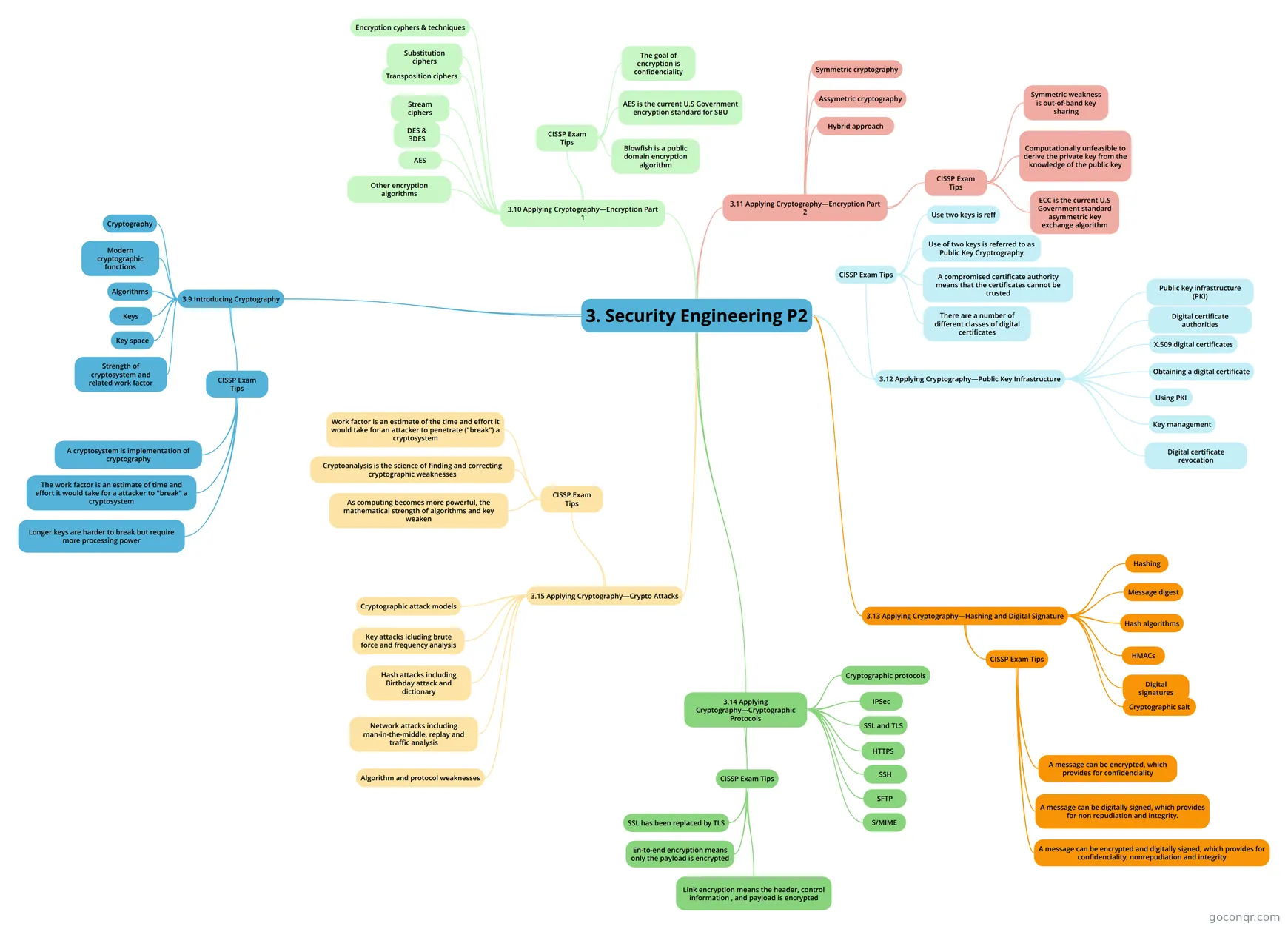
Mind map: Security engineering cryptography
Map content
3. Security Engineering P2
3.9 Introducing Cryptography
- Cryptography
- Modern cryptographic functions
- Algorithms
- Keys
- Key space
- Strength of cryptosystem and related work factor
- CISSP Exam Tips
- A cryptosystem is implementation of cryptography
- The work factor is an estimate of time and effort it would take for a attacker to "break" a cryptosystem
- Longer keys are harder to break but require more processing power
3.10 Applying Cryptography—Encryption Part 1
- Encryption cyphers & techniques
- Substitution ciphers
- Transposition ciphers
- Stream ciphers
- DES & 3DES
- AES
- Other encryption algorithms
- CISSP Exam Tips
- The goal of encryption is confidenciality
- AES is the current U.S Government encryption standard for SBU
- Blowfish is a public domain encryption algorithm
3.11 Applying Cryptography—Encryption Part 2
- Symmetric cryptography
- Assymetric cryptography
- Hybrid approach
- CISSP Exam Tips
- Symmetric weakness is out-of-band key sharing
- Computationally unfeasible to derive the private key from the knowledge of the public key
- ECC is the current U.S Government standard asymmetric key exchange algorithm
3.12 Applying Cryptography—Public Key Infrastructure
- Public key infrastructure (PKI)
- Digital certificate authorities
- X.509 digital certificates
- Obtaining a digital certificate
- Using PKI
- Key management
- Digital certificate revocation
- CISSP Exam Tips
- Use two keys is reff
- Use of two keys is referred to as Public Key Cryptrography
- There are a number of different classes of digital certificates
- A compromised certificate authority means that the certificates cannot be trusted
3.13 Applying Cryptography—Hashing and Digital Signature
- Hashing
- Message digest
- Hash algorithms
- HMACs
- Digital signatures
- Cryptographic salt
- CISSP Exam Tips
- A message can be encrypted, which provides for confidenciality
- A message can be digitally signed, which provides for non repudiation and integrity.
- A message can be encrypted and digitally signed, which provides for confidenciality, nonrepudiation and integrity
3.14 Applying Cryptography—Cryptographic Protocols
- Cryptographic protocols
- IPSec
- SSL and TLS
- HTTPS
- SSH
- SFTP
- S/MIME
- CISSP Exam Tips
- SSL has been replaced by TLS
- En-to-end encryption means only the payload is encrypted
- Link encryption means the header, control information , and payload is encrypted
3.15 Applying Cryptography—Crypto Attacks
- Cryptographic attack models
- Key attacks icluding brute force and frequency analysis
- Hash attacks including Birthday attack and dictionary
- Network attacks including man-in-the-middle, replay and traffic analysis
- Algorithm and protocol weaknesses
- CISSP Exam Tips
- Work factor is an estimate of the time and effort it would take for an attacker to penetrate ("break") a cryptosystem
- Cryptoanalysis is the science of finding and correcting cryptographic weaknesses
- As computing becomes more powerful, the mathematical strength of algorithms and key weaken
Information
- Description
- 5 Mind Maps (CISSP CBK) Mind Map on 3. Security Engineering P2, created by Marisol Segade on 21/08/2015.
- Created by
- Marisol Segade
- Views
- 3
- Rating