
Mind map
Liberalism Mindmap
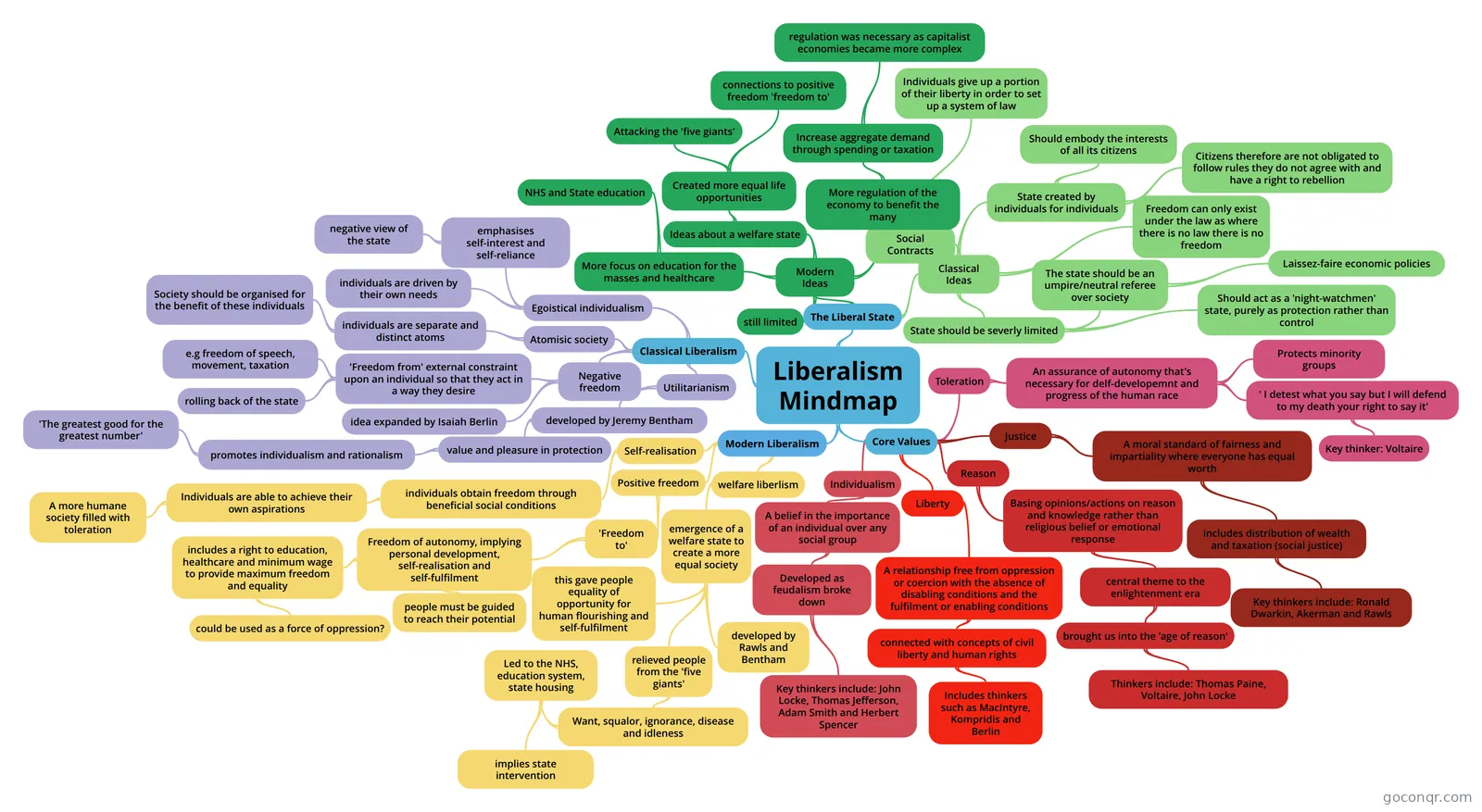
Mind map: Liberalism mind map
Map content
Liberalism Mindmap
Core Values
- Individualism
- A belief in the importance of an individual over any social group
- Developed as feudalism broke down
- Key thinkers include: John Locke, Thomas Jefferson, Adam Smith and Herbert Spencer
- Developed as feudalism broke down
- A belief in the importance of an individual over any social group
- Liberty
- A relationship free from oppression or coercion with the absence of disabling conditions and the fulfilment or enabling conditions
- connected with concepts of civil liberty and human rights
- Includes thinkers such as MacIntyre, Kompridis and Berlin
- connected with concepts of civil liberty and human rights
- A relationship free from oppression or coercion with the absence of disabling conditions and the fulfilment or enabling conditions
- Reason
- Basing opinions/actions on reason and knowledge rather than religious belief or emotional response
- central theme to the enlightenment era
- brought us into the 'age of reason'
- Thinkers include: Thomas Paine, Voltaire, John Locke
- brought us into the 'age of reason'
- central theme to the enlightenment era
- Basing opinions/actions on reason and knowledge rather than religious belief or emotional response
- Justice
- A moral standard of fairness and impartiality where everyone has equal worth
- includes distribution of wealth and taxation (social justice)
- Key thinkers include: Ronald Dwarkin, Akerman and Rawls
- includes distribution of wealth and taxation (social justice)
- A moral standard of fairness and impartiality where everyone has equal worth
- Toleration
- An assurance of autonomy that's necessary for delf-developemnt and progress of the human race
- Protects minority groups
- ' I detest what you say but I will defend to my death your right to say it'
- Key thinker: Voltaire
- An assurance of autonomy that's necessary for delf-developemnt and progress of the human race
- Individualism
The Liberal State
- Classical Ideas
- State should be severly limited
- Should act as a 'night-watchmen' state, purely as protection rather than control
- The state should be an umpire/neutral referee over society
- Laissez-faire economic policies
- Freedom can only exist under the law as where there is no law there is no freedom
- State created by individuals for individuals
- Should embody the interests of all its citizens
- Citizens therefore are not obligated to follow rules they do not agree with and have a right to rebellion
- Social Contracts
- Individuals give up a portion of their liberty in order to set up a system of law
- State should be severly limited
- Modern Ideas
- More regulation of the economy to benefit the many
- Increase aggregate demand through spending or taxation
- regulation was necessary as capitalist economies became more complex
- Increase aggregate demand through spending or taxation
- Ideas about a welfare state
- Created more equal life opportunities
- connections to positive freedom 'freedom to'
- Attacking the 'five giants'
- Created more equal life opportunities
- still limited
- More focus on education for the masses and healthcare
- NHS and State education
- More regulation of the economy to benefit the many
- Classical Ideas
Classical Liberalism
- Egoistical individualism
- emphasises self-interest and self-reliance
- negative view of the state
- individuals are driven by their own needs
- emphasises self-interest and self-reliance
- Atomisic society
- individuals are separate and distinct atoms
- Society should be organised for the benefit of these individuals
- individuals are separate and distinct atoms
- Negative freedom
- 'Freedom from' external constraint upon an individual so that they act in a way they desire
- rolling back of the state
- e.g freedom of speech, movement, taxation
- idea expanded by Isaiah Berlin
- 'Freedom from' external constraint upon an individual so that they act in a way they desire
- Utilitarianism
- developed by Jeremy Bentham
- value and pleasure in protection
- promotes individualism and rationalism
- 'The greatest good for the greatest number'
- promotes individualism and rationalism
- value and pleasure in protection
- developed by Jeremy Bentham
- Egoistical individualism
Modern Liberalism
- Self-realisation
- individuals obtain freedom through beneficial social conditions
- Individuals are able to achieve their own aspirations
- A more humane society filled with toleration
- Individuals are able to achieve their own aspirations
- individuals obtain freedom through beneficial social conditions
- welfare liberlism
- emergence of a welfare state to create a more equal society
- developed by Rawls and Bentham
- this gave people equality of opportunity for human flourishing and self-fulfilment
- relieved people from the 'five giants'
- Want, squalor, ignorance, disease and idleness
- Led to the NHS, education system, state housing
- implies state intervention
- Led to the NHS, education system, state housing
- Want, squalor, ignorance, disease and idleness
- emergence of a welfare state to create a more equal society
- Positive freedom
- 'Freedom to'
- Freedom of autonomy, implying personal development, self-realisation and self-fulfilment
- people must be guided to reach their potential
- includes a right to education, healthcare and minimum wage to provide maximum freedom and equality
- could be used as a force of oppression?
- Freedom of autonomy, implying personal development, self-realisation and self-fulfilment
- 'Freedom to'
- Self-realisation
Information
- Description
- Basic mind map of Liberalism, good for tests in lessons but not enough detail for an exam
- Created by
- floragair
- Views
- 1,529
- Tags
- Rating