
Mind map
Cell membrane
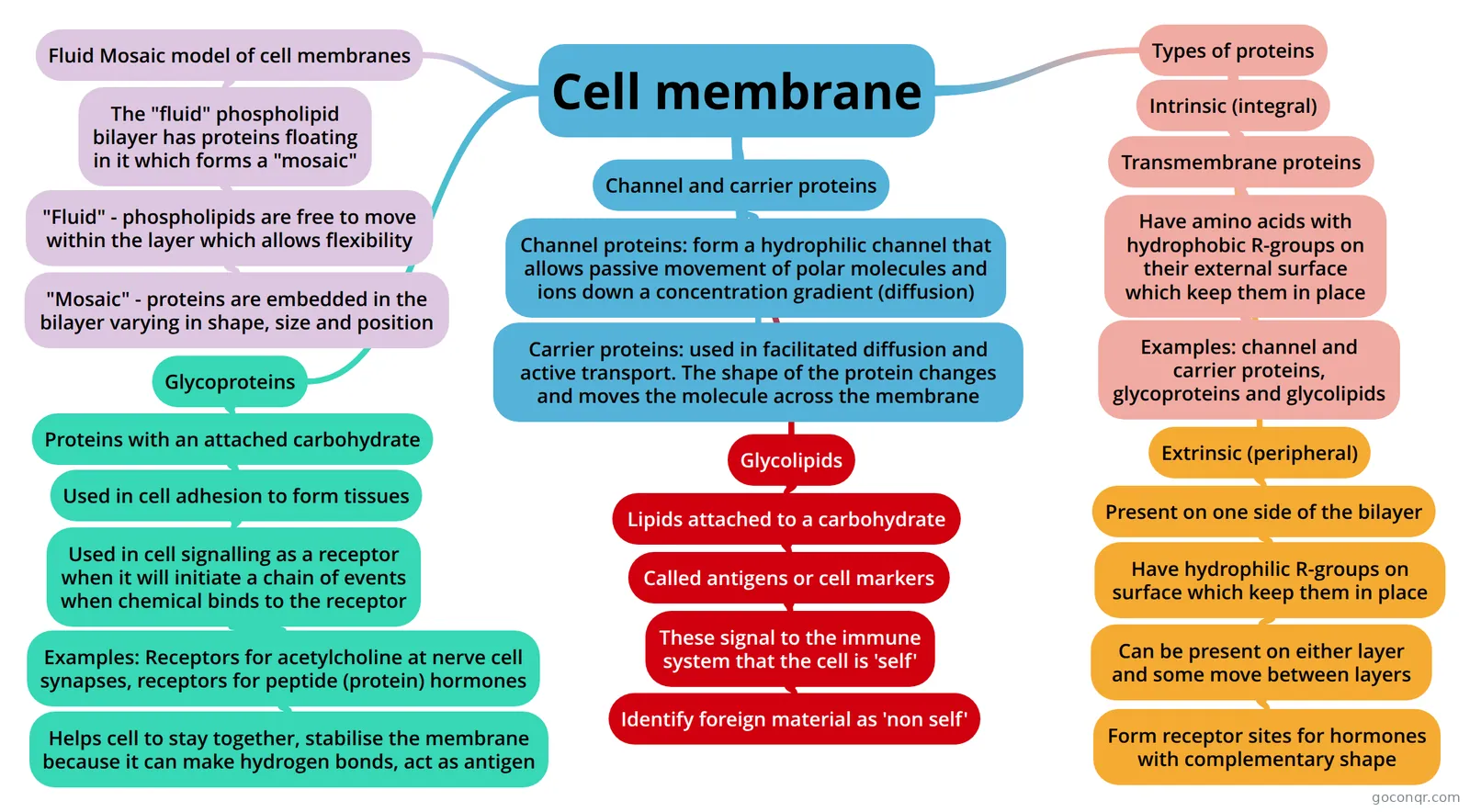
Mind map: Cell membrane
Map content
Cell membrane
Fluid Mosaic model of cell membranes
- The "fluid" phospholipid bilayer has proteins floating in it which forms a "mosaic"
- "Fluid" - phospholipids are free to move within the layer which allows flexibility
- "Mosaic" - proteins are embedded in the bilayer varying in shape, size and position
- "Fluid" - phospholipids are free to move within the layer which allows flexibility
- The "fluid" phospholipid bilayer has proteins floating in it which forms a "mosaic"
Types of proteins
- Intrinsic (integral)
- Transmembrane proteins
- Have amino acids with hydrophobic R-groups on their external surface which keep them in place
- Examples: channel and carrier proteins, glycoproteins and glycolipids
- Have amino acids with hydrophobic R-groups on their external surface which keep them in place
- Transmembrane proteins
- Extrinsic (peripheral)
- Present on one side of the bilayer
- Have hydrophilic R-groups on surface which keep them in place
- Can be present on either layer and some move between layers
- Form receptor sites for hormones with complementary shape
- Can be present on either layer and some move between layers
- Have hydrophilic R-groups on surface which keep them in place
- Present on one side of the bilayer
- Intrinsic (integral)
Channel and carrier proteins
- Channel proteins: form a hydrophilic channel that allows passive movement of polar molecules and ions down a concentration gradient (diffusion)
- Carrier proteins: used in facilitated diffusion and active transport. The shape of the protein changes and moves the molecule across the membrane
Glycoproteins
- Proteins with an attached carbohydrate
- Used in cell adhesion to form tissues
- Used in cell signalling as a receptor when it will initiate a chain of events when chemical binds to the receptor
- Examples: Receptors for acetylcholine at nerve cell synapses, receptors for peptide (protein) hormones
- Helps cell to stay together, stabilise the membrane because it can make hydrogen bonds, act as antigen
- Examples: Receptors for acetylcholine at nerve cell synapses, receptors for peptide (protein) hormones
- Used in cell signalling as a receptor when it will initiate a chain of events when chemical binds to the receptor
- Used in cell adhesion to form tissues
- Proteins with an attached carbohydrate
Glycolipids
- Lipids attached to a carbohydrate
- Called antigens or cell markers
- These signal to the immune system that the cell is 'self'
- Identify foreign material as 'non self'
- These signal to the immune system that the cell is 'self'
- Called antigens or cell markers
- Lipids attached to a carbohydrate
Information
- Description
- Mind Map on Cell membrane, created by Nada Mohamed on 04/10/2022.
- Created by
- Nada Mohamed
- Views
- 0
- Rating