
Mind map
Electron Structure
Map content
Electron Structure
Electrons and shells
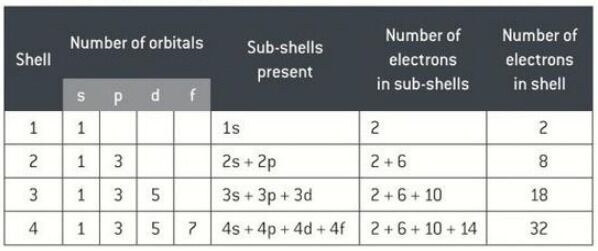
- Shell 1holds 2 e-
- Shell 2 holds 8 e-
- Shell 3 holds 18 e-
- Shell 4 holds 32 e-
- Shell 3 holds 18 e-
- Shell 2 holds 8 e-
- Shells = energy levels
- As shell no. increases, energy increases
- Energy lvl/ Shell no. = Principal Quantum Number, n
- As shell no. increases, energy increases
- Current model of e- based on idea that e- has properties of wave and particle (wave-particle duality)
- Around atom e- only fit into energy levels defined by wave nature of e-
- Max no. of e- in shell n = 2n^2
- Shell 1holds 2 e-
Atomic Orbitals
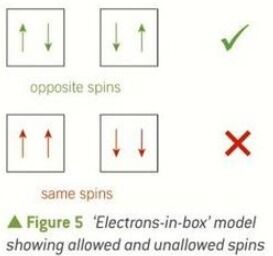
- Region around nucleus that can hold up to 2 e- with opposite spins
- Models visualise as a region in space where there is a high probability of finding 1 e-
- e- can be thought of as negative-charge cloud with shape of orbital (a.k.a electron cloud)
- Diff. types of orbitals
- s-
- p-
- d-
- f-
- Each shell from n=4 has 7 f-orbitals
- Each shell from n=3 has 5 d-orbitals
- f-
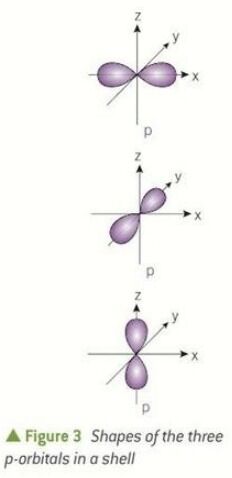
- Electron cloud has shape of dumb-bell
- There are 3 separate p-orbitals at right angles to each other (p_x, p_y, p_z)
- As shell no. increases, the further p-orbital is from nucleus
- There are 3 separate p-orbitals at right angles to each other (p_x, p_y, p_z)
- d-
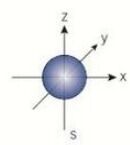
- Electron cloud has shape of sphere
- Each shell from n=1 contains 1 s-orbital
- p-
- Each type has diff. shape
- s-
- Sub-shells
- Within a shell, orbitals of the same type are grouped together as sub-shells
- Each new shell gains a new type of orbital
- No. of orbitals increases with each new type of orbital: s-1, p-3, d-5, f-7
- 2 e- fit into each orbital, so no. of e- in each sub-shell increases: s-2, p-6, d-10, f-14
- No. of orbitals increases with each new type of orbital: s-1, p-3, d-5, f-7
- Each new shell gains a new type of orbital
- Within a shell, orbitals of the same type are grouped together as sub-shells
- Region around nucleus that can hold up to 2 e- with opposite spins
Filling Orbitals
- Fill in order of increasing energy
- Sub-shells have slightly diff. energy lvls
- Within each shell, new type of sub-shell added has higher energy
- order when n=2: 2s,2p
- order when n=3: 3s,3p,3d
- order when n=4, 4s,4p,4d,4f
- 3d sub-shell has higher energy lvl than 4s sub-shell, so fills first: order = 3p,4s,3d
- Within each shell, new type of sub-shell added has higher energy
- Sub-shells have slightly diff. energy lvls
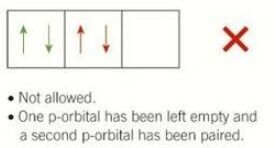
- e- repel one each other, and have property called spin (up or down); 2 electrons in an orbital must have opposite spins to help counteract repulsion
- Orbitals have the same energy within sub-shell, so one e- occupies each orbital b4 pairing starts to prevent any repulsion until there is no further orbital available at the same energy lvl
- Fill in order of increasing energy
Electron Configuration
- Shows how sub-shells are occupied by e-
- E.g. Li: 1s^2 2s^1
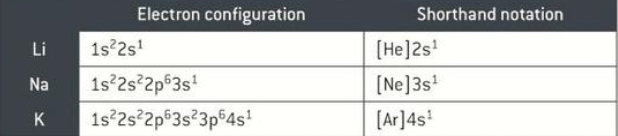
- Can be expressed more simply in terms of previous noble gas + outer electron sub-shells
- This notation is useful to emphasise similarities in electron configurations of outer shell
- Should be shown in shell order not order of filling
- Shows how sub-shells are occupied by e-
Electron Configuration of Ions
- Periodic table can be divided into blocks according to their highest energy lvl
- s-block: highest energy e- in s-sub-shell (Group 1 + 2)
- p-block: highest energy e- in p-sub-shell (Group 3-8)
- d-block: highest energy e- in d-block (Transition metals)
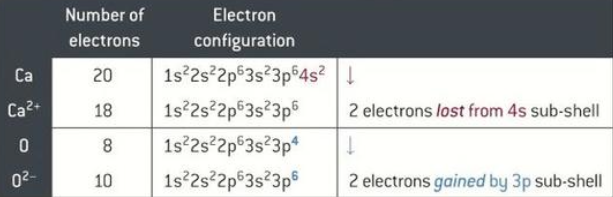
- When forming ions, highest energy sub-shells lose/ gain e-
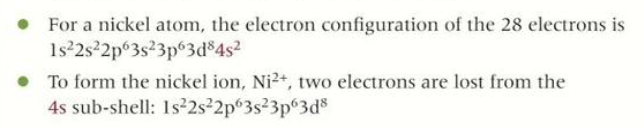
- For d-block elements, 4s sub-shell at lower energy lvl than 3d sub-shell, so filled first.
- Energy of 4s and 3d sub-shells = v. close
- Once filled, 3d energy lvl falls below 4s
- So, 4s sub-shell fills and empties b4 3d sub-shell
- Once filled, 3d energy lvl falls below 4s
- Energy of 4s and 3d sub-shells = v. close
- Periodic table can be divided into blocks according to their highest energy lvl
Images and files in the map
Information
- Description
- AS level Chemistry Mind Map on Electron Structure, created by Shreya Chawla on 09/11/2023.
- Created by
- Shreya Chawla
- Views
- 3
- Rating