
Mind map
Testing for ions
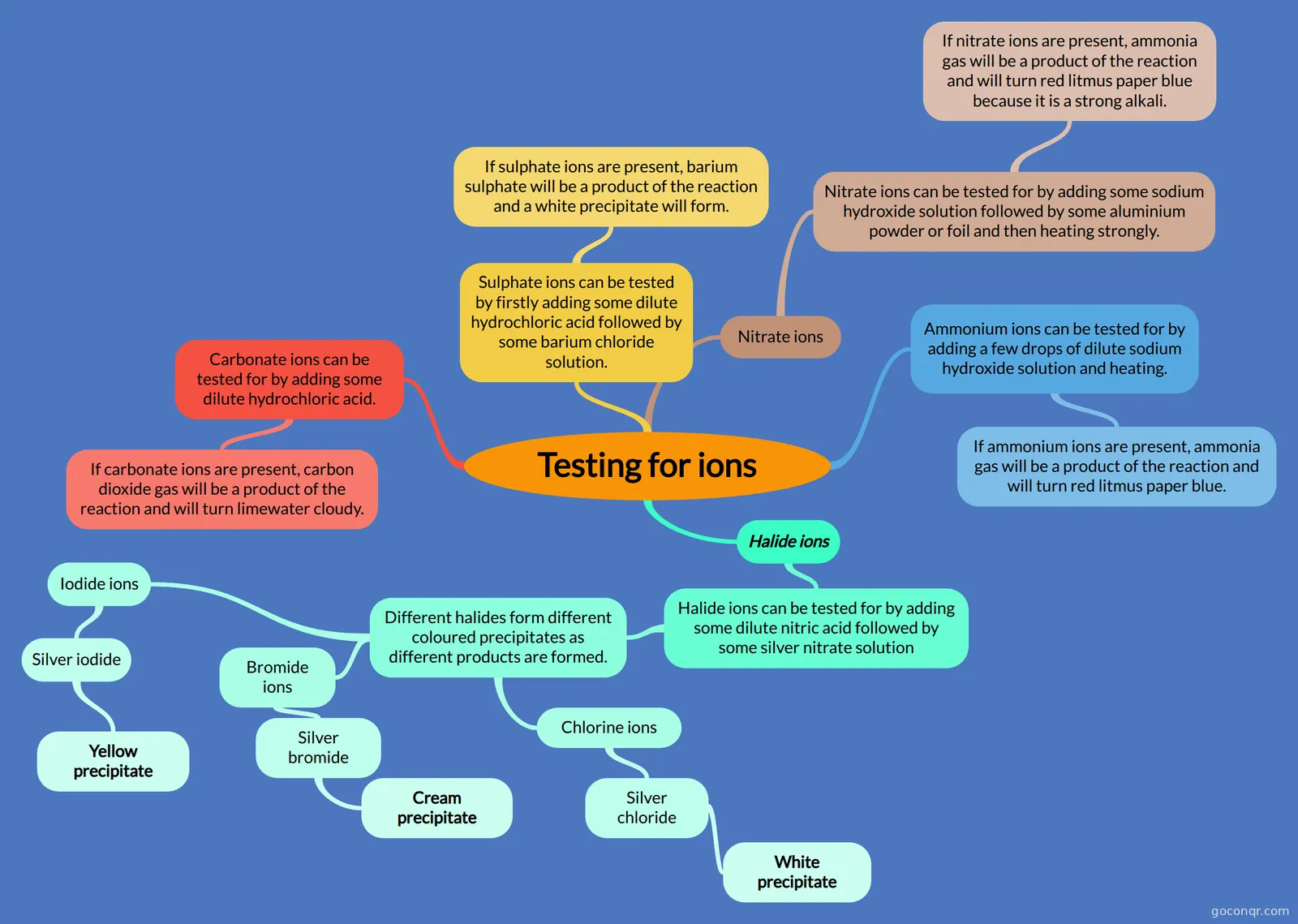
Mind map: Testing for ions
Map content
Testing for ions
Ammonium ions can be tested for by adding a few drops of dilute sodium hydroxide solution and heating.
- If ammonium ions are present, ammonia gas will be a product of the reaction and will turn red litmus paper blue.
Carbonate ions can be tested for by adding some dilute hydrochloric acid.
- If carbonate ions are present, carbon dioxide gas will be a product of the reaction and will turn limewater cloudy.
Sulphate ions can be tested by firstly adding some dilute hydrochloric acid followed by some barium chloride solution.
- If sulphate ions are present, barium sulphate will be a product of the reaction and a white precipitate will form.
Halide ions
- Halide ions can be tested for by adding some dilute nitric acid followed by some silver nitrate solution
- Different halides form different coloured precipitates as different products are formed.
- Chlorine ions
- Silver chloride
- White precipitate
- Silver chloride
- Bromide ions
- Silver bromide
- Cream precipitate
- Silver bromide
- Iodide ions
- Silver iodide
- Yellow precipitate
- Silver iodide
- Chlorine ions
- Different halides form different coloured precipitates as different products are formed.
- Halide ions can be tested for by adding some dilute nitric acid followed by some silver nitrate solution
Nitrate ions
- Nitrate ions can be tested for by adding some sodium hydroxide solution followed by some aluminium powder or foil and then heating strongly.
- If nitrate ions are present, ammonia gas will be a product of the reaction and will turn red litmus paper blue because it is a strong alkali.
- Nitrate ions can be tested for by adding some sodium hydroxide solution followed by some aluminium powder or foil and then heating strongly.
Information
- Description
- This mindmap shows the ions in a solution and the corresponding process to test for those ions in order to ensure that they are definitely present in the solution.
- Created by
- Joshua Rees
- Views
- 1,129
- Tags
- Rating