
Mind map
Finance Unit 3 HL/SL 3.1-3.4
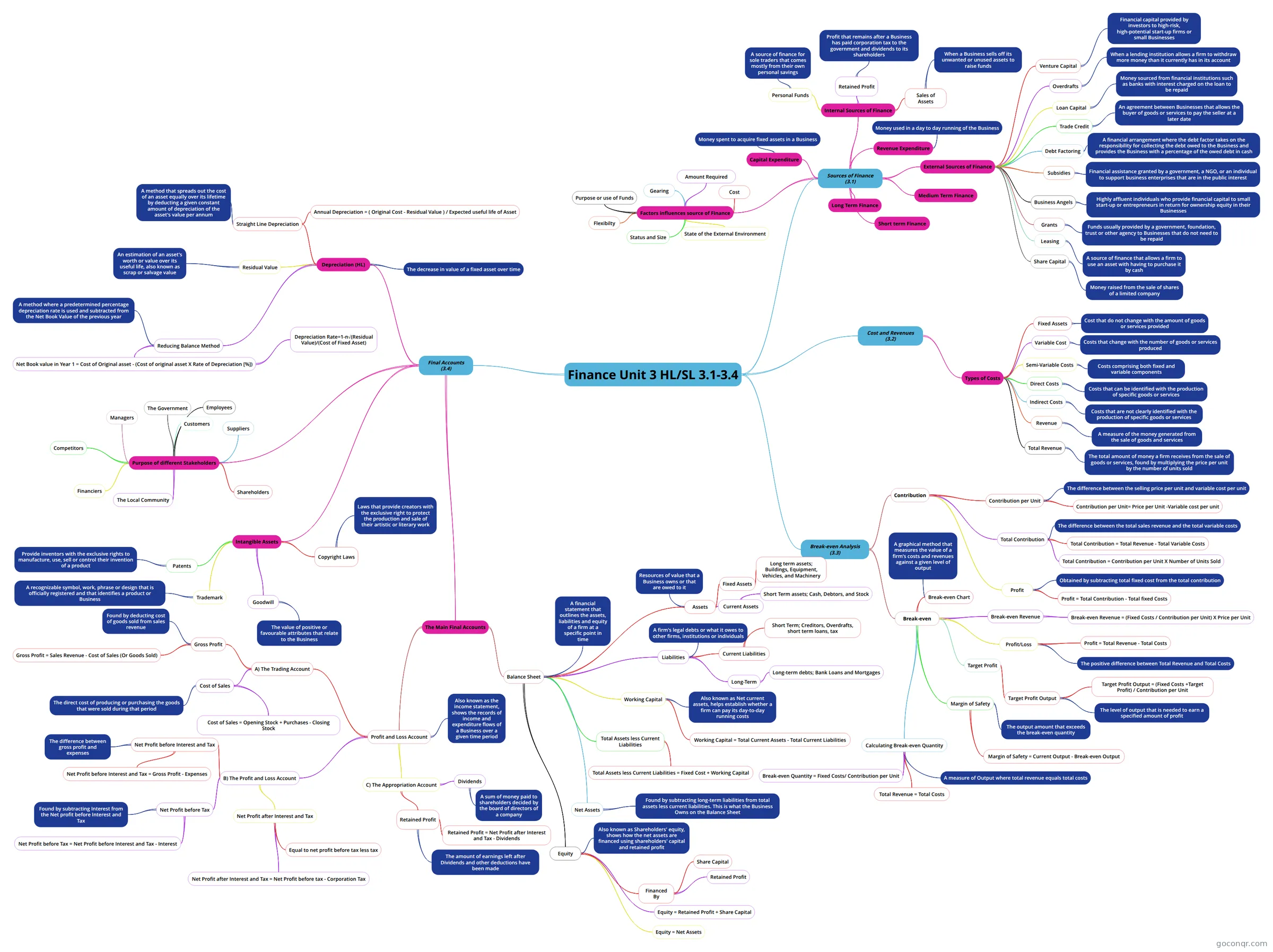
Mind map: Finance unit 3 HL/SL 3.1-3.4
Map content
Finance Unit 3 HL/SL 3.1-3.4
Sources of Finance (3.1)
- Capital Expenditure
- Money spent to acquire fixed assets in a Business
- Revenue Expenditure
- Money used in a day to day running of the Business
- Internal Sources of Finance
- Personal Funds
- A source of finance for sole traders that comes mostly from their own personal savings
- Retained Profit
- Profit that remains after a Business has paid corporation tax to the government and dividends to its shareholders
- Sales of Assets
- When a Business sells off its unwanted or unused assets to raise funds
- Personal Funds
- External Sources of Finance
- Share Capital
- Money raised from the sale of shares of a limited company
- Loan Capital
- Money sourced from financial institutions such as banks with interest charged on the loan to be repaid
- Overdrafts
- When a lending institution allows a firm to withdraw more money than it currently has in its account
- Trade Credit
- An agreement between Businesses that allows the buyer of goods or services to pay the seller at a later date
- Grants
- Funds usually provided by a government, foundation, trust or other agency to Businesses that do not need to be repaid
- Subsidies
- Financial assistance granted by a government, a NGO, or an individual to support business enterprises that are in the public interest
- Debt Factoring
- A financial arrangement where the debt factor takes on the responsibility for collecting the debt owed to the Business and provides the Business with a percentage of the owed debt in cash
- Leasing
- A source of finance that allows a firm to use an asset with having to purchase it by cash
- Venture Capital
- Financial capital provided by investors to high-risk, high-potential start-up firms or small Businesses
- Business Angels
- Highly affluent individuals who provide financial capital to small start-up or entrepreneurs in return for ownership equity in their Businesses
- Share Capital
- Short term Finance
- Medium Term Finance
- Long Term Finance
- Factors influences source of Finance
- Purpose or use of Funds
- Cost
- Status and Size
- Amount Required
- Flexibilty
- State of the External Environment
- Gearing
- Capital Expenditure
Cost and Revenues (3.2)
- Types of Costs
- Fixed Assets
- Cost that do not change with the amount of goods or services provided
- Variable Cost
- Costs that change with the number of goods or services produced
- Semi-Variable Costs
- Costs comprising both fixed and variable components
- Direct Costs
- Costs that can be identified with the production of specific goods or services
- Indirect Costs
- Costs that are not clearly identified with the production of specific goods or services
- Revenue
- A measure of the money generated from the sale of goods and services
- Total Revenue
- The total amount of money a firm receives from the sale of goods or services, found by multiplying the price per unit by the number of units sold
- Fixed Assets
- Types of Costs
Break-even Analysis (3.3)
- Contribution
- Contribution per Unit
- The difference between the selling price per unit and variable cost per unit
- Contribution per Unit= Price per Unit -Variable cost per unit
- Total Contribution
- The difference between the total sales revenue and the total variable costs
- Total Contribution = Total Revenue - Total Variable Costs
- Total Contribution = Contribution per Unit X Number of Units Sold
- Profit
- Obtained by subtracting total fixed cost from the total contribution
- Profit = Total Contribution - Total fixed Costs
- Contribution per Unit
- Break-even
- Break-even Chart
- A graphical method that measures the value of a firm's costs and revenues against a given level of output
- Margin of Safety
- Margin of Safety = Current Output - Break-even Output
- The output amount that exceeds the break-even quantity
- Calculating Break-even Quantity
- Break-even Quantity = Fixed Costs/ Contribution per Unit
- Total Revenue = Total Costs
- A measure of Output where total revenue equals total costs
- Profit/Loss
- Profit = Total Revenue - Total Costs
- The positive difference between Total Revenue and Total Costs
- Target Profit
- Target Profit Output
- The level of output that is needed to earn a specified amount of profit
- Target Profit Output = (Fixed Costs +Target Profit) / Contribution per Unit
- Target Profit Output
- Break-even Revenue
- Break-even Revenue = (Fixed Costs / Contribution per Unit) X Price per Unit
- Break-even Chart
- Contribution
Final Accounts (3.4)
- Purpose of different Stakeholders
- Shareholders
- Managers
- Employees
- Customers
- Suppliers
- The Government
- Competitors
- Financiers
- The Local Community
- The Main Final Accounts
- Profit and Loss Account
- Also known as the income statement, shows the records of income and expenditure flows of a Business over a given time period
- A) The Trading Account
- Gross Profit
- Found by deducting cost of goods sold from sales revenue
- Gross Profit = Sales Revenue - Cost of Sales (Or Goods Sold)
- Cost of Sales
- The direct cost of producing or purchasing the goods that were sold during that period
- Cost of Sales = Opening Stock + Purchases - Closing Stock
- Gross Profit
- B) The Profit and Loss Account
- Net Profit before Interest and Tax
- The difference between gross profit and expenses
- Net Profit before Interest and Tax = Gross Profit - Expenses
- Net Profit before Tax
- Found by subtracting Interest from the Net profit before Interest and Tax
- Net Profit before Tax = Net Profit before Interest and Tax - Interest
- Net Profit after Interest and Tax
- Equal to net profit before tax less tax
- Net Profit after Interest and Tax = Net Profit before tax - Corporation Tax
- Net Profit before Interest and Tax
- C) The Appropriation Account
- Dividends
- A sum of money paid to shareholders decided by the board of directors of a company
- Retained Profit
- The amount of earnings left after Dividends and other deductions have been made
- Retained Profit = Net Profit after Interest and Tax - Dividends
- Dividends
- Balance Sheet
- A financial statement that outlines the assets, liabilities and equity of a firm at a specific point in time
- Assets
- Resources of value that a Business owns or that are owed to it
- Fixed Assets
- Long term assets; Buildings, Equipment, Vehicles, and Machinery
- Current Assets
- Short Term assets; Cash, Debtors, and Stock
- Liabilities
- A firm's legal debts or what it owes to other firms, institutions or individuals
- Long-Term
- Long-term debts; Bank Loans and Mortgages
- Current Liabilities
- Short Term; Creditors, Overdrafts, short term loans, tax
- Working Capital
- Also known as Net current assets, helps establish whether a firm can pay its day-to-day running costs
- Working Capital = Total Current Assets - Total Current Liabilities
- Total Assets less Current Liabilities
- Total Assets less Current Liabilities = Fixed Cost + Working Capital
- Net Assets
- Found by subtracting long-term liabilities from total assets less current liabilities. This is what the Business Owns on the Balance Sheet
- Equity
- Financed By
- Share Capital
- Retained Profit
- Also known as Shareholders' equity, shows how the net assets are financed using shareholders' capital and retained profit
- Equity = Retained Profit + Share Capital
- Equity = Net Assets
- Financed By
- Profit and Loss Account
- Intangible Assets
- Patents
- Provide inventors with the exclusive rights to manufacture, use, sell or control their invention of a product
- Goodwill
- The value of positive or favourable attributes that relate to the Business
- Copyright Laws
- Laws that provide creators with the exclusive right to protect the production and sale of their artistic or literary work
- Trademark
- A recognizable symbol, work, phrase or design that is officially registered and that identifies a product or Business
- Patents
- Depreciation (HL)
- The decrease in value of a fixed asset over time
- Straight Line Depreciation
- A method that spreads out the cost of an asset equally over its lifetime by deducting a given constant amount of depreciation of the asset's value per annum
- Annual Depreciation = ( Original Cost - Residual Value ) / Expected useful life of Asset
- Reducing Balance Method
- A method where a predetermined percentage depreciation rate is used and subtracted from the Net Book Value of the previous year
- Net Book value in Year 1 = Cost of Original asset - (Cost of original asset X Rate of Depreciation [%])
- Depreciation Rate=1-n√(Residual Value)/(Cost of Fixed Asset)
- Residual Value
- An estimation of an asset's worth or value over its useful life, also known as scrap or salvage value
- Purpose of different Stakeholders
Information
- Description
- Since Fiance is one of the biggest unit in Business and Management it is split into to Mind Maps; this is the first one
- Created by
- Sophia Richmond
- Views
- 334
- Tags
- Rating