
Mind map
Monopoly
Map content
Monopoly
What are the assumptions of a monopoly?
- There are high barriers to entry/exit; where one firm is the industry.
- Some barriers to entry may be: high sunk costs; high MES; patents/copyright; expertise/skills; nationalisation; exploitiing economies of scale.
- Barriers of entry lead to no other firms being able to enter the market and this means that the one firm can maintain full market share.
- Patents are when the designer of the good is the only one who can sell the good, an example of this is Dyson and the hoover, they had a patent over the hoover and so only Dyson could sell the hoover.
- High sunk costs mean that the new entrant will be unable to retrieve some costs when they leave the market. This is essentially a barrier to exit but if there is restriction on the firm leaving the industry then that puts individuals off of entering the industry in the first place.
- Exploiting the economies of scale mean that the firms can just sell the good for cheaper than other firms and that means the other firms are uncompetitive because the consumers are going to buy from the cheaper firm.
- Expertise/skill can be seen as a barrier to entry because the employees who know more about the industry than other can be more productive and with an increase in productivity comes an increase in goods supplied and so the goods are cheaper because there are more available. This makes the firm more competitive.
- Some barriers to entry may be: high sunk costs; high MES; patents/copyright; expertise/skills; nationalisation; exploitiing economies of scale.
- There are high barriers to entry/exit; where one firm is the industry.
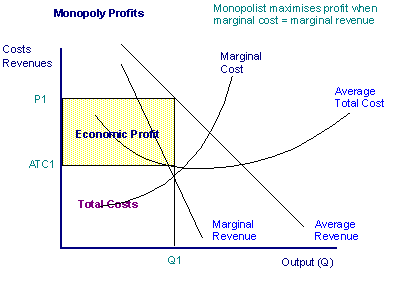
The firm in the monopoly produces where MC = MR and profit maximises, this point is not where there is neither allocative nor productive efficiency. This means that a monopoly is not statically efficient. However, because a monopoly can produce super normal profits in the long run, they can use the supernormal profits to invest in research and development and improve the quality of their own goods and be dynamically efficient.
- This leads to a fall in consumer surplus because there is an increase in the price. This means that there is a reduction in the difference between the price that consumers are willing to pay and how much they actually pay.
- This leads to an increase in producer surplus because the difference between the price that producers are willing to charge and the price that they actually get increases.
What is a natural monopoly?
- A monopoly that would be too inefficient to break up due to the high MES that can only be achieved without competition from other firms. With competition, there would be no chance of ever reaching the output that would allow the firm to exploit the economies of scale.
Price discrimination is when consumers pay different prices for the same good/service.
- First-degree discrimination is when each consumer only pays what they are willing to pay and no more.
- This type of discrimination is PURELY THEORETICAL. NOT REALISTIC
- There is no consumer surplus here because every consumer is paying what they would ideally pay.
- Second-degree discrimination is when there is excess supply and so prices are reduced. This type of discrimination usually happens in services such as football tickets/hotel rooms etc. The firm needs to sell the excess and so sells it for cheaper than what the original price that other consumers paid.
- Due to the fixed costs that have to be paid by the firm, the firm do not want to waste the excess capacity and so by selling for cheaper you are increasing the demand.
- Also known as EXCESS CAPACITY PRICING
- Third-degree discrimination happens when there is differing elasticities of demand between different groups of people. An example of this is when there is off peak and on peak times. The on peak times have inelastic demand and so they can be charged more because the firm exploits their inelasticity. The on peak consumers get cheaper prices because firms know that their demand is elastic.
- Also known as PRICE SEGMENTATION
- Firms must be able to manipulate prices and be price makers; there must not be reselling of goods for cheaper by consumers; there must be different elasticities of demand from different consumers.
- First-degree discrimination is when each consumer only pays what they are willing to pay and no more.
Images and files in the map
Information
- Description
- A-Level Economics Mind Map on Monopoly, created by veronicaamin on 22/04/2016.
- Created by
- veronicaamin
- Views
- 1
- History
-
- Created by veronicaamin · Apr 22, 2016
- Copied by veronicaamin · Apr 22, 2016
- Rating