
Mind map
Winston
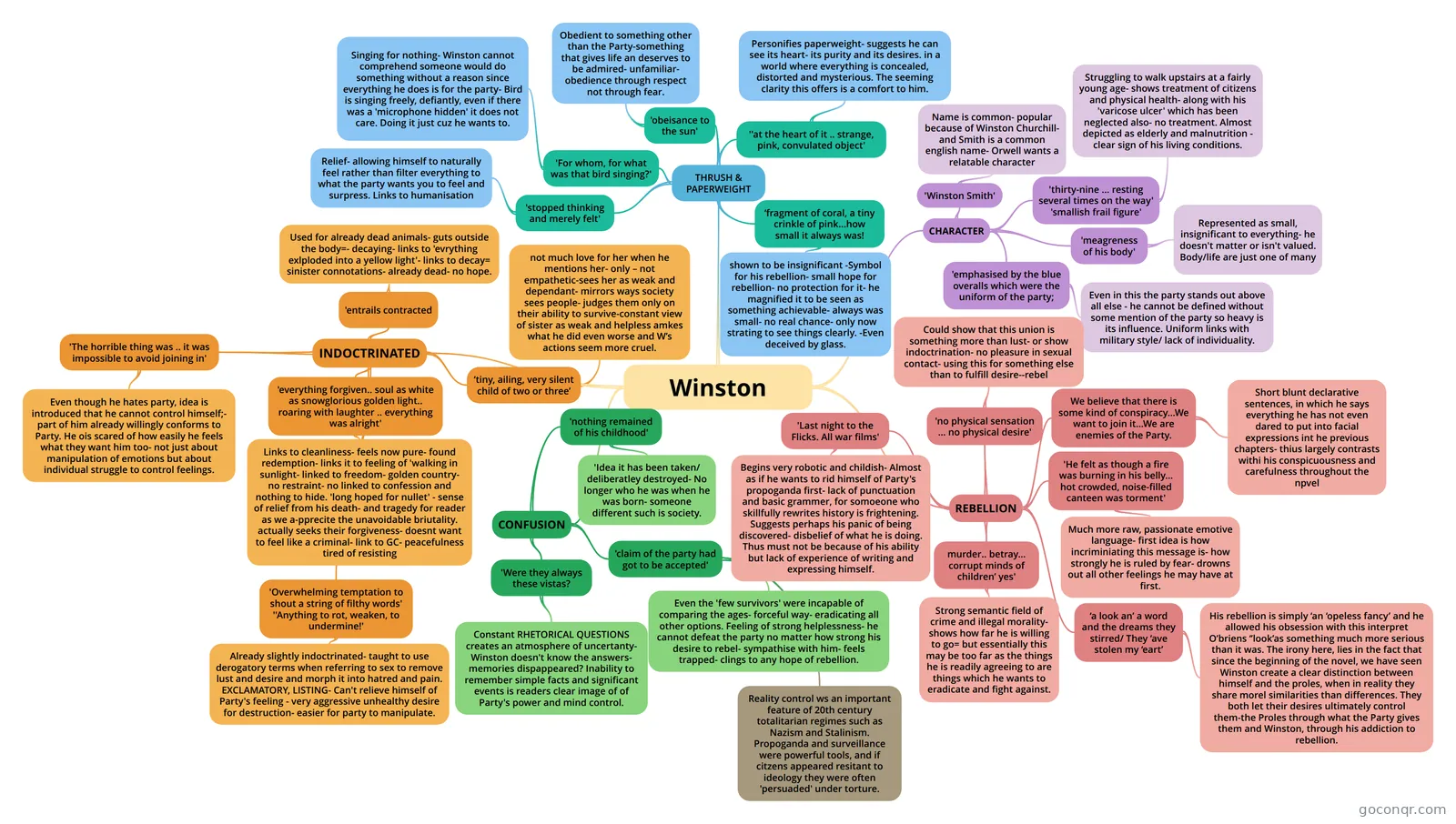
Mind map: Winston character map 1984
Map content
Winston
CHARACTER
- 'Winston Smith'
- Name is common- popular because of Winston Churchill- and Smith is a common english name- Orwell wants a relatable character
- 'thirty-nine ... resting several times on the way' 'smallish frail figure'
- Struggling to walk upstairs at a fairly young age- shows treatment of citizens and physical health- along with his 'varicose ulcer' which has been neglected also- no treatment. Almost depicted as elderly and malnutrition - clear sign of his living conditions.
- 'meagreness of his body'
- Represented as small, insignificant to everything- he doesn't matter or isn't valued. Body/life are just one of many
- 'emphasised by the blue overalls which were the uniform of the party;
- Even in this the party stands out above all else - he cannot be defined without some mention of the party so heavy is its influence. Uniform links with military style/ lack of individuality.
- 'Winston Smith'
INDOCTRINATED
- 'The horrible thing was .. it was impossible to avoid joining in'
- Even though he hates party, idea is introduced that he cannot control himself;- part of him already willingly conforms to Party. He ois scared of how easily he feels what they want him too- not just about manipulation of emotions but about individual struggle to control feelings.
- 'Overwhelming temptation to shout a string of filthy words' ''Anything to rot, weaken, to undermine!'
- Already slightly indoctrinated- taught to use derogatory terms when referring to sex to remove lust and desire and morph it into hatred and pain. EXCLAMATORY, LISTING- Can't relieve himself of Party's feeling - very aggressive unhealthy desire for destruction- easier for party to manipulate.
- ‘tiny, ailing, very silent child of two or three’
- not much love for her when he mentions her- only – not empathetic-sees her as weak and dependant- mirrors ways society sees people- judges them only on their ability to survive-constant view of sister as weak and helpless amkes what he did even worse and W’s actions seem more cruel.
- 'everything forgiven.. soul as white as snowglorious golden light.. roaring with laughter .. everything was alright'
- Links to cleanliness- feels now pure- found redemption- links it to feeling of 'walking in sunlight- linked to freedom- golden country- no restraint- no linked to confession and nothing to hide. 'long hoped for nullet' - sense of relief from his death- and tragedy for reader as we a-pprecite the unavoidable briutality. actually seeks their forgiveness- doesnt want to feel like a criminal- link to GC- peacefulness tired of resisting
- 'entrails contracted
- Used for already dead animals- guts outside the body=- decaying- links to 'evrything exlploded into a yellow light'- links to decay= sinister connotations- already dead- no hope.
- 'The horrible thing was .. it was impossible to avoid joining in'
CONFUSION
- 'Were they always these vistas?
- Constant RHETORICAL QUESTIONS creates an atmosphere of uncertanty- Winston doesn't know the answers- memories dispappeared? Inability to remember simple facts and significant events is readers clear image of of Party's power and mind control.
- 'nothing remained of his childhood'
- 'Idea it has been taken/ deliberatley destroyed- No longer who he was when he was born- someone different such is society.
- 'claim of the party had got to be accepted'
- Even the 'few survivors' were incapable of comparing the ages- forceful way- eradicating all other options. Feeling of strong helplessness- he cannot defeat the party no matter how strong his desire to rebel- sympathise with him- feels trapped- clings to any hope of rebellion.
- Reality control ws an important feature of 20th century totalitarian regimes such as Nazism and Stalinism. Propoganda and surveillance were powerful tools, and if citzens appeared resitant to ideology they were often 'persuaded' under torture.
- 'Were they always these vistas?
REBELLION
- 'Last night to the Flicks. All war films'
- Begins very robotic and childish- Almost as if he wants to rid himself of Party's propoganda first- lack of punctuation and basic grammer, for somoeone who skillfully rewrites history is frightening. Suggests perhaps his panic of being discovered- disbelief of what he is doing. Thus must not be because of his ability but lack of experience of writing and expressing himself.
- 'no physical sensation ... no physical desire'
- Could show that this union is something more than lust- or show indoctrination- no pleasure in sexual contact- using this for something else than to fulfill desire--rebel
- 'He felt as though a fire was burning in his belly... hot crowded, noise-filled canteen was torment'
- Much more raw, passionate emotive language- first idea is how incriminiating this message is- how strongly he is ruled by fear- drowns out all other feelings he may have at first.
- ‘a look an’ a word and the dreams they stirred/ They ‘ave stolen my ‘eart’
- His rebellion is simply ‘an ‘opeless fancy’ and he allowed his obsession with this interpret O’briens ‘’look’as something much more serious than it was. The irony here, lies in the fact that since the beginning of the novel, we have seen Winston create a clear distinction between himself and the proles, when in reality they share morel similarities than differences. They both let their desires ultimately control them-the Proles through what the Party gives them and Winston, through his addiction to rebellion.
- We believe that there is some kind of conspiracy...We want to join it...We are enemies of the Party.
- Short blunt declarative sentences, in which he says everything he has not even dared to put into facial expressions int he previous chapters- thius largely contrasts withi his conspicuousness and carefulness throughout the npvel
- murder.. betray... corrupt minds of children’ yes'
- Strong semantic field of crime and illegal morality- shows how far he is willing to go= but essentially this may be too far as the things he is readily agreeing to are things which he wants to eradicate and fight against.
- 'Last night to the Flicks. All war films'
THRUSH & PAPERWEIGHT
- ''at the heart of it .. strange, pink, convulated object'
- Personifies paperweight- suggests he can see its heart- its purity and its desires. in a world where everything is concealed, distorted and mysterious. The seeming clarity this offers is a comfort to him.
- 'obeisance to the sun'
- Obedient to something other than the Party-something that gives life an deserves to be admired- unfamiliar- obedience through respect not through fear.
- 'For whom, for what was that bird singing?'
- Singing for nothing- Winston cannot comprehend someone would do something without a reason since everything he does is for the party- Bird is singing freely, defiantly, even if there was a 'microphone hidden' it does not care. Doing it just cuz he wants to.
- 'stopped thinking and merely felt'
- Relief- allowing himself to naturally feel rather than filter everything to what the party wants you to feel and surpress. Links to humanisation
- ‘fragment of coral, a tiny crinkle of pink...how small it always was!
- shown to be insignificant -Symbol for his rebellion- small hope for rebellion- no protection for it- he magnified it to be seen as something achievable- always was small- no real chance- only now strating to see things clearly. -Even deceived by glass.
- ''at the heart of it .. strange, pink, convulated object'
Information
- Description
- GCSE English Literature- Texts (1984) Mind Map on Winston, created by Saheefa Ishaq on 30/12/2016.
- Created by
- Saheefa Ishaq
- Views
- 8
- Rating