
Mind map
The Polymer Revolution
Map content
The Polymer Revolution
Addition Reactions of Alkenes
- Adding hydrogen to C=C bonds produces alkanes.
- e.g. Ethene will react with hydrogen gas to produce ethene but only with a nickel catalyst, 150 degrees and high pressure/platinum catalyst at room temp and pressure.
- The C=C bond opens up and hydrogen atoms join on to give an alkane.
- Bromine water can be used to test for C=C bonds.
- When you shake an alkane with bromine water it decolourises - becomes colourless - and forms a dibromoalkane.
- Adding bromine is the test for unsaturation. Saturated compounds don't react.
- Electrophilic Addition
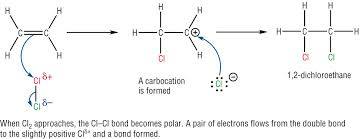
- The bromine is an example of electrophilic addition.
- During electrophilic addition reactions, the double bonds open up and atoms are added to the carbons.
- They happen because the bond has got plenty of electrons and is easily attacked by electrophiles.
- Electrophiles are electron-pair acceptors - they usually don't have enough electrons so they're are attracted to areas where there's a lot of them about.
- The double bond is nucleophilic - it's attracted to places that don't have enough electrons.
- Hydrogen Halides
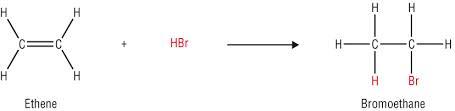
- Alkenes also undergo addition reactions with hydrogen bromide - to form bromoalkanes.
- If the HBr adds to an unsymmetrical alkene, like propene, there are two possible products.
- Reacting Alkenes with Water and an H2SO4 Catalyst Makes Alcohols
- H2C=CH2 + H2SO4 --> CH3CH2OSO2OH
- Ethene + Sulphuric Acid --> Ethyl H Sulfate
- The bromine is an example of electrophilic addition.
- Ethanol is manufactured by steam hydration.
- It is hydrated by steam at 300 degrees and a pressure of 60atm. This reaction is reversible and the reaction yield is low but the unreacted ethene gas is recyclable.
- Adding hydrogen to C=C bonds produces alkanes.
Alcohols and Other Organic Compounds
- Alcohols
- The alcohol homologous series has the general formula CnH2n+1OH.
- In a primary alcohol, the carbon with the -OH is attached to one other carbon.
- In a secondary alcohol, the carbon with the -OH is attached to 2 other carbons.
- In a tertiary alcohol, the carbon with the -OH is attached to three other carbons.
- They can be dehydrated to form alkenes. C2H5OH --> CH2=CH3 + H2O
- Ethanol vapour can be passed over a hot catalyst of pumice stone or aluminium oxide, Al2O3.
- It can also be heated by reflux with excess concentrated sulfuric acid at 170 degrees. The ethene produced is then collected over water.
- In this method, the sulfuric acid acts as the dehydrating agent in the elimination reaction.
- Alcohols can be Oxidised
- Using an Oxidising Agent
- Complete oxidation forms carbon dioxide and water. This is a combustion reaction.
- By Burning Them
- Primary alcohols are oxidised to aldehydes then carboxylic acid.
- Secondary alcohols are oxidised to ketones only
- Whether a primary alcohol is oxidised into a aldehyde or a carboxylic acid depends on the reaction conditions.
- Gently heating ethanol with potassium dichromate(VI) solution and sulfuric acid in a test tube produces apple smelling ethanal (aldehyde). However it usually oxidises to form vinegar smelling ethanoic acid.
- To just get an aldehyde it needs to be taken out of the oxidising solution as soon as it's formed.
- To produce a carboxylic acid, the alcohol has to be vigorously oxidised. The alcohol is mixed with excess oxidising agent and heated under reflux.
- Gently heating ethanol with potassium dichromate(VI) solution and sulfuric acid in a test tube produces apple smelling ethanal (aldehyde). However it usually oxidises to form vinegar smelling ethanoic acid.
- Using an Oxidising Agent
- Aldehydes and Ketones
- Their general formula is CnH2nO
- Aldehydes have their carbonyl group at the END of the carbon chain.
- Ketones have their carbonyl group anywhere in the MIDDLE of the carbon chain.
- They both contain a double-bonded oxygen.
- Carboxylic Acids
- They contain a -COOH functional group.
- Alcohols
Hydrogen Bonding
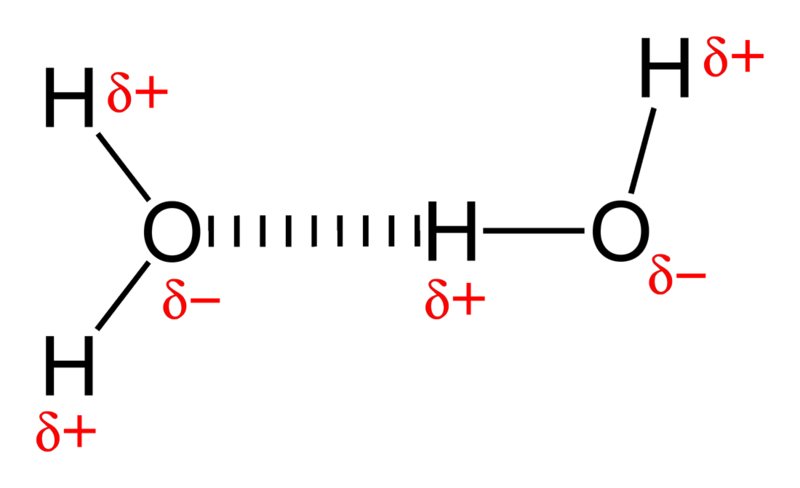
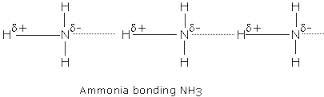
- Hydrogen bonding is the strongest intermolecular force.
- It only occurs when hydrogen is covalently bonded to fluorine, nitrogen or oxygen because they are very electronegative so they draw the bonding electrons away from the hydrogen atom.
- Water and ammonia both have hydrogen bonding.
- It only occurs when hydrogen is covalently bonded to fluorine, nitrogen or oxygen because they are very electronegative so they draw the bonding electrons away from the hydrogen atom.
- Density of Water and Ice
- There is the max no. of hydrogen bonds in ice which forms a lattice structure. As the ice melts some of the hydrogen bonds break and the lattice breaks down which allows molecules to fill the spaces.
- Boiling Points
- Hydrogen bonding is quite a strong intermolecular force, so it has a lot of effect on the properties of substances.
- Substances that form hydrogen bonds have higher boiling points and melting points because they require extra energy to break the bonds.
- This is the case with water and ammonia.
- Substances that form hydrogen bonds have higher boiling points and melting points because they require extra energy to break the bonds.
- Hydrogen bonding is quite a strong intermolecular force, so it has a lot of effect on the properties of substances.
- Polymers Can Dissolve
- Polymers have incredibly long chains so ones with -OH groups can form hydrogen bonds with water molecules, allowing it to dissolve.
- Polymer molecules can also bond to each other by hydrogen bonds.
- If the polymer has loads of -OH groups, the hydrogen bonding will be very strong.
- If the polymer has very few -OH groups, there won't be many hydrogen bonds formed with water molecules and the polymer will be insoluble.
- If the polymer has not too many hydrogen bonds and not too few then it'll be soluble.
- Hydrogen bonding is the strongest intermolecular force.
Polymers
- Addition Polymers
- The double bonds in alkenes can open up and join together to make long chains called polymers.
- This is called addition polymerisation.
- For example, poly(ethene) is made by the addition polymerisation of ethene.
- This is called addition polymerisation.
- Copolymers are made from more than one type of monomer, they join in a random order.
- For example, ethene can be combined with propene to produce a polymer with different properties from either poly(ethene) or poly(propene).
- The double bonds in alkenes can open up and join together to make long chains called polymers.
- Monomers
- To find the monomer used to form an addition polymer, take the repeated unit and add a double bond.
- Because of the loss of the double bond, poly(alkenes) are unreactive.
- Cross-Linking
- Thermoplastic Polymers
- They don't have cross-linking between chains, it's only weak intermolecular forces that hold the chains together.
- These forces are easy to overcome so it's super easy to melt the plastic. They can be melted and remoulded.
- Thermosetting Polymers
- e.g. Bakelite
- They have covalent cross links which hold the chains together in a 3D giant covalent structure.
- The polymer doesn't soften when it's heated, though, heated too much it can char. They are strong, hard and insoluble.
- Thermoplastic Polymers
- Properties and Uses
- Poly(chloroethene) is durable and flexible so it can be used for water pipes, insulation and building material.
- Poly(tetrafluorioethene) is chemically inert and has non-stick properties. This makes it ideal for coating frying pans.
- Polystyrene is cheap and can be made into expanded polystyrene which is a good, light insulator.
- Perspex is transparent and pretty strong so it can be used in place of glass for certain things.
- Addition Polymers
E/Z Isomerism
- Rotation
- Single bond allow atoms to rotate freely.
- Atoms can't rotate around C=C bonds and this is what causes E/Z isomerisation.
- Stereoisomerism
- Stereoisomers have the same structural formula but a different spacial arrangement.
- This happens when the 2 double bonded carbon atoms each have different atoms or groups attached to them.
- When the same groups are across the double bond then it's the E-isomer.
- When the same groups are both above or both below the double bond then it's the Z-isomer.
- Cis-Trans Isomers
- Rotation
Infrared Spectroscopy
Images and files in the map
Information
- Description
- A Levels Chemistry Mind Map on The Polymer Revolution, created by gordonbrad on 15/04/2014.
- Created by
- gordonbrad
- Views
- 74
- Rating