
Mind map
Themes
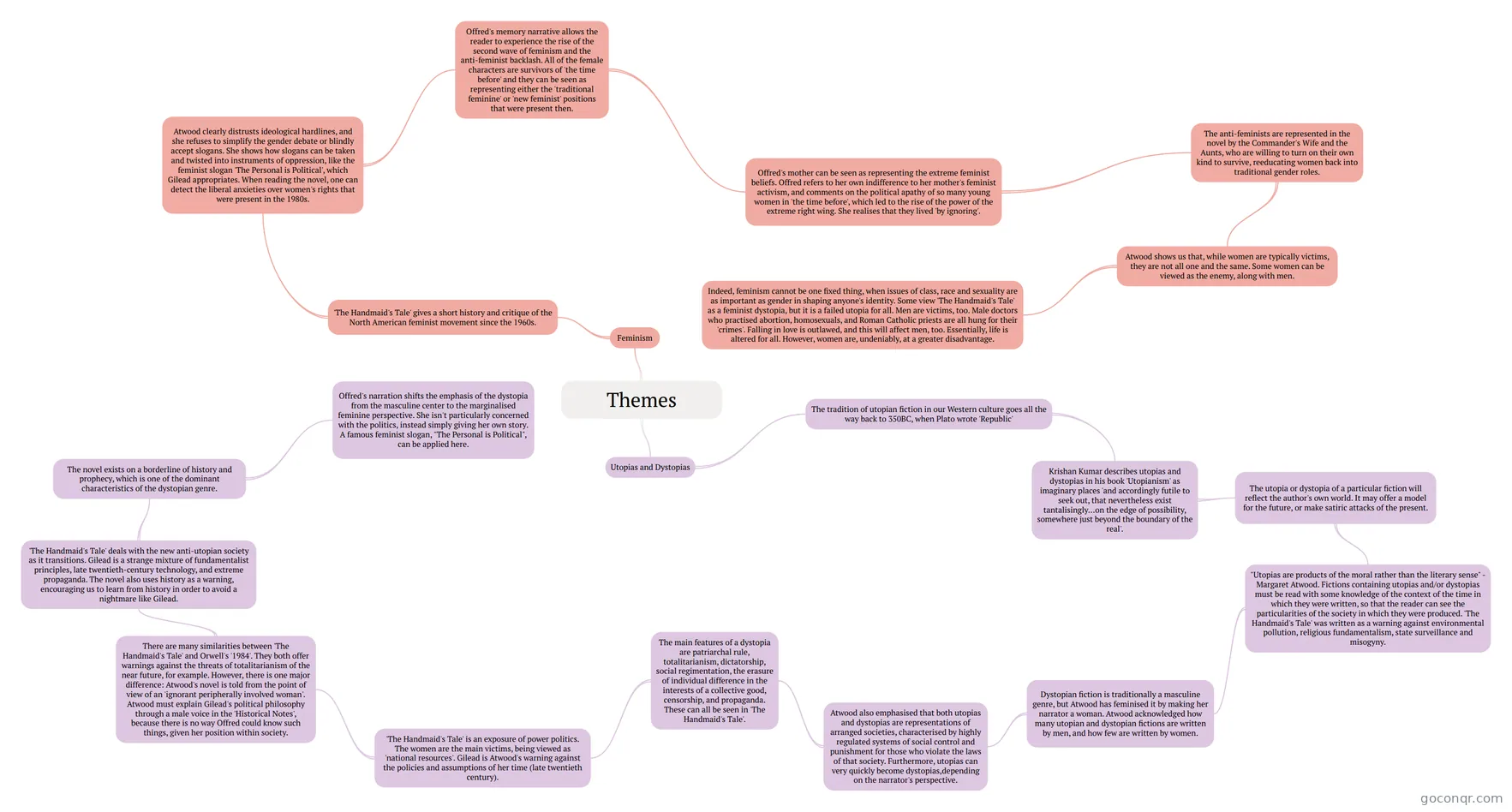
Mind map: The Handmaid's Tale themes
Map content
Themes
Utopias and Dystopias
- The tradition of utopian fiction in our Western culture goes all the way back to 350BC, when Plato wrote 'Republic'
- Krishan Kumar describes utopias and dystopias in his book 'Utopianism' as imaginary places 'and accordingly futile to seek out, that nevertheless exist tantalisingly...on the edge of possibility, somewhere just beyond the boundary of the real'.
- The utopia or dystopia of a particular fiction will reflect the author's own world. It may offer a model for the future, or make satiric attacks of the present.
- "Utopias are products of the moral rather than the literary sense" - Margaret Atwood. Fictions containing utopias and/or dystopias must be read with some knowledge of the context of the time in which they were written, so that the reader can see the particularities of the society in which they were produced. 'The Handmaid's Tale' was written as a warning against environmental pollution, religious fundamentalism, state surveillance and misogyny.
- Dystopian fiction is traditionally a masculine genre, but Atwood has feminised it by making her narrator a woman. Atwood acknowledged how many utopian and dystopian fictions are written by men, and how few are written by women.
- Atwood also emphasised that both utopias and dystopias are representations of arranged societies, characterised by highly regulated systems of social control and punishment for those who violate the laws of that society. Furthermore, utopias can very quickly become dystopias,depending on the narrator's perspective.
- The main features of a dystopia are patriarchal rule, totalitarianism, dictatorship, social regimentation, the erasure of individual difference in the interests of a collective good, censorship, and propaganda. These can all be seen in 'The Handmaid's Tale'.
- 'The Handmaid's Tale' is an exposure of power politics. The women are the main victims, being viewed as 'national resources'. Gilead is Atwood's warning against the policies and assumptions of her time (late twentieth century).
- There are many similarities between 'The Handmaid's Tale' and Orwell's '1984'. They both offer warnings against the threats of totalitarianism of the near future, for example. However, there is one major difference: Atwood's novel is told from the point of view of an 'ignorant peripherally involved woman'. Atwood must explain Gilead's political philosophy through a male voice in the 'Historical Notes', because there is no way Offred could know such things, given her position within society.
- 'The Handmaid's Tale' deals with the new anti-utopian society as it transitions. Gilead is a strange mixture of fundamentalist principles, late twentieth-century technology, and extreme propaganda. The novel also uses history as a warning, encouraging us to learn from history in order to avoid a nightmare like Gilead.
- The novel exists on a borderline of history and prophecy, which is one of the dominant characteristics of the dystopian genre.
- Offred's narration shifts the emphasis of the dystopia from the masculine center to the marginalised feminine perspective. She isn't particularly concerned with the politics, instead simply giving her own story. A famous feminist slogan, "The Personal is Political", can be applied here.
- The novel exists on a borderline of history and prophecy, which is one of the dominant characteristics of the dystopian genre.
- 'The Handmaid's Tale' deals with the new anti-utopian society as it transitions. Gilead is a strange mixture of fundamentalist principles, late twentieth-century technology, and extreme propaganda. The novel also uses history as a warning, encouraging us to learn from history in order to avoid a nightmare like Gilead.
- There are many similarities between 'The Handmaid's Tale' and Orwell's '1984'. They both offer warnings against the threats of totalitarianism of the near future, for example. However, there is one major difference: Atwood's novel is told from the point of view of an 'ignorant peripherally involved woman'. Atwood must explain Gilead's political philosophy through a male voice in the 'Historical Notes', because there is no way Offred could know such things, given her position within society.
- 'The Handmaid's Tale' is an exposure of power politics. The women are the main victims, being viewed as 'national resources'. Gilead is Atwood's warning against the policies and assumptions of her time (late twentieth century).
- The main features of a dystopia are patriarchal rule, totalitarianism, dictatorship, social regimentation, the erasure of individual difference in the interests of a collective good, censorship, and propaganda. These can all be seen in 'The Handmaid's Tale'.
- Atwood also emphasised that both utopias and dystopias are representations of arranged societies, characterised by highly regulated systems of social control and punishment for those who violate the laws of that society. Furthermore, utopias can very quickly become dystopias,depending on the narrator's perspective.
- Dystopian fiction is traditionally a masculine genre, but Atwood has feminised it by making her narrator a woman. Atwood acknowledged how many utopian and dystopian fictions are written by men, and how few are written by women.
- "Utopias are products of the moral rather than the literary sense" - Margaret Atwood. Fictions containing utopias and/or dystopias must be read with some knowledge of the context of the time in which they were written, so that the reader can see the particularities of the society in which they were produced. 'The Handmaid's Tale' was written as a warning against environmental pollution, religious fundamentalism, state surveillance and misogyny.
- The utopia or dystopia of a particular fiction will reflect the author's own world. It may offer a model for the future, or make satiric attacks of the present.
- Krishan Kumar describes utopias and dystopias in his book 'Utopianism' as imaginary places 'and accordingly futile to seek out, that nevertheless exist tantalisingly...on the edge of possibility, somewhere just beyond the boundary of the real'.
- The tradition of utopian fiction in our Western culture goes all the way back to 350BC, when Plato wrote 'Republic'
Feminism
- 'The Handmaid's Tale' gives a short history and critique of the North American feminist movement since the 1960s.
- Atwood clearly distrusts ideological hardlines, and she refuses to simplify the gender debate or blindly accept slogans. She shows how slogans can be taken and twisted into instruments of oppression, like the feminist slogan 'The Personal is Political', which Gilead appropriates. When reading the novel, one can detect the liberal anxieties over women's rights that were present in the 1980s.
- Offred's memory narrative allows the reader to experience the rise of the second wave of feminism and the anti-feminist backlash. All of the female characters are survivors of 'the time before' and they can be seen as representing either the 'traditional feminine' or 'new feminist' positions that were present then.
- Offred's mother can be seen as representing the extreme feminist beliefs. Offred refers to her own indifference to her mother's feminist activism, and comments on the political apathy of so many young women in 'the time before', which led to the rise of the power of the extreme right wing. She realises that they lived 'by ignoring'.
- The anti-feminists are represented in the novel by the Commander's Wife and the Aunts, who are willing to turn on their own kind to survive, reeducating women back into traditional gender roles.
- Atwood shows us that, while women are typically victims, they are not all one and the same. Some women can be viewed as the enemy, along with men.
- Indeed, feminism cannot be one fixed thing, when issues of class, race and sexuality are as important as gender in shaping anyone's identity. Some view 'The Handmaid's Tale' as a feminist dystopia, but it is a failed utopia for all. Men are victims, too. Male doctors who practised abortion, homosexuals, and Roman Catholic priests are all hung for their 'crimes'. Falling in love is outlawed, and this will affect men, too. Essentially, life is altered for all. However, women are, undeniably, at a greater disadvantage.
- Atwood shows us that, while women are typically victims, they are not all one and the same. Some women can be viewed as the enemy, along with men.
- The anti-feminists are represented in the novel by the Commander's Wife and the Aunts, who are willing to turn on their own kind to survive, reeducating women back into traditional gender roles.
- Offred's mother can be seen as representing the extreme feminist beliefs. Offred refers to her own indifference to her mother's feminist activism, and comments on the political apathy of so many young women in 'the time before', which led to the rise of the power of the extreme right wing. She realises that they lived 'by ignoring'.
- Offred's memory narrative allows the reader to experience the rise of the second wave of feminism and the anti-feminist backlash. All of the female characters are survivors of 'the time before' and they can be seen as representing either the 'traditional feminine' or 'new feminist' positions that were present then.
- Atwood clearly distrusts ideological hardlines, and she refuses to simplify the gender debate or blindly accept slogans. She shows how slogans can be taken and twisted into instruments of oppression, like the feminist slogan 'The Personal is Political', which Gilead appropriates. When reading the novel, one can detect the liberal anxieties over women's rights that were present in the 1980s.
- 'The Handmaid's Tale' gives a short history and critique of the North American feminist movement since the 1960s.
Information
- Description
- A level English (The Handmaid's Tale) Mind Map on Themes, created by Em Maskrey on 22/02/2017.
- Created by
- Em Maskrey
- Views
- 1
- Rating